
Tracking stolen Bitcoin from Coldcard breach: Challenges investigators face
Investigators tracking the Coldcard security breach face challenges establishing exact theft amounts, depending on victim testimonies and blockchain forensics that yield different calculations.
The security breach affecting Coldcard wallets has become a proving ground for cryptocurrency investigators attempting to quantify theft from self-custody storage solutions, where the participation of victims in reporting becomes essential to understanding the full magnitude of the incident.
Analytics firm CryptoQuant has identified 1,432 Bitcoin as verified losses at this time, though alternative analysts have discovered significantly larger amounts connected to the security breach.
Both Galaxy Research and blockchain intelligence firm TRM Labs indicate their forensic work suggests greater losses, though they draw clear distinctions between directly verified victim losses and cryptocurrency linked to the breach via blockchain transaction analysis.
This characteristic makes self-custody security breaches challenging to measure accurately: In contrast to compromised exchange platforms, no comprehensive database of compromised wallets exists, forcing investigators to construct estimates instead of determining exact totals.
Galaxy traces losses beyond victim reports
In conversation with Cointelegraph, Galaxy's Alex Thorn clarified the platform's previous calculation of up to 1,816 BTC represented a possible amount instead of a verified loss figure.
By Tuesday's assessment, Galaxy established its high-confidence baseline at 1,730 Bitcoin, with Thorn noting the number may continue rising as additional victim testimonies validate identified attack signatures.
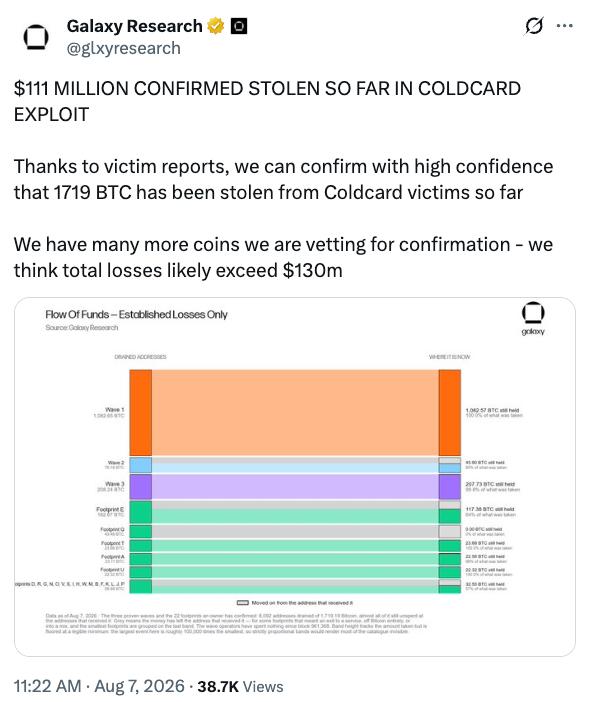
"We have directly confirmed 450+ BTC directly from victim reports, but their reports have helped identify other, as-yet-unknown victims in more than 730 total BTC," Thorn said. The platform leverages these testimonies to validate wider attack characteristics, simultaneously excluding cryptocurrency they suspect originated from the breach but cannot adequately confirm. "We are still withholding many more BTC we suspect but for which we lack sufficient corroboration," Thorn said.
TRM Labs reported its separate investigation arrives at comparable figures to Galaxy, with recent forensic work calculating that threat actors extracted approximately 1,816 BTC from over 5,200 addresses throughout four distinct attack phases. "Investigators should expect the estimate to keep moving upward before it stabilizes," TRM's global head of policy Ari Redbord told Cointelegraph.
CryptoQuant takes a stricter approach
In an interview with Cointelegraph, CryptoQuant's head of research, Julio Moreno, explained the organization begins with publicly available victim testimonies, incorporating wallet addresses or transaction IDs, followed by verification of these claims against recognized blockchain patterns associated with the attack.
This methodology results in CryptoQuant's validated count of 1,432 BTC, which Moreno characterized as a minimum threshold likely to increase should additional victims come forward with their compromised address information.
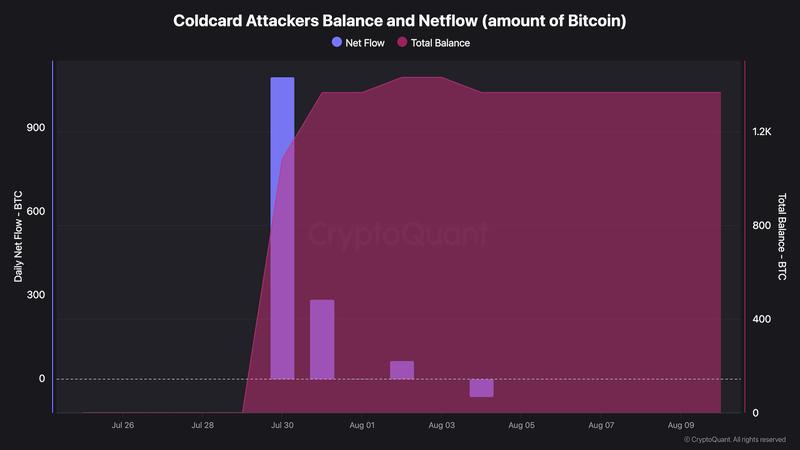
According to Moreno, CryptoQuant exercises restraint when attributing victims based exclusively on blockchain transaction patterns since this practice risks generating inaccurate positives that artificially elevate the calculation.
"Because the stolen Bitcoin belonged to individuals and not to a centralized entity, like an exchange, we can only confirm what each victim publicly discloses," he said.
Hard number to pin down
Moreno stressed the final amount will continue being an approximation since investigators possess only the information victims choose to share. He said:
"Knowing the total BTC stolen is difficult, and it will always be an estimation."
When contacted by Cointelegraph, Chainalysis confirmed it has not performed a separate accounting of the stolen funds, and blockchain investigator ZachXBT has publicly announced he does not intend to track or analyze this particular incident.