Three-Year Minimum Hold Recommended for Bitcoin Investors to Minimize Losses, Analysis Reveals
Investors who purchased Bitcoin between three and five years ago maintain approximately 90% gains on average, despite recent market downturns.

Those who invest in Bitcoin (BTC) stand to benefit most by maintaining their positions for a minimum of three years, based on research presented by André Dragosch, head of research at Bitwise Europe.
Key takeaways:
- Maintaining BTC positions for a minimum of three years has historically reduced losses to merely 0.70%.
- Forecasts for Bitcoin pricing during 2026–2027 converge around the $100,000–$150,000 range in optimistic projections.
Extended holding periods shield Bitcoin investors from losses
Research conducted by Bitwise examined Bitcoin's pricing trajectory from July 17, 2010, through Feb. 11, 2026, determining that the likelihood of experiencing negative returns decreases to merely 0.70% when investors maintain BTC positions for no less than three years.
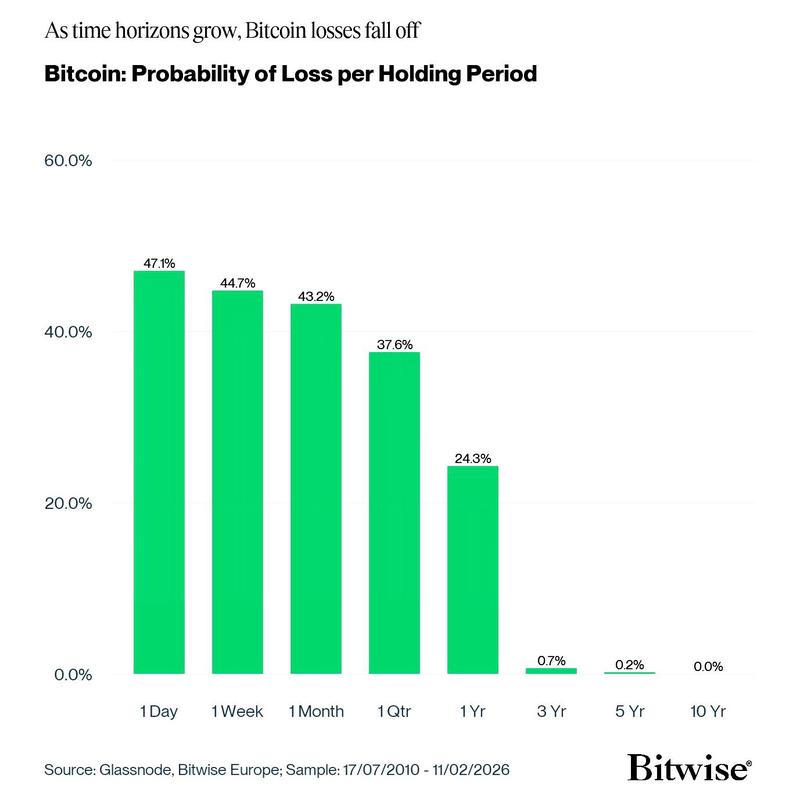
Put differently, virtually every rolling three-year entry position throughout Bitcoin's historical record resulted in gains. When extending beyond the three-year mark, loss probability diminished even more dramatically: declining to 0.2% across five-year periods and reaching 0% over decade-long timeframes.
Individuals holding Bitcoin for periods shorter than three years encountered substantially greater risk of experiencing losses.
Those buying and selling within the same day, as an example, faced a 47.1% probability of holding at a loss. This likelihood remained high at 44.7% across one-week periods, 43.2% for monthly holdings, and 24.3% when holding for one year.
Multi-year holders maintain 90% profitability
The realized price indicator similarly demonstrates reduction in holder losses across extended multi-year timeframes.
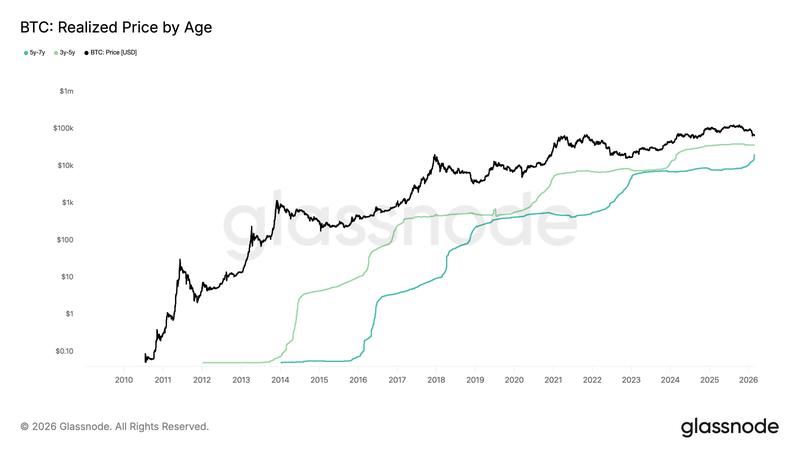
As of Saturday, Bitcoin had declined approximately 50% from its peak in October 2025, with trading occurring around the $65,000 level.
This price point remained significantly higher than the three-to-five-year realized price of $34,780, indicating that investors who purchased and maintained positions throughout this timeframe continued to hold roughly 90% in gains.
At the same time, certain market participants suggest the current Bitcoin price decline may continue toward the $30,000 threshold.
Should prices reach that target, it would eliminate a substantial portion of this cohort's profit margin, bringing the three–five year segment nearer to their entry price. This scenario would provide a critical test of whether these holders begin contributing to selling activity or continue maintaining their positions.
In contrast, the majority of individuals who acquired Bitcoin within the previous two years held underwater positions.
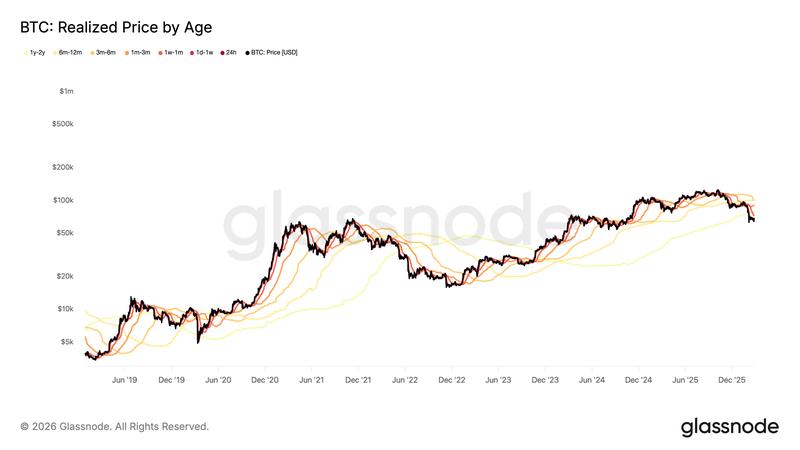
The average entry price for the 6m–12m cohort, representing entities holding BTC for a maximum of one year, stood at approximately $101,250, placing them at roughly 35% in unrealized losses as of Saturday.
In comparison, the 1y–2y cohort's average cost basis registered lower, approximately $78,150, resulting in about 15% in unrealized losses.
This disparity reinforced the identical trend observed in holding-period analysis: extended holding timeframes correlate with reduced drawdowns during market corrections.
What are the projected price targets for BTC?
Extended-timeframe projections continue to converge around several bullish price targets for the 2026–2027 period.
As one example, international brokerage company Bernstein has upheld its $150,000 BTC price projection for 2026, citing relatively limited net outflows of approximately 7% from spot Bitcoin ETFs, even while BTC's valuation dropped by 50%.
The current Bitcoin price action is a mere crisis of confidence
Bernstein analysts led by Gautam Chhugani
Standard Chartered, on the other hand, cautioned about a possible "final capitulation" period that might push BTC down to $50,000 due to sluggish ETF flows and a more challenging macroeconomic environment, before rebounding toward $100,000 by the conclusion of 2026.
Projecting into 2027, Timothy Peterson's historical "average return" analytical model suggests $122,000 by the beginning of 2027, with strong probability that BTC will trade above this threshold.