
The Rise of Fake World Assets: Why onchain gacha is captivating crypto users
Fake World Assets transforms old NFTs into a blockchain-based lottery system — but can crypto's newest trend sustain its momentum?
Right when the cryptocurrency space seemed to be entering a lull, a fresh trend is capturing attention across Crypto Twitter — Fake World Assets (FWAs). You read that correctly.
This represents the newest version of the onchain gacha trend, a system where participants obtain random collectibles that typically hold minimal value, though occasionally some prove to be quite valuable.
In just four days following its release, FWAs consumed such massive amounts of Ethereum gas that the platform temporarily topped the network's gas consumption charts by fees across a single day.
On July 25, at the height of activity, FWAs produced around $1.53 million in fees for the day, momentarily surpassing both Tether and Circle to rank among Ethereum's top blockspace users. TokenWorks, the project's creators, announced:
"4 days since launch. Fake World Assets are the next big thing."
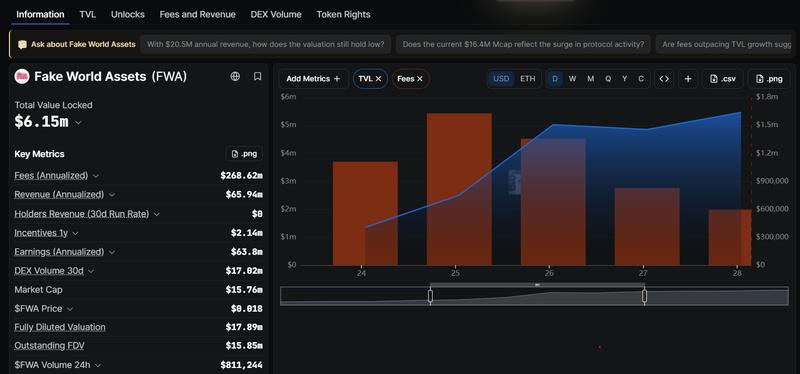
While TokenWorks can hardly be considered neutral, total value locked keeps growing, surpassing $6.15 million by July 31. Daily fee revenue has subsequently settled to approximately $350,000, which translates to an annualized run rate of about $268 million. As of August 1, FWA had processed 10,000 ETH in trading volume, with 100,000 total purchases. A portion of this engagement stems from participants seeking early FWA token rewards, though there seems to be authentic enthusiasm for the gamification aspect.
"I'm very bullish on gamified commerce... my skepticism on FWA is specific."
According to Dedic, the majority of present activity stems from attractive token rewards instead of organic user interest.
"The entire concept is purely targeted at crypto degens so they can gamble and speculate," he notes.
The question remains: is this merely another fleeting trend, or has the sector finally discovered something with staying power?
Fascinating, but what exactly are FWAs?
The cryptocurrency industry has dedicated years attempting to bring real-world items onchain, ranging from equities and fixed income securities to trading cards and even livestock from Brazil.
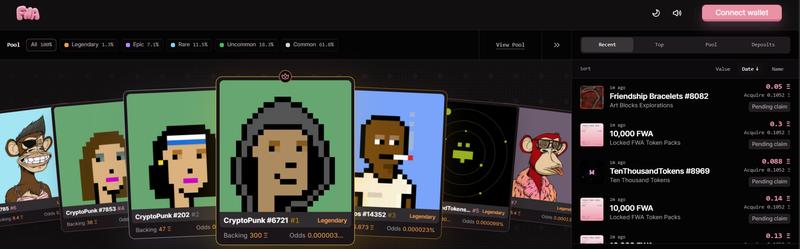
TokenWorks chose to invert this concept entirely by launching Fake World Assets, which are simply NFTs. Instead of purchasing a particular collectible such as a Bored Ape, participants pay to activate an onchain "gacha" system for an opportunity to obtain a randomly distributed NFT with Ether backing.
Available rewards include items from numerous popular collections, spanning from CryptoPunks and Azuki to Lil Pudgys and Art Blocks.
Fake World Assets represents merely the most recent Ethereum-based platform to introduce a fresh take on this phenomenon.
Gacha derives from gachapon/gashapon, vending machines that originated in Japan during the 1960s which dispense random toys inside capsules. This gameplay mechanic transitioned to mobile and online gaming platforms, with loot boxes in Dragon Collection from 2010 frequently referenced as the pioneering major gacha game. A comparable mechanism existed in physical Pokemon trading card "booster packs" which provided random assortments of collectible cards, featuring different rarity tiers and valuations.
These physical cards were later tokenized onchain through platforms like Collector Crypt, Beezie and Courtyard. According to a previous Magazine report, onchain gacha achieved an unprecedented $324 million in trading volume during June. (Numerous tokenized cards have since been wrapped for integration with FWA.)
The innovation continues expanding weekly, as creators test randomized "token packs" filled with ERC-20 tokens, while StockRip operating on Robinhood chain, demonstrates how tokenized equities can be packaged into NFT-based gacha offerings.
According to AzFlin, who founded DAO launchpad daos.world and previously worked as a Uniswap engineer:
"Just when you think everything in crypto has been invented, something new springs up."
What makes onchain gacha attractive?
The gacha system merges cryptocurrency, collectibles and wagering. According to pseudonymous cryptocurrency observer 2Lambroz, from the participant's viewpoint, "you're buying a lottery ticket on the pool."
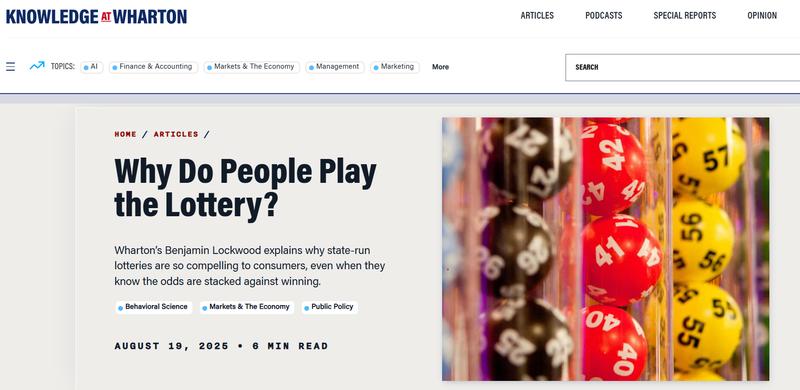
"People enjoy playing the lottery, and it's important to take that seriously," explains Benjamin Lockwood, a Wharton economist whose research into state-run lotteries found that people value the experience itself, not just the chance of winning.
"There is a parallel to 'onchain gacha' in people bidding on the contents of abandoned storage units. Most find items worth placing in the trash, but some find items they can sell on eBay. One found a painting worth hundreds of thousands of dollars. These combine hope for riches with playfulness. This is what lotteries offer."
Two sides to every story
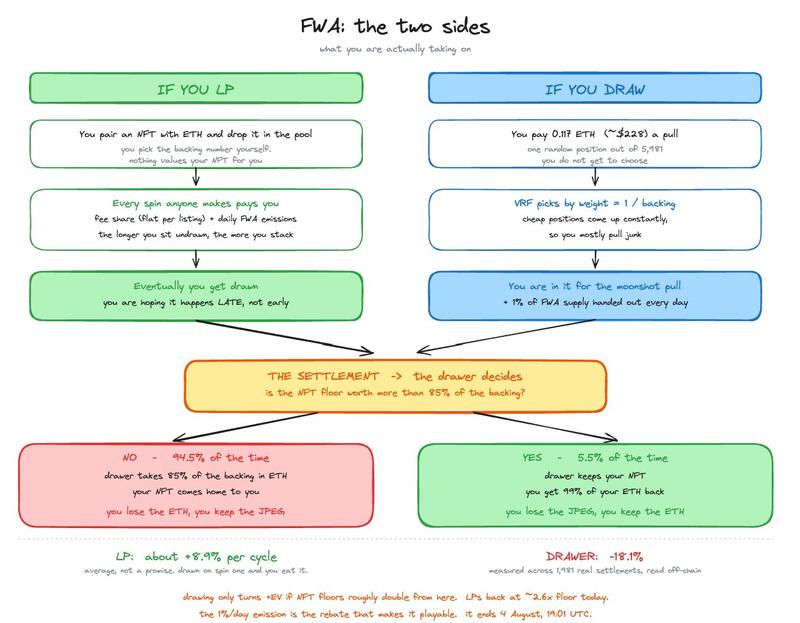
The FWA protocol features two distinct participant roles.
Holders of NFTs function as liquidity providers (LPs), contributing collectibles together with ETH and collecting a portion of protocol fees for as long as their holdings remain pooled.
Participants, on the other hand, spend funds for the opportunity to draw a randomly chosen NFT, then determine whether to retain it or claim the majority of its associated ETH value instead. (According to Blockworks Research, currently about 70% of buyers opt to convert their rewards to FWA.)
According to 2Lambroz's explanation, LPs essentially want their NFT to remain in the pool collecting fees before being drawn, whereas participants are pursuing the possibility of securing a reward valued significantly higher than what they paid to play.
Materkel, a self-described Ethereum maximalist, states:
"The most fun NFT/casino primitive in over a decade of crypto, where users actually get to be both players and the house at the same time […] Money legos on Ethereum are back!"
Can the hype last?
Although Dedic attributes substantial activity to token rewards, he expresses that he's "very bullish on gamified commerce for a generational reason."
"The further Gen Z moves into being the generation with the strongest buying power, the more shopping is going to be gamified and come with a dopamine kick attached."
Rather than providing random NFTs from previous market cycles, Dedic suggests the mechanism works better with assets consumers actively desire to purchase, including collectibles such as Pokémon cards, timepieces and even spirits.
"I see enormous potential in selling much-demanded assets in a gamified way," he says. "I see very little in building Ponzi schemes to create demand for assets nobody wanted in the first place."
The ultimate challenge arrives when initial excitement subsides and reward programs diminish. Should participants continue engaging regardless, onchain gacha might have discovered a consumer application the cryptocurrency sector has been pursuing throughout its existence. Otherwise, this trend will become another addition to the collection of unsuccessful crypto ventures that shined intensely before disappearing.