
Texas Judge Dismisses Developer's Attempt to Obtain Legal Protection for Crypto Software
Michael Lewellen, the developer behind Pharos, stated that his legal team is evaluating every possible avenue to move forward following a Texas judge's decision to throw out the lawsuit without prejudice.

A federal court in Texas has thrown out legal action brought by cryptocurrency developer Michael Lewellen, who had requested a declaratory judgment confirming that Pharos, his software platform that enables contributions to charitable crowdfunding initiatives, would not face prosecution for breaching money-transmission regulations.
The case was dismissed by Chief US District Judge Reed O'Connor on Wednesday, with the ruling determining that Lewellen had not established the existence of a legitimate threat of immediate prosecution.
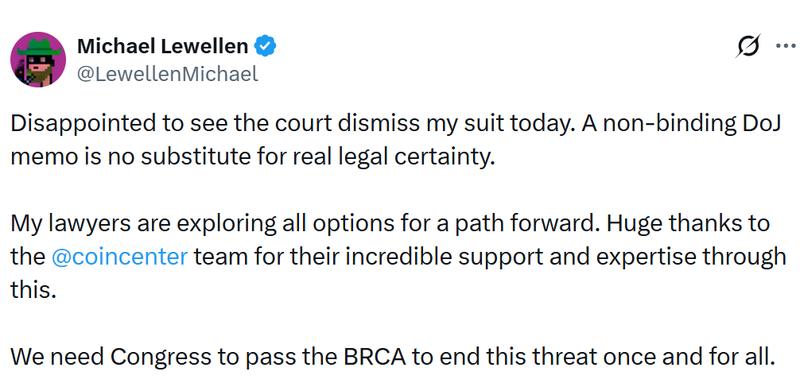
"Disappointed to see the court dismiss my suit today," said Lewellen on X on Wednesday.
The court's dismissal also referenced a Department of Justice memorandum indicating that the agency will cease targeting virtual currency platforms, mixing and tumbling operations, or offline storage solutions based on actions taken by their end users or for inadvertent regulatory infractions.
"A non-binding DoJ memo is no substitute for real legal certainty," added Lewellen.
Developers of cryptocurrency software are progressively pursuing legal safeguards to protect themselves from criminal responsibility related to the software applications they build.
Other crypto software developers prosecuted
Lewellen, who serves as a fellow at Coin Center, a cryptocurrency advocacy organization that supported the legal action, contended in his complaint filed last January that creators of software products comparable to his own, including developers behind Tornado Cash and Samourai Wallet, have been subjected to prosecution under money transmitter statutes.
Roman Storm, co-founder of Tornado Cash, was found guilty last year on charges related to conspiracy to operate an unlicensed money-transmitting enterprise. The individuals who co-founded Samourai Wallet, a privacy-oriented Bitcoin storage solution, were convicted on identical charges — both prosecutions were referenced by Lewellen as proof of a genuine legal danger facing developers in his position.
However, Judge O'Connor argued that the "core conduct of those cases is money laundering."
"By contrast, the core conduct here would be running a business. And Lewellen disclaims any knowing transmission of criminal funds, which is central to the prosecutions he invokes," Judge O'Connor wrote.
Case dismissed for now but it might not be over
Lewellen said his lawyers are exploring all options for a path forward.
The dismissal by Judge O'Connor was rendered without prejudice, which means Lewellen retains the ability to bring the same legal action again after implementing specific corrections or adjustments.
According to Peter Van Valkenburgh, the executive director at Coin Center, the memorandum referenced by Judge O'Connor "has not provided meaningful protection to developers, given the outcomes in the Tornado Cash and Samourai Wallet cases."
Valkenburgh and Lewellen have both issued calls for Congress to enact the Blockchain Regulatory Certainty Act of 2026.
The proposed legislation, introduced by Senator Cynthia Lummis in January, seeks to establish clear guidelines specifying that creators and providers of non-custodial software platforms who lack control over user assets are exempt from money transmitter regulations.
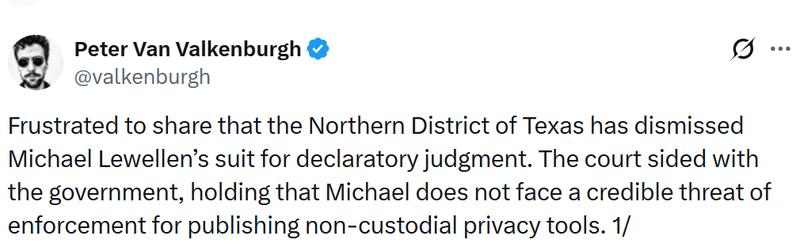
"So while I hope the court is right that non-custodial software developers are not at real risk, the Blanche memo is not enough to secure their rights. It is a vague enforcement signal, not a durable limit on government power," Valkenburgh added.
"Worse, the court has now used that vague signal as a reason not to provide actual judicial clarity on the scope of developer liability. Instead of a clear rule, developers get a revocable memo and a court telling them not to worry."