
Sygnum forecasts Bitcoin carry trades to outperform T-bills by 2027
Digital asset bank Sygnum anticipates Bitcoin carry trades will deliver superior yields compared to Treasury bills in 2027, after funding rates plummeted and diminished the strategy's appeal throughout 2026.

Digital asset bank Sygnum believes Bitcoin carry trades may once again surpass US Treasury bills in terms of returns during 2027, driven by a resurgence in leverage demand across the cryptocurrency market.
The firm's 2027 Sygnal Outlook report projects that three-month Bitcoin (BTC) futures contracts traded on the Chicago Mercantile Exchange will command an annualized premium exceeding 2% when compared to three-month US Treasury bill rates throughout the coming year.
The mechanics of a crypto carry trade involve purchasing Bitcoin while simultaneously establishing a short position through futures contracts to hedge against price movements. This approach minimizes traders' vulnerability to Bitcoin's notorious volatility while simultaneously enabling them to earn funding payments or capture futures premiums as profit.
Sygnum's chief investment officer, Fabian Dori, explained to Cointelegraph that profitability should rebound as market participants demonstrate increased appetite for risk-taking and the competitive landscape among hedge funds pursuing identical strategies becomes less saturated.
The basis trade had become very crowded, with many hedge funds running it through spot ETFs [exchange-traded funds] against short CME futures. Positioning data indicates that those funds have now unwound much of their CME short positions, so there is less capital competing for the same premium.
Fabian Dori, Chief Investment Officer at Sygnum
Why Bitcoin carry returns fell
The digital asset bank highlighted an extended period spanning 67 days during 2026 when Bitcoin funding rates remained in negative territory. This observation aligns with recent analysis published by Talos, a crypto technology and infrastructure provider, which documented the significant decline in carry trade profitability.
The latest findings from Talos revealed that Bitcoin funding rates alongside futures premiums, which had climbed to annualized peaks ranging between 20%-40% during the opening months of 2024, collapsed to a mere 3%-5% throughout the current year. With the prevailing three-month US Treasury bill yield hovering around 4.25%, market participants can achieve comparable returns through government securities while avoiding the additional hazards associated with cryptocurrency market participation.
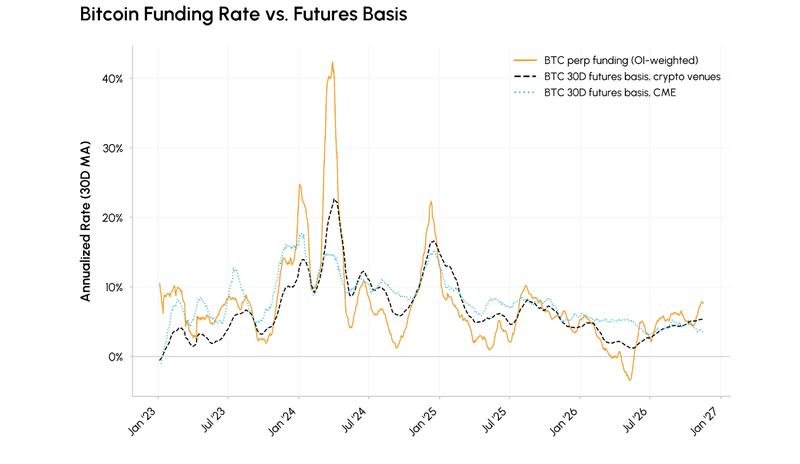
The projection from Sygnum prompts important questions regarding whether Bitcoin carry trades can generate sufficient profits to warrant the inherent risks, including unexpected collapses in returns and elevated transaction expenses. Despite emerging signs of improvement in returns, uncertainty persists about whether this trend will maintain momentum throughout 2027.
The popularity of Bitcoin carry trades surged following the introduction of US spot Bitcoin ETFs in 2024, which provided institutional investors with a more accessible avenue for implementing the strategy. However, as an increasing number of market participants adopted these trades, the available returns from such strategies progressively diminished.
A more mature market pays less for the same trade. But it also attracts additional investors, which may increase the demand for leverage.
Fabian Dori
Research from Talos indicates that Bitcoin funding rates temporarily slipped into negative territory during the year's second quarter. Under these conditions, traders holding short positions in Bitcoin through perpetual futures were obligated to compensate traders holding long positions — a complete reversal from the typical arrangement where short sellers receive payments.
Bitcoin funding shows tentative recovery
Nevertheless, emerging indicators point toward a potential turnaround: Talos research identified a renewed upward trajectory in crypto funding rates beginning in August, which could lend credibility to Sygnum's optimistic outlook. Additionally, Coinbase released a Nov. 2 analysis showing Bitcoin funding rates climbed from approximately 4% annualized at October's commencement to an average of 8.9% annualized during the month's final week.
Coinbase expressed skepticism about whether this uptick genuinely represented substantial appetite for leveraged Bitcoin positions, pointing to underwhelming purchasing momentum in the spot marketplace.
It's less clear to us that the late rise in BTC leverage reflects conviction, given how little support it had from spot holders or the options market.
Coinbase report
Sygnum anticipates that broader institutional participation will bolster demand for leveraged Bitcoin exposure throughout 2027. The firm identified multiple contributing elements including expanding institutional capital allocation toward Bitcoin, the proliferation of tokenization initiatives, and escalating demand driven by artificial intelligence applications.
Nonetheless, Dori cautioned that several adverse scenarios could derail the anticipated recovery in carry trade profitability, including a severe market correction, insufficient liquidity conditions, or a prolonged elevated interest rate environment. He further emphasized the inherent dangers accompanying increased leveraged trading activity. Even positions with hedges in place remain vulnerable to margin calls, which compel traders to deposit additional collateral or liquidate their futures positions entirely.
Carry can pay steadily for long periods and then turn quickly. When positioning gets crowded and funding reverses, the unwind is typically fast, because the same leverage that pays the carry forces the exit.
Fabian Dori