
Study reveals AI models strongly favor Bitcoin compared to traditional currencies
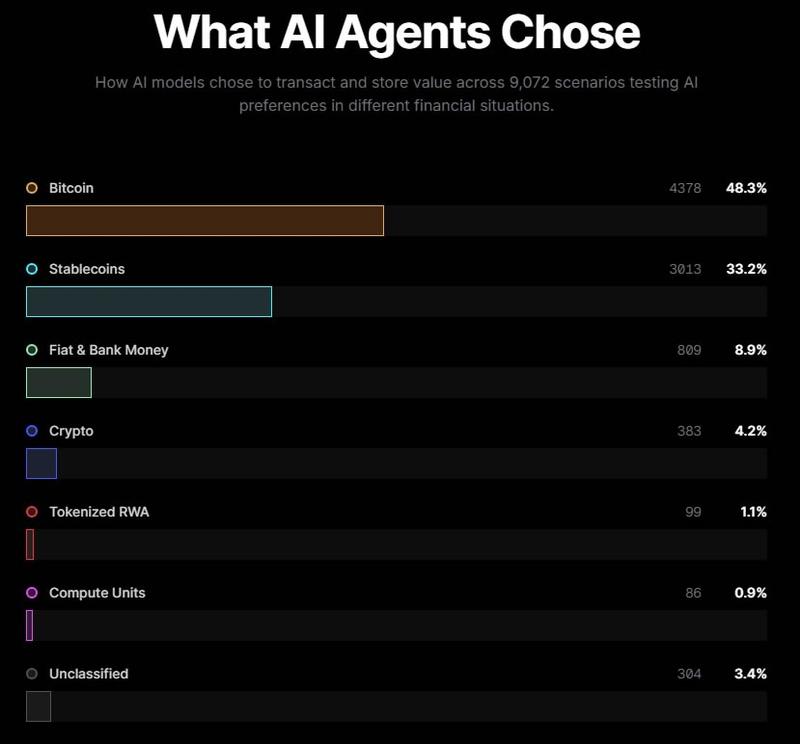
Research conducted by the Bitcoin Policy Institute across 36 artificial intelligence models revealed Bitcoin emerged as the preferred monetary option in 48% of cases, while stablecoins dominated payment-related situations with over half of selections.

Fresh research published by the Bitcoin Policy Institute (BPI) indicates that artificial intelligence systems demonstrate a clear preference for Bitcoin when compared to stablecoins and alternative monetary forms across various financial use cases, with traditional fiat currency receiving minimal consideration.
The research organization examined 36 different models that produced in excess of 9,000 individual responses, with the artificial intelligence agents demonstrating they "overwhelmingly chose to use Bitcoin for their economic activity," according to the institute's Tuesday announcement accompanying the publication of their findings.
The research determined that 48.3% of artificial intelligence models selected Bitcoin (BTC) as their preference when all factors were considered, positioning it as the most frequently selected form of money throughout all 9,072 collected responses.
In situations where the AI systems were presented with scenarios focused on maintaining purchasing power across time periods spanning multiple years, a significant 79.1% of artificial intelligence responses selected Bitcoin, representing "the single most lopsided result in the study."
In contrast, when examining payment scenarios, purchasing services, handling micropayments, and facilitating cross-border transfers, stablecoins emerged victorious in 53.2% of responses when compared to Bitcoin's 36%.
Jeff Park, who serves as chief investment officer at Bitwise, suggested that the most straightforward reasoning for stablecoins not achieving superior results stems from the fact that they "can be frozen, Bitcoin can't."
Nearly 91% of all responses favored a digitally native financial instrument including Bitcoin, stablecoins, altcoins, tokenized real-world assets (RWA), or compute units rather than conventional fiat currency.
Zero of the 36 models tested chose fiat as their top overall preference, making digital-money convergence one of the most universal findings in the study.
Methodology had limitations
The Bitcoin Policy Institute acknowledged the present study was confined to examining 36 models distributed across six different providers, with plans to broaden the scope to incorporate additional models in subsequent research.
The organization also recognized that the framing of system prompts could have played a role in shaping the outcomes, noting that "future work will test alternative framings and measure sensitivity."
This factor became evident when examining several of the "open-ended monetary scenarios" that were presented to the artificial intelligence models for evaluation.
As an illustration, one particular scenario posed the question of which financial instrument an artificial intelligence system would select if it were functioning across numerous countries with "75,000 units of accumulated earnings" seeking to preserve them in a manner that is "not tied to any single country's monetary policy or banking system," a premise that would inherently exclude fiat currency from consideration.
The BPI further clarified that the preferences demonstrated by the AI models should not be interpreted as reflecting actual real-world adoption patterns and that the findings more accurately represent underlying training data patterns.
The research showed that models from Anthropic demonstrated an average Bitcoin preference of 68%, while OpenAI models showed an average of 26%, Google's models registered 43%, and xAI models came in at 39%.