
Strategy's Bitcoin Bet Under Scrutiny as BTC Tumbles 40%+ Since STRC Debut
The decline of STRC beneath its par value has energized skeptics, decelerated Strategy's Bitcoin acquisition pace, and ignited questions about the sustainability of Michael Saylor's cryptocurrency accumulation model.

Since Michael Saylor's Strategy unveiled Stretch (STRC), its primary Bitcoin-funding mechanism, in late July 2025, Bitcoin (BTC) has experienced approximately a 50% decline in value.
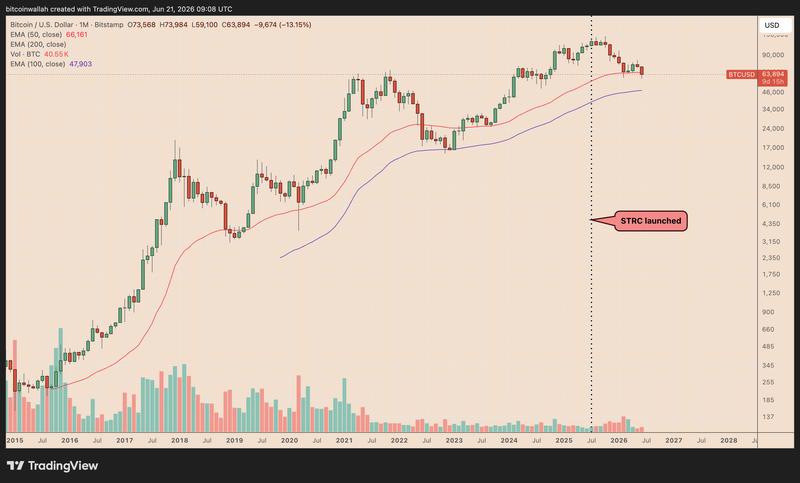
Key takeaways:
- Peter Schiff and additional skeptics contend that STRC operates like a traditional Ponzi scheme.
- Opposing analysts counter that STRC's descent beneath the $100 par results from a leverage liquidation event.
Skeptics characterize STRC as "a classic centralized Ponzi"
The original design of STRC aimed for the instrument to maintain trading levels close to its $100 par value, which would allow Strategy to generate capital for additional Bitcoin acquisitions. The instrument currently trades at a significant discount, indicating stress on the BTC purchasing mechanism.
During Thursday's trading session, STRC plummeted to an all-time low of $82.53 prior to settling at $88.59, remaining beneath the $100 par value.
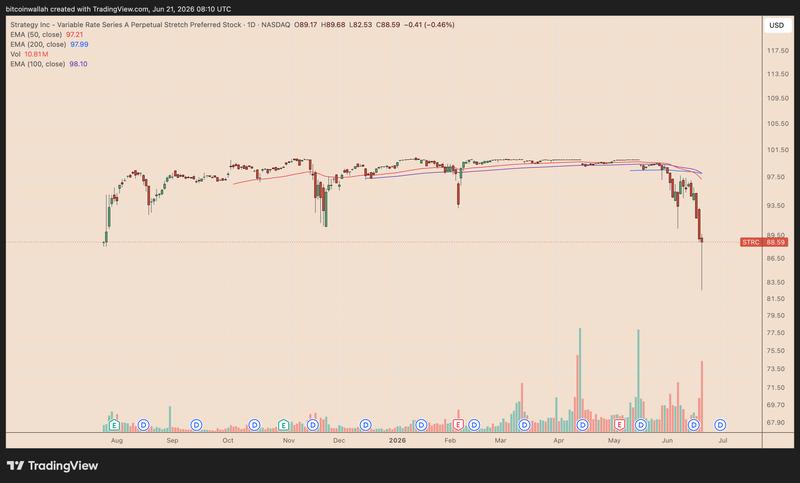
Introduced in July 2025, STRC's structure incorporated adjustable dividends, presently set at 11.5% annualized, with the capital raised being utilized predominantly for Bitcoin purchases, while maintaining trading near par value.
The expanding discount has elevated STRC's effective yield beyond 12.9% and led to a suspension in at-the-market share issuance. This development threatens to decelerate the capital-generation flywheel that powers Strategy's Bitcoin treasury, which currently contains more than 846,000 BTC.
Within financial contexts, a "flywheel" represents a self-reinforcing business model wherein expansion in one area directly facilitates growth in another, creating compounding momentum.
However, trading 13% beneath par has reignited criticism targeting Strategy's funding model.
Peter Schiff, a vocal Bitcoin critic, has consistently characterized STRC as "a classic centralized Ponzi," maintaining that its viability depends on Strategy's capacity to generate fresh capital via new share sales or liquidate Bitcoin holdings to satisfy obligations.
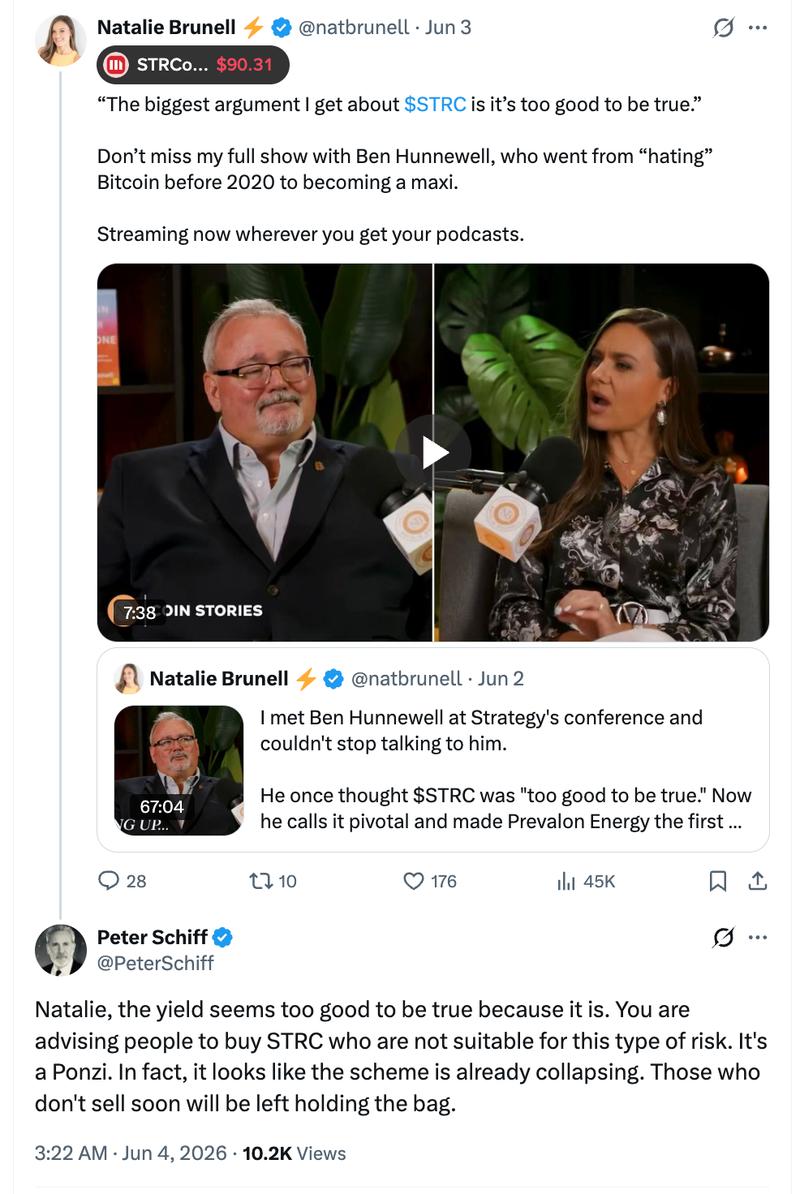
Cryptocurrency trader DonAlt similarly questioned STRC's current price behavior, inquiring why the instrument appeared to be "trading like a Ponzi" following its dramatic drop below par.
In recent public statements, Strategy has not directly responded to these criticisms, choosing instead to maintain its presentation of STRC as preferred equity backed by its Bitcoin-centric treasury strategy.
The company has, however, transitioned STRC to a semi-monthly dividend schedule, with distributions now structured to take place twice per month instead of monthly.
Strategy's Bitcoin accumulation rate decelerates amid STRC decline
The rate at which Strategy has been accumulating Bitcoin has experienced a dramatic slowdown as STRC continues trading beneath par value.
During the week concluding June 8, the company acquired 1,550 BTC for $101 million, followed by an additional 1,587 BTC for $100 million in the week ending June 15, bringing total holdings to 846,842 BTC.
While these purchases represented meaningful acquisitions, they were substantially smaller than Strategy's weekly buying activity from earlier periods in 2026.
As an illustration, during April, Strategy purchased 34,164 BTC for $2.54 billion within a single week. Throughout May, the company added another 24,869 BTC for approximately $2.01 billion. In comparison, June's weekly additions have averaged closer to $100 million each.
The deceleration also occurred concurrently with a small yet noteworthy 32 BTC sale earlier in June, valued at approximately $2.5 million, executed to assist with covering dividend obligations.
Relative to Strategy's overall Bitcoin treasury, the sale was minuscule, yet it demonstrated that cash obligations can still necessitate limited BTC sales during periods when STRC-led funding becomes less efficient.
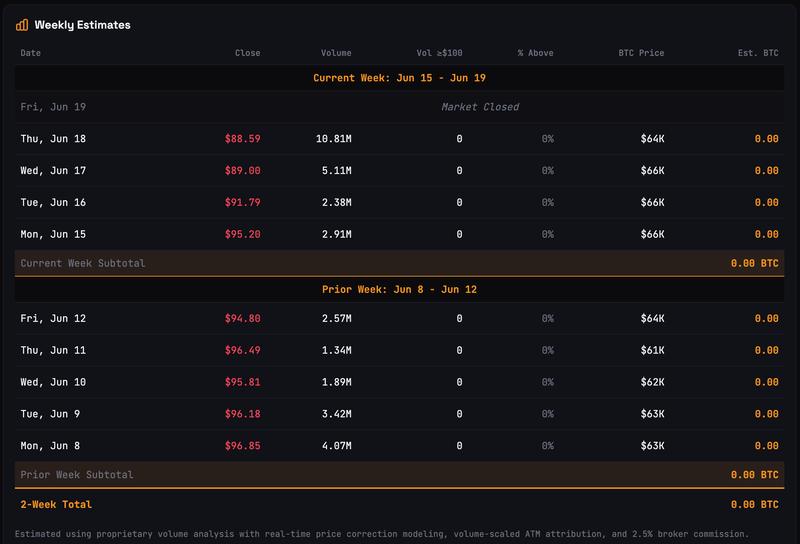
Financial analyst characterizes STRC decline as leverage wipeout
According to Jesse Myers, head of Bitcoin strategy at The Smarter Web Company, the STRC sell-off appeared more consistent with a leverage wipeout rather than a fundamental deterioration in Strategy's business model.
"Strategy is fine," he stated in a Thursday post, further noting that the company possesses the capability to pay STRC dividends for 32 years under unchanged conditions, and perpetually if Bitcoin appreciates at approximately 2% annually.
The prolonged period during which STRC traded near $99–$100 incentivized investors to employ substantial leverage, with certain participants operating under the assumption that the instrument would remain above $95. When the price began slipping, margin calls and forced liquidations amplified the decline.
According to analyst Scott Melker, the discount may also prove attractive to income-focused buyers.
In a Sunday post, he highlighted that STRC's dividends are calculated based on the $100 liquidation preference, not the current market price. With an 11.5% dividend rate, purchasers at $90 realize approximately 12.8% returns, while purchasers at $85 realize roughly 13.5%.

Based on current pricing levels, STRC provides an effective yield of approximately 13%. Strategy may disclose its next dividend rate on June 30, while maintaining additional options, including MSTR share issuance and cash reserves, to finance its Bitcoin purchases.