
Stellar's XLM Token Surges Over 50% This Week: Here's What's Driving It
The XLM token experienced a significant rally following the DTCC's announcement of integration with the Stellar Network, though analysts warn of potential substantial corrections ahead.
The native cryptocurrency of the Stellar blockchain, XLM, has experienced an impressive surge exceeding 50% over the past week, significantly outperforming the wider cryptocurrency market, which has seen a decline of approximately 5% during the identical timeframe.
Key takeaways:
- The DTCC, a major US financial institution, revealed plans to incorporate its platform for tokenized securities with the Stellar Network.
- Following the announcement, XLM experienced a rally surpassing 50%, though it faces the potential for a significant correction in upcoming weeks.
XLM rally gains momentum from DTCC collaboration
The price of XLM experienced a significant jump following a landmark institutional partnership announcement from the Depository Trust & Clearing Corporation (DTCC), an American financial behemoth responsible for clearing and settling securities transactions valued between $10 trillion and $12 trillion on a daily basis.
Through a press release issued on Wednesday, the organization disclosed its intentions to incorporate its platform for tokenized securities with the Stellar network, with a planned rollout scheduled for the first six months of 2027.
This development expands upon DTCC's tokenized trading platform, which was introduced in July 2026, and forms part of its comprehensive multi-chain approach for the issuance, reporting, corporate actions, and settlement of tokenized assets.
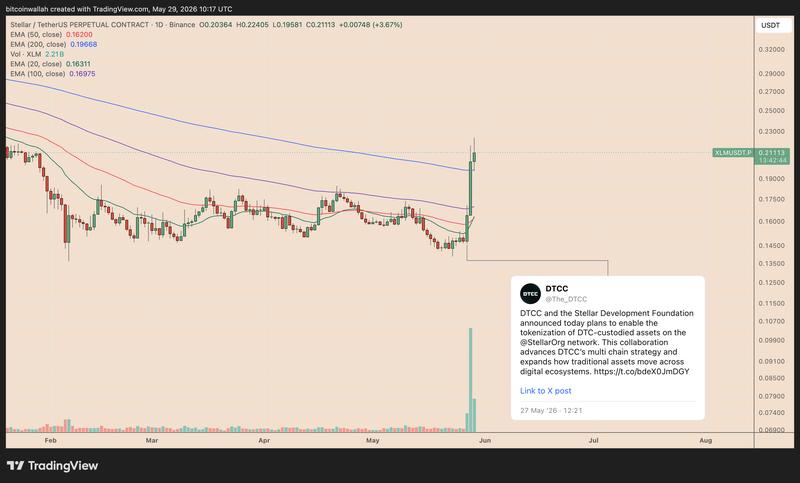
Following the DTCC partnership revelation, XLM experienced a 51.75% surge and reached a trading high of $0.224 on Friday, marking its strongest performance since January. The upward price movement was accompanied by a significant increase in trading volumes, indicating substantial buyer interest in the market.
XLM price surge amplified by short squeeze dynamics
The XLM rally appears to have been further intensified by a concentrated short position that triggered forced liquidations. From May 28 onwards, short liquidations for Stellar have totaled $12.41 million, while long liquidations reached $6.82 million, based on data from CoinGlass.
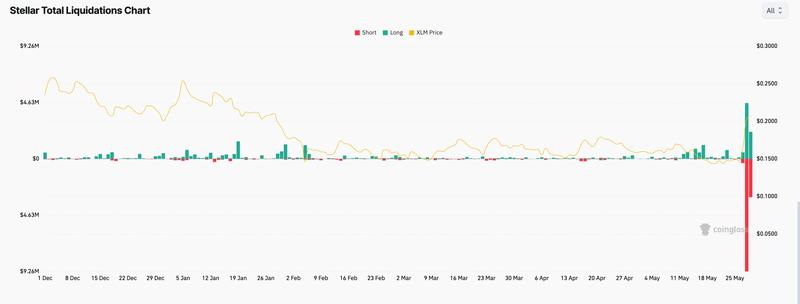
This indicates that traders betting against XLM experienced approximately 1.8 times more forced position closures than bullish traders as the token's price climbed from approximately $0.15 to a peak of $0.224.
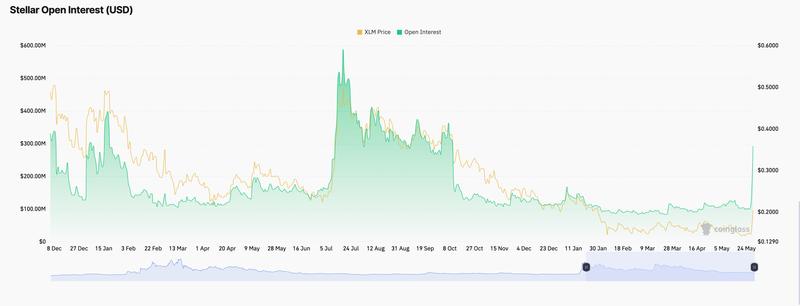
During this same timeframe, open interest in XLM contracts nearly doubled, climbing to $292.11 million by Friday. This demonstrates that traders were increasing their leveraged positions as the price rally continued, rather than simply unwinding existing positions.
Simultaneously, the OI-weighted funding rate for XLM declined to approximately -0.0270%, representing its lowest point since April, despite the upward price trajectory.
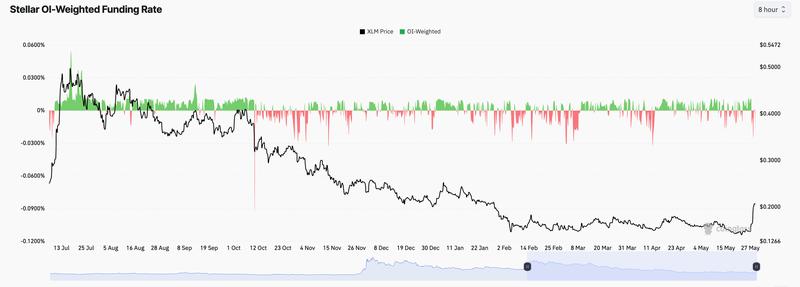
A negative funding rate indicates that traders holding short positions were compensating those holding long positions to maintain their open trades, demonstrating that bearish sentiment remained concentrated throughout the price breakout.
As prices rise in opposition to heavily leveraged short positions, trading platforms compel bearish traders to repurchase the token to exit their positions. This forced purchasing creates additional upward momentum, resulting in what market participants call a "short squeeze."
Historical XLM rallies suggest elevated pullback risks
The current breakout in Stellar shares similarities with previous XLM price surges that ultimately resulted in significant downward corrections.
During November 2024, XLM experienced an approximately 640% increase following Donald Trump's victory in the US presidential election. The rally proved unsustainable, however, with XLM subsequently declining by roughly 68.6% from its peak price.
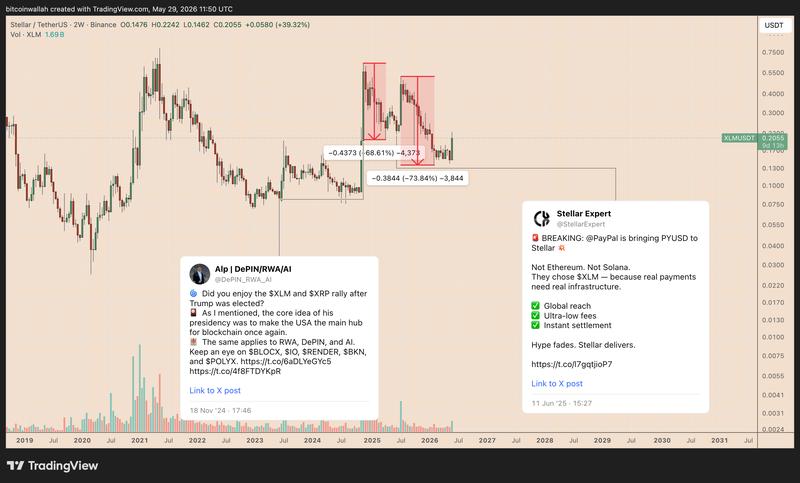
An analogous pattern emerged in July 2025, when PayPal's decision to launch its stablecoin on Stellar combined with increasing enthusiasm surrounding the Protocol 23 upgrade drove XLM upward by approximately 140%.
The gains proved temporary, with the XLM/USD trading pair subsequently experiencing a correction of approximately 73.8%.
The current concern is that the rally triggered by the DTCC partnership may follow this established pattern.
Long-term resistance zone challenges XLM's continued rally
The recent XLM rally has brought the token into a significant long-term resistance area, increasing the probability of either a price pullback or a period of consolidation.
By Friday, XLM was trading within the $0.198–$0.224 resistance ceiling, a zone that also coincides with three exponential moving averages (EMA), specifically the 50-week EMA (red) positioned near $0.2216, the 100-week EMA (purple) located near $0.2281, and the 200-week EMA (blue) situated near $0.2083.
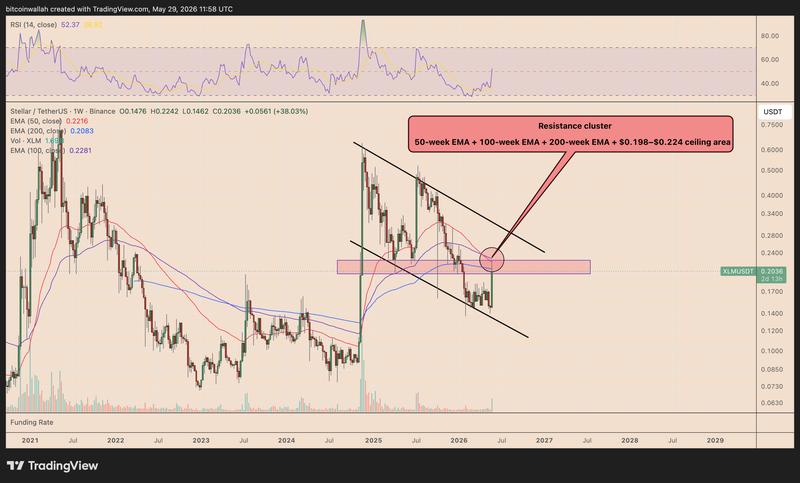
An inability to penetrate above this confluence of resistance levels, which analyst MAGIC characterized as "too strong for the first test," could result in XLM prices retreating toward the $0.112–$0.136 range, representing a decline of 30%–40% from present levels, potentially occurring by June or July.
This downside price target corresponds with the lower boundary trendline of XLM's current descending channel formation.
On the other hand, a definitive breakthrough above the resistance zone would increase the probability of XLM rallying toward the channel's upper trendline near the $0.28–$0.30 range by June or July. This represents a potential increase of approximately 40% from current price levels.