
Stellar network receives RedStone oracle integration following $10M DeFi security breach
RedStone brings comprehensive price feed solutions to Stellar blockchain as the platform grows its DeFi ecosystem with focus on lending protocols and real-world asset tokenization.

The Stellar network has welcomed RedStone's oracle price feed infrastructure, bringing a critical data layer to support decentralized finance (DeFi) protocols on a blockchain platform that has traditionally concentrated on payment processing and stablecoin transaction capabilities.
Through this integration, price feeds covering prominent cryptocurrency assets and stablecoins are now accessible on Stellar's mainnet, encompassing Bitcoin (BTC), Ether (ETH), USD Coin (USDC) and PayPal USD (PYUSD). Additionally, the implementation provides pricing information for the Franklin Templeton BENJI tokenized money market fund.
According to RedStone, these feeds are engineered to facilitate various financial applications including lending markets, decentralized exchanges (DEXs) and platforms focused on tokenized real-world asset (RWA) development within the Stellar ecosystem.
This integration represents an additional infrastructure component for Stellar's growing DeFi ecosystem as developers continue to explore opportunities in lending, asset tokenization and blockchain-based financial services.
Stellar expands DeFi infrastructure
According to RedStone, the price feed technology utilizes a deviation-based update mechanism combined with freshness verification protocols designed to maintain data accuracy for financial applications.
Stellar has long demonstrated its strength as a blockchain for real-world financial activity, particularly in payments and stablecoins.
RedStone co-founder Marcin Kazmierczak
Kazmierczak noted that enterprise-grade oracle infrastructure was "what has been missing" to enable the network to support more sophisticated financial applications.
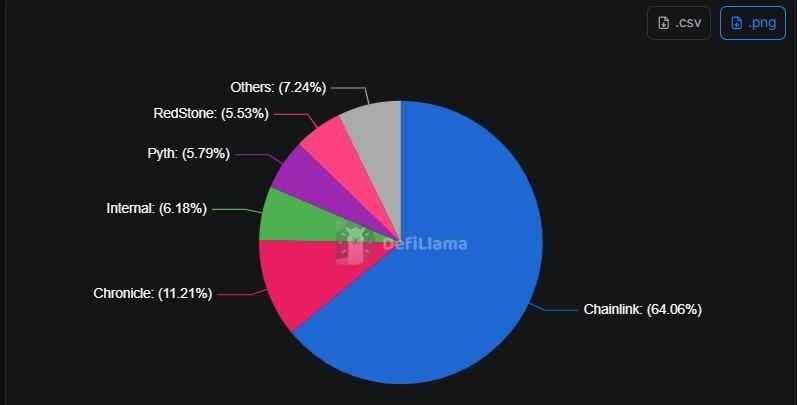
Within the competitive oracle ecosystem, RedStone faces competition from market leader Chainlink. According to DeFiLlama data, Chainlink commands approximately 64% of the market by total value secured, with Chronicle capturing 11% market share.
Internal protocol oracles represent approximately 6% of the market, while Pyth and RedStone maintain roughly 5.8% and 5.5% market shares, respectively.
Oracle risks highlighted by recent exploit
This deployment arrives several weeks following a DeFi security incident on Stellar that exposed vulnerabilities related to price feed mechanisms and collateral assessment in lending protocols.
On Feb. 21, malicious actors extracted approximately $10 million from a YieldBlox DAO-managed lending pool operating on the Blend protocol through manipulation of the USTRY token price used for collateral purposes.
According to a security investigation conducted by blockchain security firm BlockSec, the lending protocol depended on a price pathway connected to the illiquid USTRY/USDC market on Stellar's decentralized exchange. The artificially inflated price increased the token's collateral valuation, enabling the attacker to borrow assets significantly exceeding its actual value.
A spokesperson from Redstone explained to Cointelegraph that depending on illiquid onchain markets for price determination can create manipulation vulnerabilities for lending pools.
The February exploit was only possible because an oracle was deriving a price from a market with less than one dollar in hourly trading volume.
RedStone spokesperson
According to RedStone, its price feed technology employs deviation-based update mechanisms, generally ranging from 0.5% to 1% for stablecoins, complemented by minimum daily refresh requirements to maintain data currency.