
Stablecoins Emerging as Primary Method for Circumventing Sanctions, FATF Reports
Global financial watchdog highlights how peer-to-peer stablecoin transactions using self-custody wallets circumvent anti-money laundering controls, calling on nations to evaluate threats and implement appropriate protective measures.

The Financial Action Task Force (FATF) has identified peer-to-peer transactions conducted via self-custody cryptocurrency wallets as a critical vulnerability within the stablecoin landscape, noting that such transfers can occur outside the purview of regulated intermediaries. This warning comes in a newly released report calling for nations to strengthen regulatory oversight as stablecoins gain traction in payment systems and international money transfers.
The global anti-money laundering watchdog's focused analysis of stablecoins, unhosted wallets and peer-to-peer transactions emphasized that direct user-to-user transactions facilitated through unhosted wallets can proceed without the involvement of regulated intermediaries like cryptocurrency exchanges or custodial service providers.
According to the FATF, such an arrangement has the potential to generate vulnerabilities in Anti-Money Laundering (AML) supervision since these transactions take place beyond the reach of entities mandated to track financial activity and flag questionable transfers. The analysis underscored increasing regulatory scrutiny of stablecoins as their utilization grows throughout trading platforms, payment networks and international transfer systems.
The international watchdog urged member jurisdictions to evaluate the threats posed by stablecoin frameworks and implement mitigation strategies that are "proportionate" to identified risks, potentially including strengthened surveillance when self-custody wallets interface with regulated platforms and more explicit AML and counterterrorism financing requirements for organizations participating in stablecoin issuance and distribution.
P2P stablecoin transfers seen as regulatory blind spot
According to the FATF, peer-to-peer transfers conducted through self-custody wallets constitute a "key vulnerability" due to their capacity to circumvent AML safeguards that are ordinarily implemented by regulated intermediaries.
Such transfers take place directly among users without requiring participation from virtual asset service providers (VASPs) or financial institutions bound by regulatory compliance requirements, which could restrict the capacity of authorities to identify questionable transactions.
The FATF observed that while transactions executed on public blockchains maintain traceability due to on-chain activity recording, the pseudonymous characteristics of wallet addresses can complicate the process of identifying specific individuals or entities.
Illicit activity accounts for only 1% of the total crypto transaction volume
On Jan. 9, blockchain analytics firm Chainalysis found that illicit crypto addresses received at least $154 billion in 2025, with stablecoins accounting for 84% of illicit transaction volume.
The FATF reiterated the stat in its report, emphasizing the current usage of stablecoins in illicit transactions.
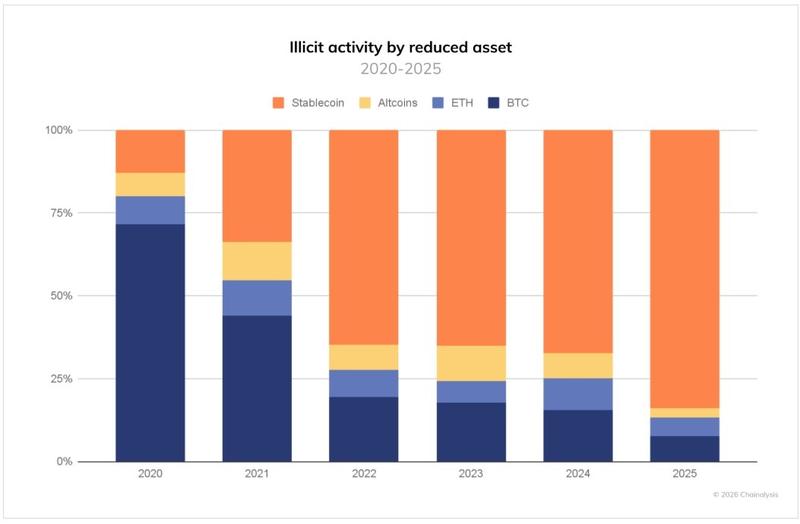
Chainalysis said illicit activity remains a small share of total on-chain volume, even as absolute dollar totals rose.
In the same report, Chainalysis said illicit transactions accounted for less than 1% of the total crypto transaction volume.