Solayer introduces USDC spending card with Visa integration
Users can now utilize their USDC holdings for digital purchases, physical retail payments, and tap-to-pay functionality, with additional ATM cash withdrawal capabilities in eligible territories.

Blockchain infrastructure provider Solayer has unveiled a payment card compatible with the Visa network, enabling customers to utilize their USDC holdings for physical retail purchases, digital commerce, and tap-to-pay transactions.
According to the official announcement, the card offers ATM cash withdrawal functionality in eligible territories and can be requested via the Solayer Pay application. Current platform members can obtain the card at no cost, whereas newcomers are required to pay a $20 yearly activation charge.
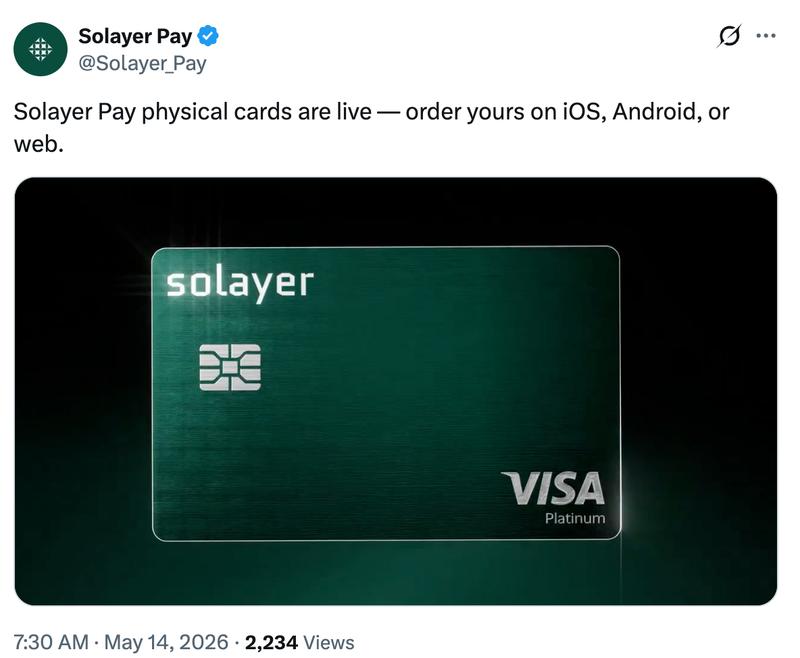
Originally introduced in April 2025 as Emerald Card, Solayer Pay was made available to 40,000 initial users spanning over 100 nations worldwide, the company reports. According to Solayer, this physical card offering represents an extension of the current Solayer Pay ecosystem, which facilitates the storage, movement, and expenditure of cryptocurrency through Visa-connected payment systems.
According to the company's statement, cardholders can utilize their USDC (USDC) holdings anywhere globally via Visa's payment network, drawing funds straight from their Solayer Pay wallets.
The company is responsible for developing infiniSVM, a layer-1 blockchain network that maintains compatibility with the Solana Virtual Machine and is engineered to support high-volume decentralized applications while utilizing Solana (SOL) tokens for transaction costs.
Stablecoin payment cards expand
Solayer's card introduction arrives amid a broader trend of cryptocurrency platforms and financial technology firms rolling out stablecoin-backed payment solutions integrated with established card networks such as Visa and Mastercard.
Earlier this year in January, digital asset platform OKX introduced a payment card linked to Mastercard's network for users throughout Europe via regulated partner Monavate, enabling authenticated account holders to spend various stablecoins, including USDC and Paxos' Global Dollar (USDG).
A month later in February, MetaMask broadened the availability of its Mastercard-integrated cryptocurrency spending card throughout the United States, notably including New York state in its coverage area for the first time, giving users the ability to spend cryptocurrencies straight from non-custodial wallet solutions.
During March, payment giants Visa and Stripe-acquired Bridge broadened their stablecoin-connected card initiative to encompass 18 nations and announced intentions to launch the offering in over 100 countries before 2026 concludes. The partnership also commenced testing of stablecoin-based transaction settlement via Visa's experimental initiative.
That same month saw Mastercard announce its intention to purchase stablecoin technology provider BVNK through an acquisition agreement worth as much as $1.8 billion. BVNK delivers technology solutions enabling commercial entities to transmit and accept stablecoin transactions across multiple blockchain platforms in excess of 130 nations.
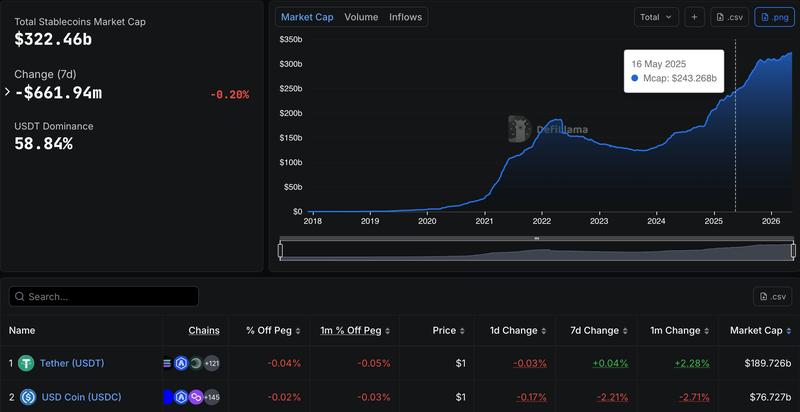
Information compiled by DefiLlama indicates the stablecoin sector has expanded from approximately $243.3 billion in May 2025 to roughly $322.5 billion at present, reflecting growth of approximately $79 billion.
Tether continues to hold its position as the leading stablecoin provider, with its USDt (USDT) maintaining a market valuation of approximately $189.7 billion, which accounts for roughly 58.8% of the entire stablecoin marketplace, whereas Circle's USDC holds the second position with a market valuation of approximately $76.7 billion.