
Security Breach in Ledger Devices Sparks Fresh Debate: Are Bitcoin ETFs Superior to Hardware Wallets?
A recent finding of a tampered Ledger hardware device has sparked renewed discussion about the comparative safety between Bitcoin ETFs and self-custody through hardware wallet solutions.
The recent revelation of a Ledger security vulnerability has ignited widespread conversation throughout the cryptocurrency industry regarding the comparative security of hardware wallets versus the custody of Bitcoin assets through exchange-traded funds (ETFs).
Cryptocurrency analyst Plan B stated that his previously contentious choice to transfer his Bitcoin (BTC) assets to ETFs during 2025 proved to be the correct decision following the recent security breaches affecting Coldcard and Ledger devices. The analyst expressed "Zero regrets" regarding his ETF choice in an X post published on Monday.
Major cryptocurrency holders have been transitioning their self-custodied holdings to ETFs in pursuit of "enhanced security" over a period of several years, representing one of the primary "selling points" associated with ETFs, according to 21Shares co-founder Ophelia Snyder in an email communication with Cointelegraph on Monday. She further noted that these recent security exploits have brought this trend into the realm of "public discourse."
These comments come in the wake of the identification of a Ledger wallet that had been compromised through an unauthorized hardware implant. Certain blockchain security investigators have projected that financial losses stemming from these implanted devices could exceed $86 million, prompting serious concerns about the reliability of self-custodial cold storage wallet solutions.
Hardware wallets are still safe, but providers need better threat modelling: Adam Back
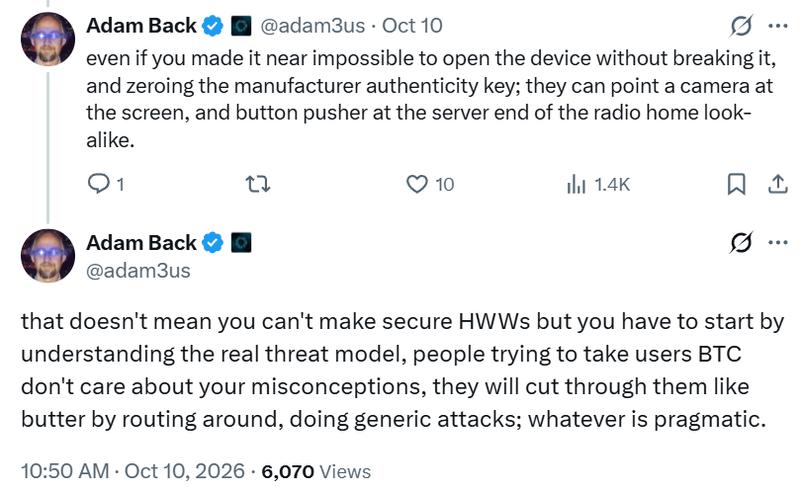
It's important to note that hardware wallets retain the potential to serve as secure custodial solutions, though manufacturers require an improved comprehension of the evolving threat environment, as stated by Blockstream CEO and Hashcash inventor Adam Back.
"Surprisingly few manufacturers understood the generic attacks, or so it seemed from their marketing and design choices, for the last decade. Time to catch up with threat-modelling," Back stated in an X post published on Saturday.
Nonetheless, Snyder emphasized that the principal challenge with self-custodial wallet solutions lies in the fact that their security is contingent upon the technical knowledge and specific configuration implemented by individual investors. She said:
"Without taking the time and rigor to set up properly, self-custody will always be less secure than handing over the assets to a specialist firm whose job it is to manage those protocols for you."
Bitcoin security researcher and cypherpunk Jameson Lopp similarly acknowledged that self-custodial wallet solutions can provide a robust security option, but he cautioned investors against engaging in mass migrations that could establish new central points of failure during hastily executed transactions.