
Robinhood Gains IPO Underwriting Status While Cryptocurrency Platforms Challenge Traditional Mega-Offering Access
As SpaceX gears up for a historic public market debut, Robinhood secures underwriter credentials while cryptocurrency derivatives exchanges and retail trading platforms compete to influence pricing mechanisms and investor participation.
Robinhood Securities has obtained regulatory clearance to function as an underwriter for initial public offerings, transitioning from its previous capacity as a distributor into the primary underwriting syndicate where it will work alongside traditional Wall Street investment banks.
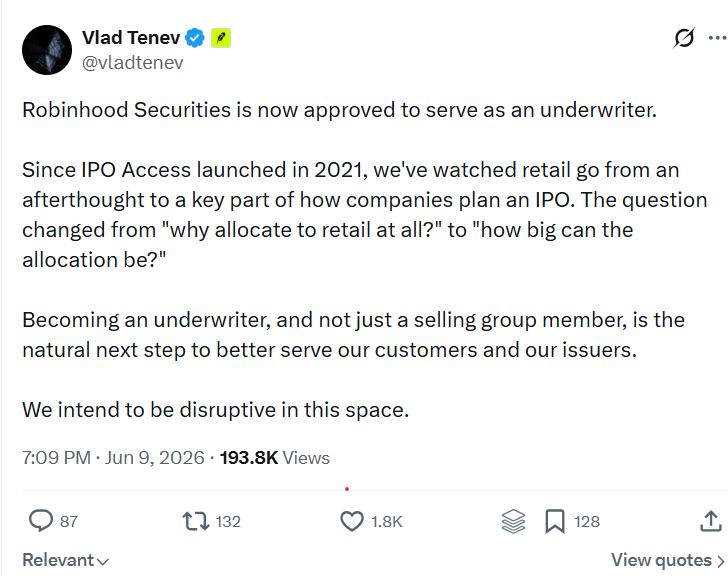
In a Tuesday post on X, chief executive Vlad Tenev announced that Robinhood Securities has "now approved to serve as an underwriter," though he did not identify the specific regulatory body that granted the authorization, a procedure that generally requires supervision from both the Securities and Exchange Commission (SEC) and the Financial Industry Regulatory Authority (FINRA).
Characterizing the development as the "natural next step" following the introduction of IPO Access in 2021, Tenev stated that the central question in equity capital markets has evolved from "why allocate to retail at all?" to "how big can the allocation be?"
The announcement arrives at a moment when SpaceX is reportedly exploring the possibility of making as much as 30% of its record-setting offering available to retail investors and as demand already runs at close to four times the planned size.
Crypto rails race for SpaceX
The company's effort to distribute IPO shares directly to users of its mobile trading application coincides with cryptocurrency platforms rushing to construct alternative infrastructure around the same public listings.
Leading cryptocurrency exchanges have started providing alternative pathways to private market exposure via tokenized pre-IPO instruments, including Bybit's xStocks, Kraken's pre-IPO equity tokens and Coinbase's secondary markets.
On the derivatives front, a Tuesday analysis from Talos and Coin Metrics contends that blockchain-based pre-IPO perpetual contracts are emerging as a significant price discovery mechanism in their own right.
Market liquidity is progressively becoming a combination of retail traders, crypto-native funds and systematic market makers, according to the report, with SpaceX contracts on Hyperliquid generating billions in volume and hundreds of millions in open interest.
The analysis points to Cerebras Systems, where Hyperliquid's pre-IPO futures tracked the stock's eventual opening level within about 1%, while underwriters priced the IPO itself far lower.
Samar Sen, vice president of international markets at Talos, told Cointelegraph that underwriters and retail platforms like Robinhood are increasingly likely to monitor these signals for high-profile listings as a supplementary input for assessing demand, though not as a replacement for traditional book-building.
From an underwriter's perspective, pre-IPO perpetuals are "unlikely to determine retail versus institutional allocations on their own, but they can provide an additional signal around investor demand ahead of listing," he said.