
Resolv Labs confirms collateral intact following USR stablecoin security breach in DeFi
Following a Sunday security breach that generated 80 million tokens without backing and sent the USR stablecoin plummeting to $0.14, Resolv Labs confirms its collateral pool has not been compromised.

Following a security breach affecting its USR stablecoin's issuance system on Sunday, Resolv Labs acted swiftly to provide assurances to its user base. The incident caused the token to lose its dollar peg and triggered rapid responses from decentralized finance (DeFi) platforms with exposure to the stablecoin as they worked to minimize potential damage.
Earlier on Sunday, Cointelegraph provided coverage of how an attacker compromised USR's token creation mechanisms, generating massive quantities of tokens lacking collateral backing and selling them across DeFi liquidity pools. This action severed the stablecoin's peg to the dollar and led Resolv to suspend protocol operations while conducting damage evaluation.
Following the security incident, the token plummeted to as low as $0.14, representing an 86% decline from its target $1 valuation, before recovering to $0.42 as of publication time, based on CoinGecko's market data.
Through a recent X platform statement, the team at Resolv indicated that the collateral pool "remains fully intact," adding that the issue seems "isolated to USR issuance mechanics." The company continues its containment efforts and impact evaluation processes.
Blockchain analytics from Arkham, verified by Web3 cybersecurity company Cyvers, revealed that the exploiter had exchanged the majority of the newly minted USR for Ether (ETH), liquidating a portion for approximately 11,400 ETH (valued at roughly $24 million). Additional analysis from independent researchers indicated that the outstanding 36.74 million USR was "still being continuously dumped."
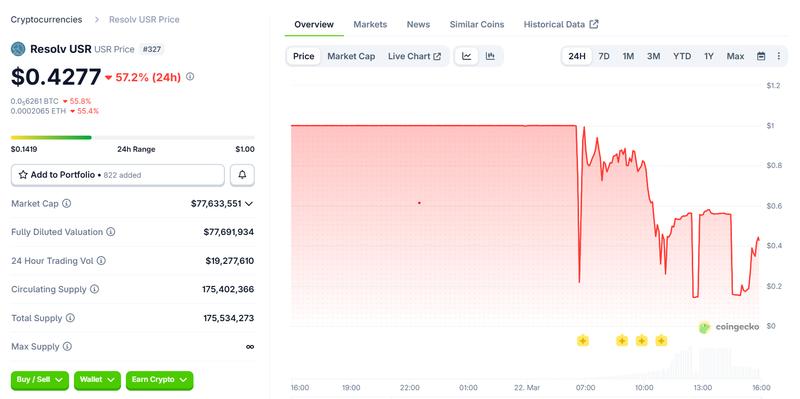
Speaking to Cointelegraph, Michael Pearl, vice president GTM and strategy at Cyvers, explained that because the token supply expanded more rapidly than market demand could accommodate and the stablecoin immediately lost its peg, the worth of the unsold tokens had been substantially diminished.
DeFi platforms act swiftly to limit damage
Decentralized finance (DeFi) platforms holding positions in Resolv moved rapidly to communicate their status. Liquid staking platform Lido confirmed that funds in Lido Earn remained secure. Morpho cofounder Merlin Egalite stressed that the lending platform's core smart contracts were not compromised and that exposure existed only within specific vaults, while Aave's founder, Stani Kulechov, confirmed that the platform lacked direct USR holdings and that Resolv was settling its remaining obligations.
The X account "yieldsandmore" flagged potential losses within Resolv's junior RLP tranche, drawing attention to possible cascading impacts on yield-generating platforms including Stream and yoUSD that utilized RLP as underlying collateral.
In his conversation with Cointelegraph, Pearl noted that based on current information, the vulnerability seemed to be "relatively concentrated" within lending markets and leverage cycles "rather than system-wide," predominantly affecting protocols that had incorporated USR, wstUSR, or RLP into their lending, leverage or yield-generation frameworks.
According to Pearl, multiple protocols including Euler, Venus, Lista and Fluid had implemented preventative measures such as halting markets or segregating vaults, while additional platforms had announced complete lack of exposure. "It is more accurate to describe the risk as concentrated with localized spillover, rather than widespread contagion," he said.
Charles Guillemet, chief technical officer at Ledger, also provided his evaluation of the incident on X, noting that given the comparatively limited scale of USR, "this is not a Terra Luna-type event."
Debate emerges over security audit effectiveness
Since 2024, Resolv's smart contract code has been subjected to numerous security audits, yet Pearl maintained that although audits were "necessary," they remained "inherently static and scoped." He contended that real-time, artificial intelligence-driven surveillance to "continuously analyze protocol activity" was essential for identifying irregularities as they develop.
For stablecoin infrastructure particularly, he explained this required monitoring token creation and destruction flows against anticipated patterns in real time, ongoing validation of circulating supply against reserves and supporting assets, and identification of irregularities in oracle data feeds, valuation mechanisms and liquidity dynamics.
Cybersecurity firm Pashov, which conducted an audit of Resolv's staking module in July 2025, informed Cointelegraph that Resolv's architectural approach was "good," and that the fundamental issue was "not the design so much as the private key compromise," which was probably an operational security weakness. "We have to understand how that happens," he said.
Cointelegraph contacted Resolv Labs seeking additional comment but had not received a reply at the time of publication.