
Record-Breaking 83 Security Breaches Mark Q2 2026 as Cryptocurrency's Most Targeted Quarter
A total of 83 security breaches occurred during Q2 2026, resulting in losses totaling $755 million across the cryptocurrency sector, with bridge infrastructure exploits representing the most expensive attack methodology.

By incident volume alone, the second quarter of 2026 has established itself as the most heavily targeted three-month period in cryptocurrency history, with 83 separate exploits compromising various cryptocurrency protocols, based on research conducted by market insights platform Unfolded utilizing DefiLlama data.
Despite this record-breaking incident count, the $755.3 million in stolen funds accumulated throughout the quarter remains substantially below the $3.56 billion extracted during Q4 2020, which continues to hold the record as the most financially damaging quarter for cryptocurrency security breaches.
The two largest security incidents of the quarter were the $293 million compromise of KelpDAO and the $280 million breach of Drift Protocol.
These statistics indicate that hacking incidents are occurring with increased frequency, despite the fact that aggregate financial losses have not yet surpassed historical peak levels.
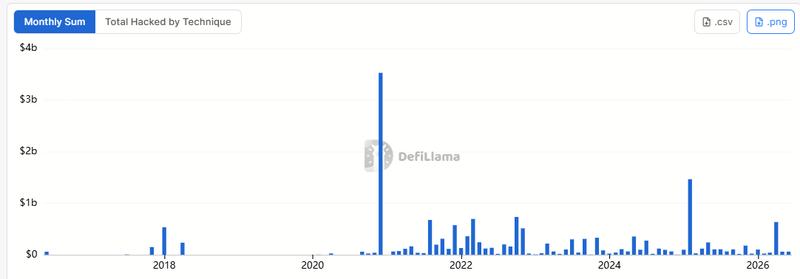
The combination of increasing incident frequency alongside decreasing total stolen amounts indicates that diminished value remains available for extraction from the sector, given that total value locked (TVL) within DeFi protocols declined from $164 billion prior to the October 10 liquidation event to approximately $73 billion as of press time, according to Dmytro Tarasiuk, product director at risk intelligence platform CORE3 and crypto security rating platform CER.live.
The sector's most critical security weakness continues to be that protocols undergo re-engineering at a pace that outstrips the development of their fundamental risk management sophistication, which frequently results in projects that "declare 3-6 multisig stores 3 keys on one laptop," creating additional operational security vulnerabilities, he explained to Cointelegraph.
Bridge exploits emerged as leading attack vector in Q2 2026
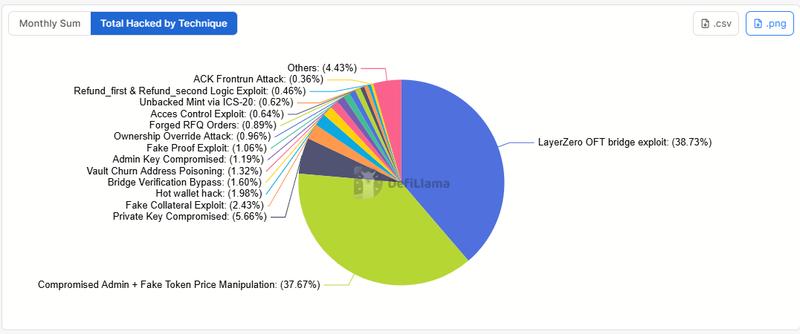
Exploits targeting cross-chain bridge infrastructure surfaced as the predominant attack methodology during the quarter, with bridge vulnerabilities alone accounting for $351 million in stolen assets.
The LayerZero OFT bridge vulnerability, which resulted in the $293 million KelpDAO security breach, represented more than 38% of total funds stolen throughout the quarter. Administrative access compromises combined with fraudulent token price manipulation were responsible for 37% of total losses, while breaches involving private key compromises constituted 5.66%.
Taiko, an Ethereum layer-2 blockchain network, became the most recent platform to experience a security breach on one of its bridge protocols, as malicious actors extracted $1.7 million through compromising Taiko's chain state verification infrastructure.
Additional significant security incidents from the previous quarter include the $36 million theft from Humanity Protocol occurring on June 8 and the $10.7 million breach affecting THORChain on May 15.
Further recent security breaches include two separate exploits targeting Aztec Connect's deprecated smart contracts, with each incident resulting in $2.1 million in stolen funds, and $1.3 million extracted from decentralized exchange Raydium during early June.
These security breaches contribute to the continuing discussion regarding whether emerging artificial intelligence models have fundamentally altered the cryptocurrency industry's security environment, concerns that originated from the sequence of exploits occurring throughout April.
In a recent conversation, Mitchell Amador, the CEO of bug bounty platform Immunefi, shared with Cointelegraph that the emergence of novel AI models has transformed the cybersecurity landscape to favor those conducting attacks, triggering a "vulnerability apocalypse" that has driven the recent surge in security exploits.