RBA endorses asset tokenization following pilot revealing $16.7B economic benefit
Australia's Reserve Bank forecasts annual economic benefits of $16.7 billion through real-world asset tokenization while examining digital financial market sandbox opportunities.

Australia's central banking institution, the Reserve Bank of Australia, is throwing its weight behind real-world asset tokenization initiatives, pointing to fresh research indicating the sector could deliver 24 billion Australian dollars ($16.7 billion) in annual economic contributions.
Brad Jones, who serves as assistant governor at the nation's central bank, revealed findings from the Project Acacia initiative this Wednesday, noting that advocates believe tokenized finance alongside corresponding infrastructure enhancements will prove to be "revolutionary."
According to his statements, the prospective economic advantages for Australia stemming from real-world asset tokenization are estimated at approximately $16.7 billion annually, "and larger still if new markets emerged."
"First, we no longer see the main question as whether tokenization has a future in Australia's financial system, but rather, how."
International consulting powerhouse McKinsey & Company has projected that tokenized assets could reach a valuation approaching $2 trillion by the year 2030. Joe Longo, who heads Australia's securities regulatory body, made a call in November for the nation to "seize the opportunity" or risk falling behind in the global race.
The Reserve Bank of Australia's Project Acacia represents a collaborative research initiative conducted in partnership with the Digital Finance Cooperative Research Centre alongside various industry organizations.
The project was developed as an extension of an earlier pilot program focused on central bank digital currency, examining whether the tokenization of assets might enhance operational efficiency within Australia's wholesale financial market ecosystem.
New digital finance sandbox to be explored
According to Jones, the RBA plans to collaborate with regulatory agencies and industry stakeholders to examine the possibilities of a "new digital financial market infrastructure (DFMI) sandbox."
Jones noted that such an initiative would enable both industry participants and policy architects to expand upon the insights gathered through Project Acacia's implementation.
The sandbox framework could potentially "smooth the path to practical implementation by providing a safe space for the testing and scaling of tokenized money, assets, and new infrastructure in a longer-term, stage-gated environment," according to his remarks, with possibilities for integration with a central bank digital currency.
"The interaction of wholesale CBDC with bank deposit tokens and stablecoins, and the synchronisation of tokenized asset ledgers with RITS [Reserve Bank Information and Transfer System], will be particular areas of interest."
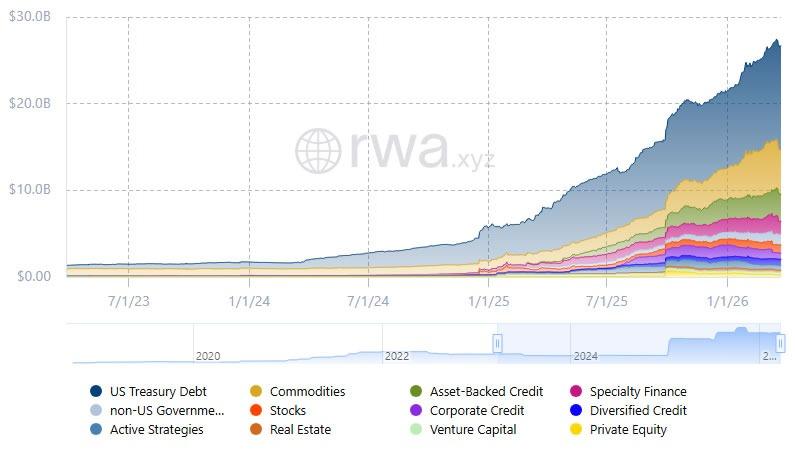
RWA onchain value surges 234% in a year
In closing his remarks, Jones emphasized that guaranteeing Australia's infrastructure for payments, monetary policy, and financial operations remains "fit for purpose" within the emerging digital landscape stands as a "strategic priority for the RBA."
Data from RWA.xyz indicates that the aggregate onchain market value for real-world assets reached an unprecedented peak of $27.5 billion in the previous week, with stablecoins excluded from this calculation. The industry has experienced remarkable expansion, climbing 234% throughout the preceding 12-month period even as the wider cryptocurrency asset market endured bearish conditions.