
Push Notification Systems Pose Significant Privacy Risks, Warns Telegram's Durov
Push notification data retained on users' devices enables the recovery of erased messages and conversations, even when protected by end-to-end encryption protocols.

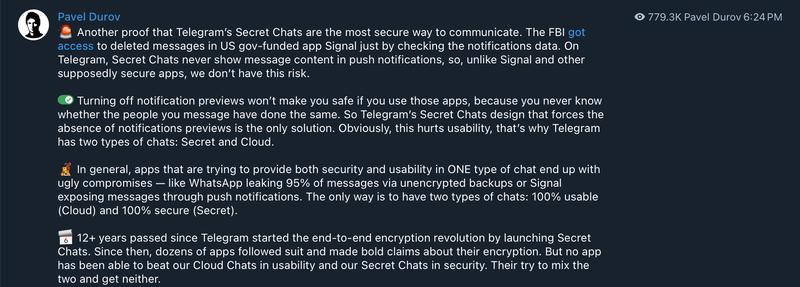
According to Pavel Durov, who co-founded the Telegram messaging platform, push notification systems represent an ongoing and serious threat to user privacy. These systems create vulnerabilities that enable the recovery of data long after users have deleted both their messages and the messaging applications themselves from their devices, with the notification data remaining accessible on the device.
In his statement, Durov referenced a recent investigative report that was initially published through 404 Media, revealing how the United States Federal Bureau of Investigation (FBI) successfully retrieved messages that had been deleted by a Signal user. The agency accomplished this by examining device notification logs stored on an Apple iPhone. On Friday, Durov issued the following warning:
"Turning off notification previews won't make you safe if you use those applications, because you never know whether the people you message have done the same."
Signal was contacted by Cointelegraph for commentary regarding the FBI's successful data retrieval, however no response was provided before this article went to publication.
These recent revelations underscore how law enforcement investigators and individuals possessing adequate technical expertise can bypass end-to-end encryption protections and compromise user privacy through the exploitation of metadata and additional information that applications generate. This reality emphasizes the growing necessity for decentralized messaging platforms that refrain from collecting such information.
Alternative messaging application use surges amid spikes in civil unrest and geopolitical turmoil
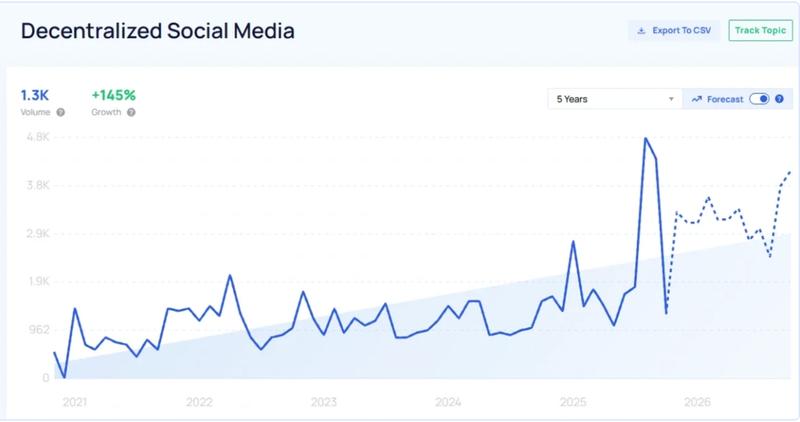
Since 2025, decentralized messaging applications along with social media platforms have witnessed a dramatic increase in user adoption, driven by rising geopolitical tensions, government-imposed nationwide communication blackouts and episodes of civil unrest throughout various regions.
One such platform, Bitchat, operates as a decentralized peer-to-peer messaging application utilizing Bluetooth mesh networks to transmit information between mobile devices. This technology enables users to completely bypass both the internet and centralized communication networks in their communications.
During a nationwide social media ban imposed in September 2025, more than 48,000 users in Nepal proceeded to download the Bitchat application to maintain their communication capabilities.
Users are also discovering methods to work around national firewalls and prohibitions on privacy-focused applications through the deployment of virtual private networks (VPNs) and additional tools that conceal or disguise IP addresses and geolocation information, as Durov has observed.
According to Durov, government-imposed bans on Telegram have produced unintended consequences, with users successfully circumventing state-enforced restrictions by employing VPNs, which grant them the ability to access and download prohibited platforms.
"The government hoped for mass adoption of its surveillance messaging apps, but got mass adoption of VPNs instead," he continued, adding that over 50 million users in Iran have downloaded the Telegram application, despite a years-long government ban.