
Prediction market platforms achieve unprecedented Q2 trading volumes amid broader crypto decline: CoinGecko
While spot centralized exchange activity, derivatives trading, and stablecoin valuations saw decreases, prediction markets posted an all-time high of $113.8 billion in notional volume during Q2.

The second quarter of 2026 brought widespread challenges to cryptocurrency markets, with downward trends affecting stablecoins, spot trading platforms and derivatives exchanges, yet prediction markets bucked the trend by achieving unprecedented trading volumes.
Trading volume on spot markets across the ten largest centralized exchanges (CEXs) dropped to $1.95 trillion during the second quarter of 2026, representing a 27.9% decrease from the first quarter's $2.7 trillion, based on data from CoinGecko's most recent Crypto Industry Report released on Thursday.
Perpetual futures volume on centralized exchanges similarly fell by 10% to $12.7 trillion, and the stablecoin market capitalization experienced a 1.6% reduction to $305.1 billion. By contrast, prediction markets delivered their most impressive quarterly performance ever, registering $113.8 billion in notional volume.
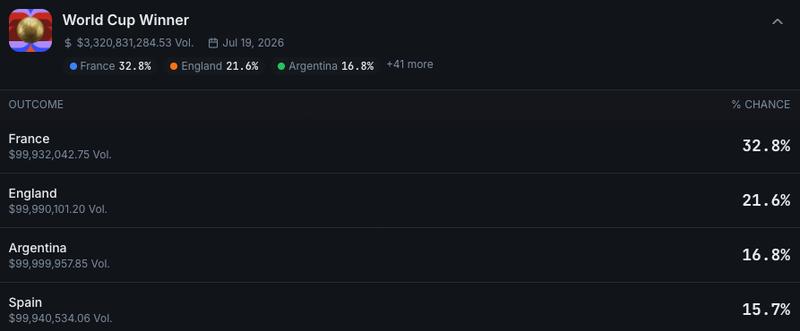
This sharp contrast underscores the expanding significance of prediction markets, where sports betting and political forecasting have become the primary catalysts for growth. Polymarket's market for World Cup winner predictions alone has generated over $3.3 billion in trading activity, and contracts related to the 2028 US presidential election represent some of the platform's most heavily traded markets, as shown by Polymarketscan data.
Binance extends dominance despite bear market as DEX activity falls
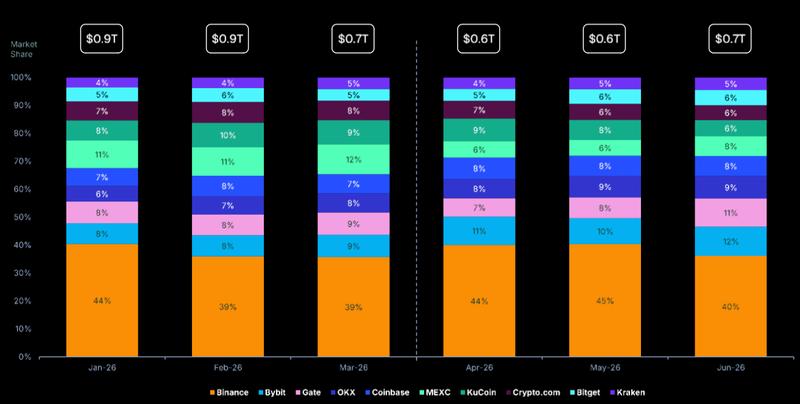
Even as bearish conditions persisted, Binance continued to strengthen its market position, capturing a 38.7% market share throughout Q2. Meanwhile, MEXC experienced the most severe decline among spot centralized exchanges, with its trading volume plummeting by more than half from $275.2 billion in the first quarter to $121.2 billion in the second quarter.
Decentralized exchange activity similarly lost momentum throughout the quarter, as the ten largest spot DEXs recorded $408.9 billion in trading volume, a decrease from $556.4 billion in the first quarter. Uniswap consolidated its leadership position as the dominant DEX, maintaining a 41.2% market share even as its volume declined 21.4% to $168.5 billion.
These decreases occurred as the overall cryptocurrency market experienced weakness, with aggregate market capitalization declining 12.6% to $2.1 trillion over the three-month period. Additionally, April established itself as a record-breaking month for security breaches in decentralized finance (DeFi), underscoring persistent vulnerabilities affecting decentralized platforms.
Kalshi holds lead as prediction markets expand
Trading activity on prediction market platforms reached its zenith in June, aligning with the FIFA World Cup kickoff, as monthly notional volume — representing the aggregate value of all traded contracts — hit an unprecedented peak of $50.7 billion, marking a 91.9% surge compared to the five-month preceding average.
Kalshi, the foremost prediction market platform by volume, preserved its dominant position throughout the quarter with a 58.9% market share, whereas Polymarket experienced share erosion from 35.8% to 30.2%. Rothera Markets, backed by Robinhood, advanced to the fourth position in the rankings.
This expansion has captured the attention of regulatory bodies. Within the United States, regulators and state authorities have engaged in disputes regarding whether prediction markets ought to be classified as financial markets or gambling operations, with legal proceedings involving platforms like Kalshi intensifying throughout 2026.
Regulatory agencies in additional jurisdictions have likewise taken steps to impose restrictions on prediction markets, pointing to various concerns such as gambling regulations, market integrity preservation and the potential risks associated with insider trading.