
Prediction market ETF launches postponed as SEC requests additional structural details: Report
The financial regulator has reportedly asked GraniteShares, Roundhill and Bitwise for additional details regarding the operational mechanics of their event contract investment vehicles.

The United States Securities and Exchange Commission has postponed the anticipated debut of the nation's first exchange-traded funds (ETFs) tied to prediction markets following requests for additional details regarding their operational structure and disclosure requirements, Reuters reported on Monday.
More than two dozen proposed ETFs from GraniteShares, Roundhill Investments and Bitwise are impacted by the postponement, Reuters reported, citing individuals with knowledge of the situation. The asset managers submitted applications for these investment products in February, with market debuts anticipated this week following the completion of a 75-day regulatory review period.
The planned investment vehicles would provide market participants with access to event contracts linked to binary outcomes, such as elections, economic indicators and asset prices, eliminating the need for direct participation on prediction market platforms like Kalshi.
The postponement represents another chapter in the United States' evolving framework for overseeing prediction markets, which have faced regulatory examination regarding insider trading risks, ethical considerations and potential market manipulation.
"Delay is likely temporary"
Based on information from the sources referenced by Reuters, the postponement appears to be short-term in nature, indicating that advancement of the applications could continue after the SEC obtains and evaluates supplementary information from the asset managers concerning product mechanics and disclosure protocols.
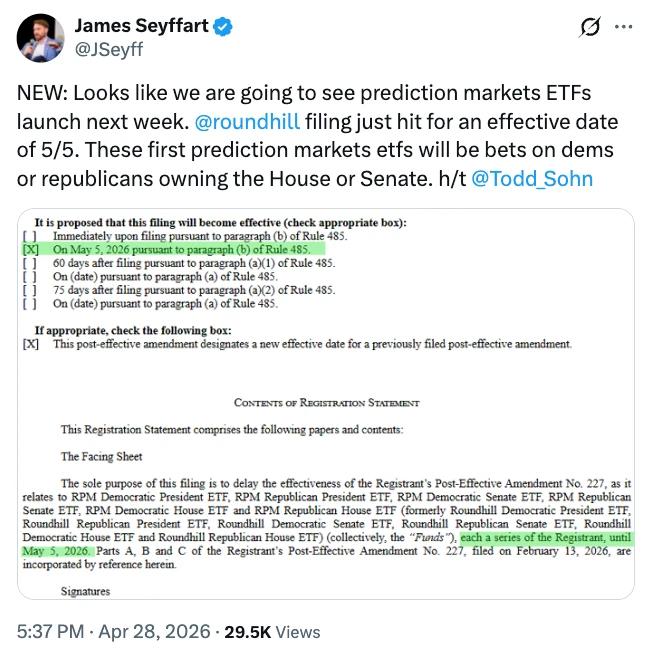
Bloomberg ETF analyst Eric Balchunas stated that the ETFs had been anticipated to debut on Thursday. His colleague James Seyffart indicated last week that Roundhill's application had received an effective date of May 5, representing the first prediction market ETFs connected to event-contract results including whether the Democratic or Republican party maintains control of the House or Senate.
How prediction market ETFs would work
Prediction market ETFs are structured to provide market participants with access to binary event contracts while eliminating the requirement to engage in trading on specialized prediction market venues.
Individual characteristics vary among the more than 20 proposed ETFs, but these investment products typically employ derivatives to follow the probability of binary "yes" or "no" results in underlying contracts traded on platforms regulated by the CFTC, such as Kalshi. The contracts are designed to settle at $1 when an event takes place and $0 when it does not occur.
In its February regulatory filings, Roundhill previously emphasized substantial risks connected to the proposed ETFs, noting that exposure to event contracts involves "unique risks that differ from those associated with traditional futures, options or securities."
The asset manager indicated that these types of investments could lead to substantial losses, uncertainty in valuation and departures from the fund's stated investment objective.
The company also drew attention to possible settlement complications related to the interpretation of event outcomes, encompassing errors, unclear language or disagreements regarding the definition of the underlying event, the information sources utilized or the determination timeline.