
Post-Quantum Blockchain Debuts From Naoris Amid Growing Quantum Computing Threats
As quantum computing risks intensify, Naoris Protocol debuts its layer-1 blockchain utilizing post-quantum cryptography to safeguard transactions from emerging cryptographic threats.
The mainnet launch of Naoris Protocol marks the debut of a layer-1 blockchain that employs post-quantum cryptography to validate transactions and secure the network. Currently operational with restricted access through an invite-only model, the platform enables early adopters to operate validator nodes and execute transaction processing.
In an announcement provided to Cointelegraph, the protocol incorporates cryptographic standards that were finalized by the National Institute of Standards and Technology (NIST) to mitigate vulnerabilities present in current blockchain systems, where traditional encryption approaches may face exposure to threats as technology advances.
Prior to the mainnet release, the protocol's testing environment handled upward of 100 million transactions and detected hundreds of millions of security threats, the project reports, with participation involving millions of wallets and operational nodes.
The platform operates on a consensus mechanism known as distributed proof of security (dPoSec) for transaction verification across the node network, while the NAORIS token serves to facilitate network functionality as the economic framework continues to evolve.
The deployment commences with a limited cohort of validators and partner organizations, with plans to broaden participation through successive phases.
The initiative features advisers who bring expertise from cybersecurity, governmental sectors, and enterprise technology domains, and has secured funding from investors such as Draper Associates.
New research suggests quantum computing may arrive sooner than expected
This deployment arrives at a time when updated projections for quantum computing capabilities, which leverage qubits and quantum states to handle information processing in ways fundamentally distinct from traditional computing architectures, are accelerating initiatives to transition away from existing cryptographic frameworks.
Recent research published by Google on Monday indicates that quantum computers might require considerably fewer resources than past projections suggested to compromise blockchain encryption protocols. The investigation determined that under 500,000 physical qubits could potentially breach security systems protecting Bitcoin (BTC) and Ether (ETH), representing approximately a 20-fold decrease from previous calculations.
These results suggest an accelerated timeframe for quantum-related security risks, with Justin Drake, a researcher at the Ethereum Foundation, projecting no less than a 10% probability that a quantum computer could successfully extract a private key by 2032.
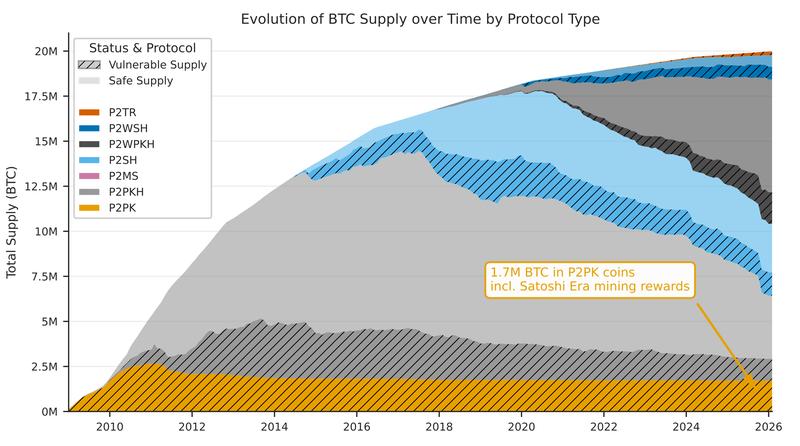
Scientists at California Institute of Technology collaborating with Oratomic arrived at comparable findings, recently determining that advancements in error correction techniques (which decrease the qubit count necessary to maintain computational stability) could bring down the threshold for operational systems to between 10,000 and 20,000 qubits, a significant reduction from previous projections of millions.
Drawing from these reduced requirements, the research team indicated that a functional quantum computer could materialize by approximately 2030.
Blockchain development teams are starting to take action. In January, developers within the Solana ecosystem unveiled a quantum-resistant vault that employs hash-based signatures to create fresh keys for every transaction, minimizing the visibility of public keys.
On March 24, developers from the Ethereum Foundation rolled out a "Post-Quantum Ethereum" resource hub that details strategies to enhance the network's cryptographic infrastructure, setting protocol-level modifications as a target for 2029 while simultaneously acknowledging the substantial multi-year challenges involved in executing such a transformation.