
Polish lawmakers unable to reverse president's rejection of cryptocurrency legislation
For the second time, Poland's legislative body has been unsuccessful in overruling President Karol Nawrocki's rejection of cryptocurrency regulation legislation, extending the ongoing political dispute regarding the nation's implementation of the EU's MiCA framework.
The Polish legislative assembly has been unsuccessful yet again in its attempt to reverse a presidential rejection that continues to block crucial cryptocurrency regulation legislation, further prolonging the ongoing political confrontation concerning the nation's approach to digital asset supervision.
During Friday's parliamentary session, legislators were unable to secure the necessary 263 votes needed to nullify the veto put forth by President Karol Nawrocki, as documented by TVP World, a local news source. The voting results showed 243 members of parliament casting ballots against the presidential veto, with 191 voting in favor of maintaining it, the report indicated.
The proposed legislation, which has received support from Prime Minister Donald Tusk, seeks to bring Poland into compliance with the European Union's Markets in Crypto-Assets Regulation (MiCA), which was introduced in 2024 to provide governance over the issuance and safekeeping of digital assets. At present, Poland stands as the sole EU member nation that has not yet adopted the regulatory framework established by the bloc.
President Nawrocki has stood by his veto decision, expressing apprehensions regarding overregulation, insufficient transparency, and the possible strain on smaller enterprises, as reported by TVP World.
On the other hand, administration representatives caution that postponing regulatory measures leaves market participants at risk. According to reports, Finance Minister Andrzej Domański stated that the lack of well-defined regulations threatens to transform the marketplace into an "El Dorado for fraudsters," emphasizing that both individual investors and commercial entities continue to face exposure to potential exploitation.
Poland's crypto bill faces repeated defeats
This unsuccessful effort to nullify the presidential veto represents the second failed endeavor by the governing coalition to advance the proposed legislation into law, following a comparable rebuff that occurred in December.
Nevertheless, following the initial defeat, Polish legislators resubmitted the regulatory proposal just days later in December of last year. Parliamentary members asserted that the newly submitted draft represented an "improved" iteration, despite criticism from opponents who maintained that it was essentially identical to the previously rejected version.
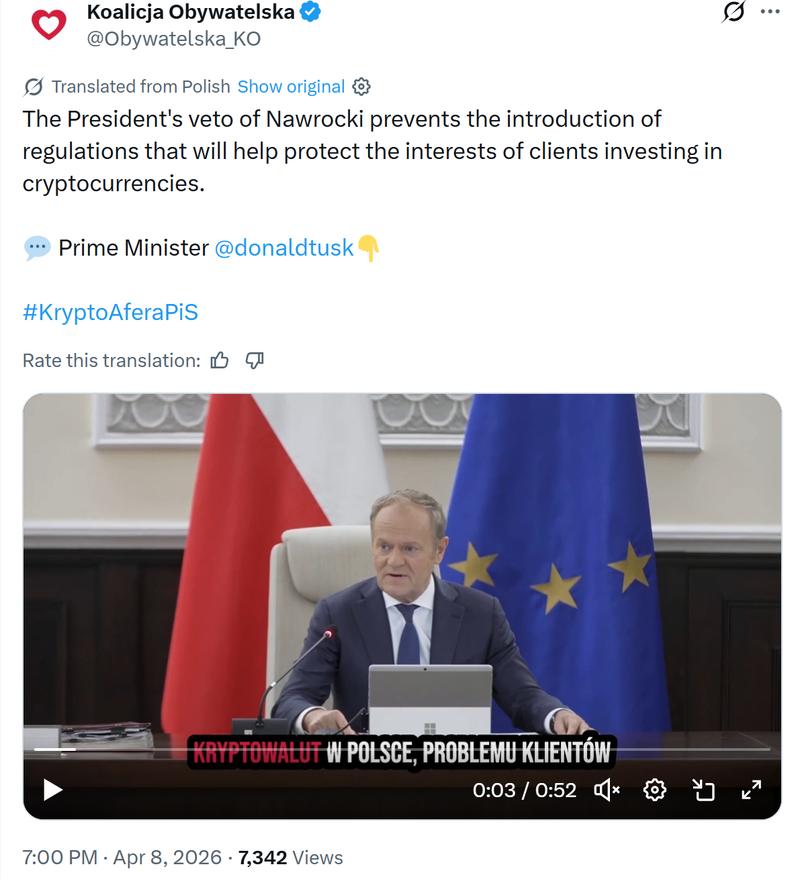
President Nawrocki exercised his veto power once more in February this year, blocking the resubmitted bill. "I will not sign a wrong law just because it was passed again by the parliamentary majority. A wrong law that passed a hundred times still remains a wrong law," he said at the time.
Zonda caught in Poland crypto political row
The ongoing disagreement has additionally implicated Zonda, Poland's premier cryptocurrency trading platform, which has allegedly engaged in lobbying activities opposing the proposed bill. The conflict intensified following accusations from Tusk directed at the exchange, alleging connections to illegal financing operations, referencing intelligence documentation that purportedly links the platform's establishment to Russian criminal organizations.
"Attempts to drag me and Zonda into the current political squabbles are as absurd as they are harmful to the Polish innovation market," Zonda CEO Przemysław Kral wrote on X, adding that he is "compelled to take appropriate legal steps to protect my personal rights."
In a statement made last week, he further indicated that he does not possess control over access credentials to a cryptocurrency wallet that allegedly contains $330 million, asserting that control of the wallet stayed with previous CEO Sylwester Suszek before his disappearance in 2022.