
New legislation targets political officials' participation in predictive betting platforms
This legislation contributes to an expanding series of federal and state initiatives aimed at regulating prediction markets amid increasing concerns about sports gambling, military conflict wagers and potential insider trading violations.

Congressional representatives in the United States have put forward legislation designed to prohibit congressional members, the nation's president and additional senior government officials from participating in wagers on prediction market platforms.
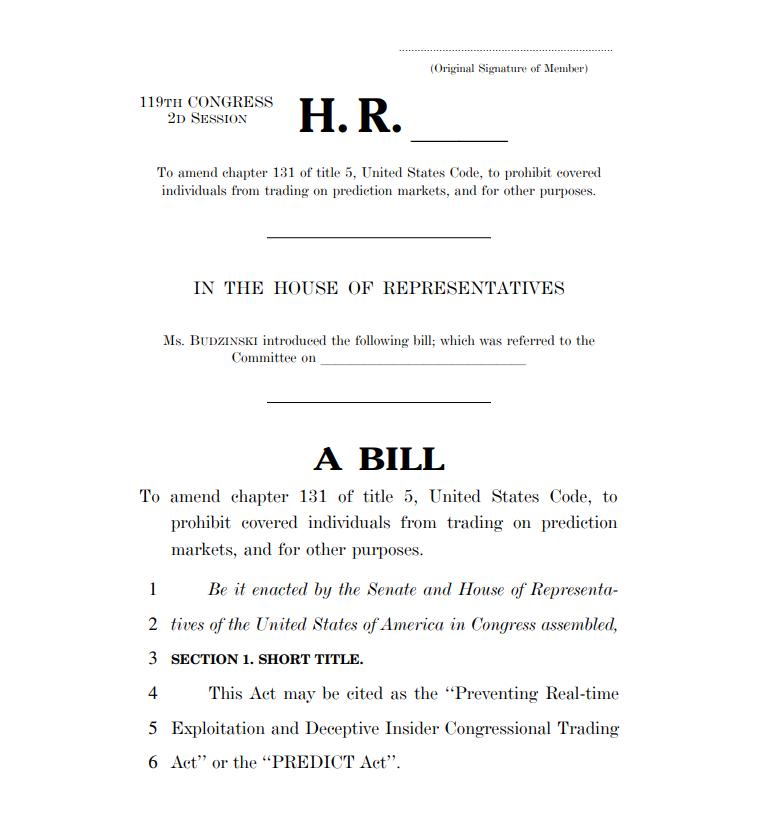
The legislative proposal, representing a bipartisan collaboration between US Representative Adrian Smith and Representative Nikki Budzinski, received its introduction on Tuesday under the name Preventing Real-time Exploitation and Deceptive Insider Congressional Trading Act (PREDICT Act).
"In recent months, we've seen instances of little-known traders making massive profits on events ranging from war with Iran to how long a government shutdown will last, raising necessary questions about the use of inside information," Budzinski said.
This legislative push arrives during a period of heightened examination of prediction markets across the United States, as both lawmakers and regulatory bodies direct their focus toward platforms like Kalshi and Polymarket concerning their offerings tied to athletic competitions, military conflicts and political outcomes.
The proposed legislation aims to prohibit congressional members, the president, vice president and individuals holding political appointments from placing bets on the "outcomes of political events, policy decisions, and other government actions on prediction markets." The prohibition would additionally apply to the spouses and dependent family members of these governmental figures.
According to the PREDICT Act, those who violate the proposed regulations would face penalties consisting of a 10% fine calculated on the contract's total value along with the requirement to surrender all earned profits to the US Treasury.
In remarks addressing the bill, Budzinski emphasized the critical need to eliminate gaps in regulation to prevent individuals possessing inside knowledge from being able "cannot profit from it."
Budzinski stands among multiple voices raising alarms about suspected corruption within prediction markets. In the earlier part of this month, a pair of Democratic lawmakers presented a different piece of legislation titled the Banning Event Trading on Sensitive Operations and Federal Functions (BETS OFF) Act.
During discussions about the bill, Senator Chris Murphy claimed that evidence suggested individuals probably utilized "inside information" to place wagers on US President Donald Trump's military operations concerning Iran.
US lawmakers turn up heat on prediction markets
Congressional representatives in the United States aren't limiting their concerns solely to insider trading activities on prediction markets. Contracts associated with sporting events have similarly attracted considerable attention from authorities at both federal and state governmental tiers.
Earlier during this week, Cointelegraph published reporting indicating that 11 states have initiated legal proceedings against prediction market operators, with an additional two states currently preparing pending legal measures.
On the federal governmental plane, Sens. John Curtis and Adam Schiff presented legislation on Monday with the objective of prohibiting any Commodity Futures Trading Commission (CFTC) registered entity from offering prediction market contracts that bear resemblance to "a sports bet or casino-style game."
The senators contended that numerous companies have been providing substantial volumes of contracts that "are indistinguishable from gambling" and additionally criticized the CFTC regarding its regulatory approach toward the industry.
"For fifteen years, the CFTC has enforced its authority to prohibit the listing of a contract that involves, relates to or references 'gaming.' However, the CFTC and its chair have abruptly reversed course -- intervening in ongoing litigation and proceeding with rulemaking to significantly relax the CFTC's enforcement of this clause," they said.
In response to this legislative action, both Kalshi and Polymarket, representing two of the most prominent prediction market platforms in the industry, implemented measures to strengthen their internal regulations aimed at preventing professional athletes and individuals running for political office from placing wagers on prediction market platforms.