
Nakamoto Bitcoin Treasury Implements Reverse Stock Split to Combat Declining Share Value
In an effort to prevent Nasdaq delisting and restore share value compliance, Bitcoin treasury firm Nakamoto is implementing a 1-for-40 reverse stock split this Friday, as the exchange mandates stocks maintain a minimum $1 price threshold.
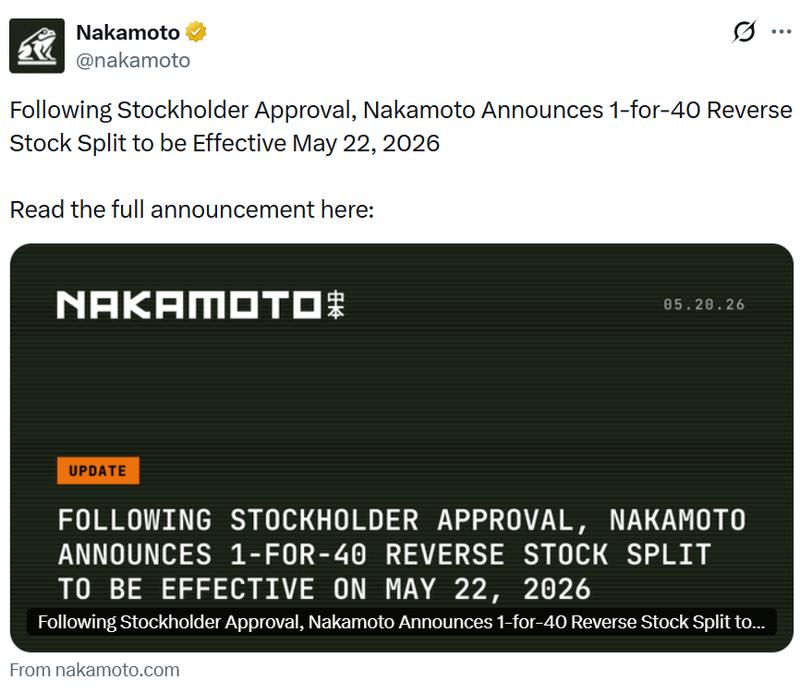
Nakamoto, a Bitcoin treasury firm, is proceeding with its shareholder-authorized 1-for-40 reverse stock split scheduled for Friday as part of its strategy to prevent removal from the Nasdaq Stock Exchange.
On Dec. 10, the company was issued a notification from Nasdaq, alerting the firm that its share price had dropped beneath the required $1 minimum threshold for 30 consecutive business days, as disclosed in a filing with the SEC. The company has been given until June 8 to rectify the situation and maintain its stock price above $1 for a minimum of 10 consecutive days.
Through a reverse stock split, the total number of outstanding shares is decreased. With a 1-for-40 split ratio, 40 existing shares are consolidated into a single share. Following the implementation, Nakamoto's outstanding common shares will decrease from 696.1 million down to 17.4 million, as the company announced on Wednesday.
"The reverse stock split is intended to increase the per-share trading price of the company's common stock to regain compliance with the $1 minimum bid price requirement for continued listing on the Nasdaq Global Market," it added.
The crypto treasury company sector has experienced a significant downturn throughout 2025, with numerous firms seeing their stock valuations fall beneath the actual value of the cryptocurrency assets held on their balance sheets, as Standard Chartered detailed in a report last September.
In March, Wojciech Kaszycki, chief strategy officer of BTCS, a crypto infrastructure and treasury firm, informed Cointelegraph that treasury companies will probably begin merging and consolidating operations during this year as a survival strategy.
Shares of Nakamoto, trading under the ticker NAKA, ended Wednesday's session at 16 cents, representing a 7.5% decline, based on Google Finance data. The stock has plummeted more than 99% since May of last year, a period when it was trading above $25 following the company's announcement of its Bitcoin treasury strategy and its merger with healthcare provider KindlyMD.
Nakamoto posts $238.8 million net loss in Q1
At a special shareholder meeting held on May 8, Nakamoto shareholders gave their approval for a reverse split within a ratio range spanning from 1-for-20 to 1-for-50. According to Nakamoto, the shares are set to undergo this transformation on Friday.
On May 14, the company disclosed its financial results for the first quarter, reporting a 500% quarter-over-quarter revenue increase while simultaneously posting a net loss of $238.8 million, with over $102 million of that loss stemming from a mark-to-market decline on its Bitcoin (BTC) treasury of 5,058 coins following a 23% drop in the cryptocurrency's price throughout the quarter.
The majority of Bitcoin treasury companies, with the exception of Strategy and Metaplanet, have decreased their Bitcoin acquisition activities over the past 12 months, while some have begun liquidating portions of their Bitcoin treasuries to settle outstanding debts. In February, the Genius Group sold off its complete treasury holdings consisting of 84 Bitcoin to assist with debt repayment.
Throughout the quarter, Nakamoto made no Bitcoin purchases but proceeded to sell 284 Bitcoin on March 31 for the purpose of covering operational expenses.
Based on data from BitcoinTreasuries.Net, Nakamoto's present holdings position it as the 20th largest Bitcoin treasury company, ranking immediately behind ProCap Financial, which maintains 5,457 Bitcoin. Michael Saylor's company Strategy holds the leading position among treasuries, boasting more than 843,000 Bitcoin on its balance sheet.