MoneyGram and Kraken Join Forces to Offer Cryptocurrency Cash Withdrawals Worldwide
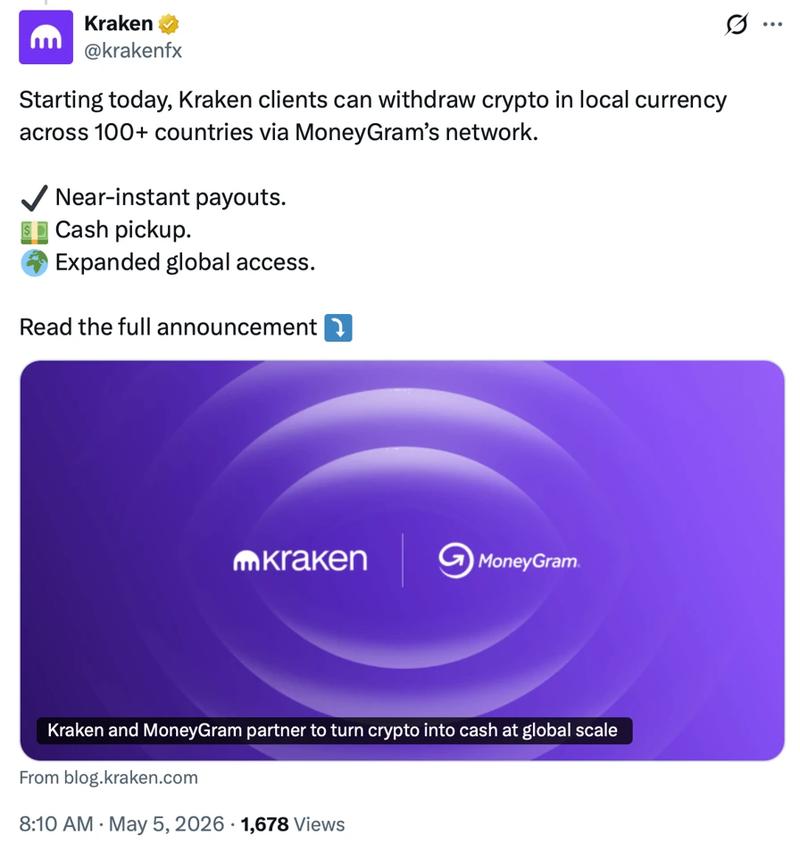
In a new collaboration, Kraken and MoneyGram are bringing crypto-to-cash withdrawal services to users in more than 100 nations, providing access to local currencies via MoneyGram's extensive global distribution network.

A new collaboration between cryptocurrency exchange Kraken and financial services giant MoneyGram will enable users to transform their digital currencies into physical cash that can be picked up in more than 100 nations worldwide, broadening the availability of off-ramp solutions via MoneyGram's extensive retail presence.
Based on an announcement made on Tuesday, individuals using Kraken's platform will gain the ability to transform their cryptocurrency holdings into their preferred local fiat currency and receive physical cash either immediately or within a short timeframe at MoneyGram's distribution network, which facilitates transactions in hundreds of different national currencies.
The new offering will be introduced gradually across multiple geographical areas such as the United States, European nations, Latin American countries, the African continent, and select Asia-Pacific territories, with future enhancements expected to incorporate direct bank account deposits and international money transfer capabilities.
According to Kraken, the cryptocurrency platform will manage the customer verification and regulatory compliance processes, whereas MoneyGram will supply the regionally authorized payment distribution framework through its worldwide money transfer infrastructure. The service debut will concentrate on physical currency withdrawals initially, though both organizations have outlined intentions to broaden the partnership to encompass additional payment channels and remittance-oriented transaction types as the program develops.
MoneyGram, recognized as among the world's premier remittance service providers, maintains operations at approximately 500,000 physical locations spanning more than 200 nations and territories around the globe, based on company figures.
Stablecoins gain traction in remittances and emerging markets
Digital stablecoins are assuming an increasingly significant position in international payment systems, with remittance providers incorporating new technological infrastructure and emerging economies demonstrating heightened adoption rates.
Just one day earlier on Monday, Western Union, a direct competitor to MoneyGram in the remittance space, introduced its own US dollar-backed stablecoin called USDPT, which operates on the Solana (SOL) blockchain network. The digital token is beginning its deployment in Bolivia and the Philippines first, with the company and its infrastructure collaborator Fireblocks announcing expansion plans covering more than 40 additional countries throughout 2026.
During March, Western Union revealed details about its forthcoming Digital Asset Network, which would enable customers to exchange digital dollar holdings for local fiat currencies at over 360,000 pickup locations around the world.
During her remarks at the World Economic Forum in January, economist Vera Songwe stated that remittance flows have evolved to become "more important than aid" throughout various regions of Africa, underscoring their expanding significance in supporting household finances and facilitating cross-border monetary transfers.
Across Latin America, stablecoin usage is similarly experiencing upward momentum. Research published in 2025 by cryptocurrency platform Bitso revealed that stablecoins represented 40% of all cryptocurrency acquisitions among its customer base, while Bitcoin (BTC) accounted for just 18%. The remittance market throughout the region is valued at approximately $174 billion, based on analysis from former Bybit executive Claudia Wang.
Notwithstanding the expanding acceptance, certain national governments are implementing more restrictive regulatory frameworks. Brazil's monetary authority recently prohibited the utilization of digital assets in specific cross-border payment operations, mandating that service providers employ conventional foreign exchange mechanisms as an alternative.
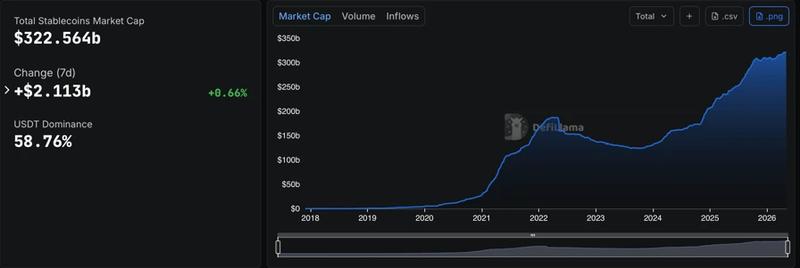
The total market capitalization of stablecoins presently sits at approximately $322 billion, representing an increase from around $243 billion measured one year prior, according to information from DeFiLlama data aggregation services.