
Michael Saylor and Adam Back voice strong opposition to Bitcoin's BIP-110 Ordinals proposal
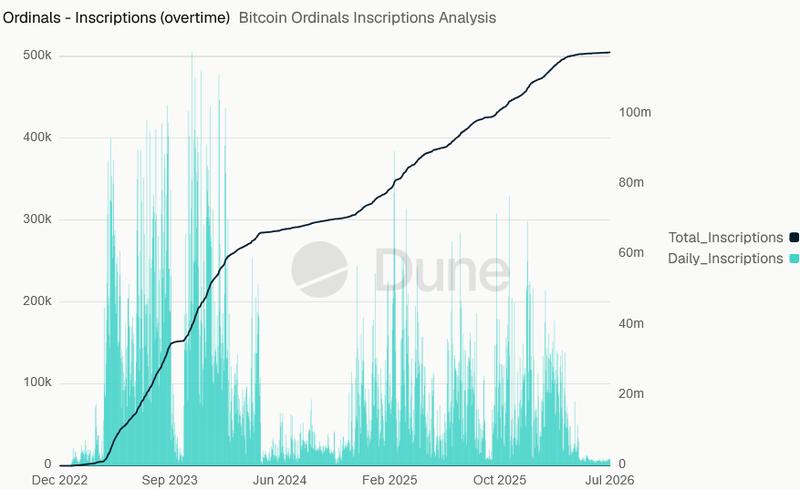
The controversy persists even as Ordinals-related blockchain activity has experienced significant decline throughout the past two years.

Michael Saylor, executive chairman at Strategy, along with Adam Back, CEO of Blockstream, have reinforced their stance against BIP-110, a proposal for a temporary fork designed to restrict non-monetary transaction types on Bitcoin's blockchain.
The Bitcoin Improvement Proposal-110 emerged in December 2025 with the aim of preventing Ordinals inscriptions—which function similarly to nonfungible tokens—and other forms of arbitrary data from congesting the network, thereby maintaining Bitcoin's primary function as a peer-to-peer electronic cash system.
Despite their criticism of Ordinals-related activity, both Saylor and Back express concern that implementing a fork might inflict greater damage than benefit to Bitcoin's network credibility. In a Saturday post on X, Saylor stated, "There are 110 things more dangerous to Bitcoin than spam," further noting that BIP-110 has the potential to invalidate legitimate transactions occurring on the network.
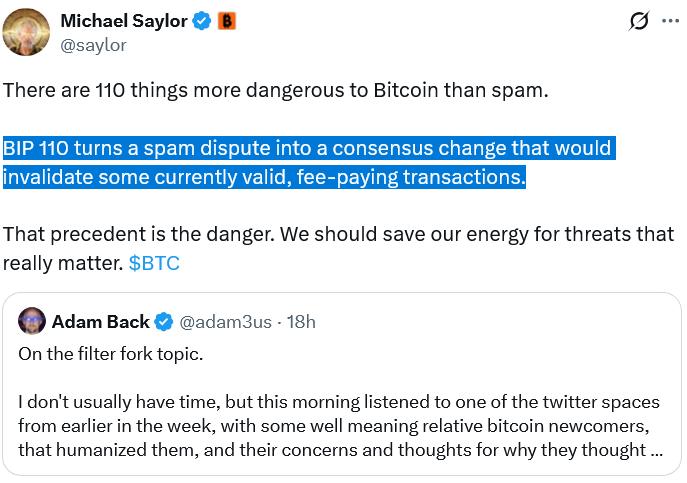
The BIP-110 proposal represents one of the most significant protocol-level controversies within Bitcoin's development community since the Blocksize Wars, which took place from 2015 through 2017, a period during which the ecosystem's participants engaged in heated debate over whether risking a potential chain split was justified to increase the block size limit for improved scalability.
The introduction of BIP-110 came from a pseudonymous Bitcoin developer known as "Dathon Ohm" and received backing from Luke Dashjr, the founder of Ocean protocol.
BIP-110 is a long shot from activating
Activation of BIP-110 requires that at least 55% of Bitcoin nodes responsible for validating blocks express support for the proposal throughout a Bitcoin block "period."
During the most recent period, identified as period number 475 spanning blocks 955,584 through 957,599, a mere 1% of blocks demonstrated support for BIP-110.
This controversy unfolds during a time when Ordinals-related activity has reached levels close to all-time lows, with daily Ordinals inscriptions on the Bitcoin blockchain numbering fewer than 10,000 throughout the past month, representing a dramatic decrease from the peak of over 400,000 daily inscriptions recorded in August 2023.
Back, meanwhile, provided a more comprehensive critique of BIP-110, characterizing the proposal as a "quest to police other people."
According to Back, Bitcoin's foundational principle of decentralization should ensure that "you can't impose your views on others," arguing that such attempts are fundamentally incompatible with the cypherpunk philosophy underlying Bitcoin—one that emphasizes permissionless access and censorship-resistant monetary systems.
Dashjr, along with other supporters advocating for BIP-110, have characterized the bloat generated by Ordinals as a "serious threat" to network integrity, arguing that an urgent solution is necessary.
Proponents have additionally contended that BIP-110 would not trigger a chain split, contrary to widespread concerns, while emphasizing that the BIP-110 fork establishes only a temporary one-year limitation and therefore would not result in the invalidation of fee-paying transactions on a long-term basis.