
Markets Decline as Iran Tensions Send Oil Prices Swinging, Cryptocurrency Under Pressure
Asian equities and Bitcoin suffered losses on Monday following Iran's escalating warnings of potential strikes against Gulf infrastructure.

Markets across cryptocurrency and traditional finance experienced sharp declines on Monday as tensions between the United States and Iran intensified for the fourth consecutive week, creating volatility in oil pricing.
In a Truth Social post on Sunday, US President Donald Trump declared the US would "hit and obliterate" Iran's power plants, "starting with the biggest one first," unless the nation reopened the Strait within a 48-hour timeframe.
The Iranian government countered by stating it would retaliate against any American strikes targeting its power or water facilities with offensive operations against American and Israeli installations throughout the Gulf region, while also threatening to fully shut down the Strait of Hormuz, a critical artery for global oil transportation.
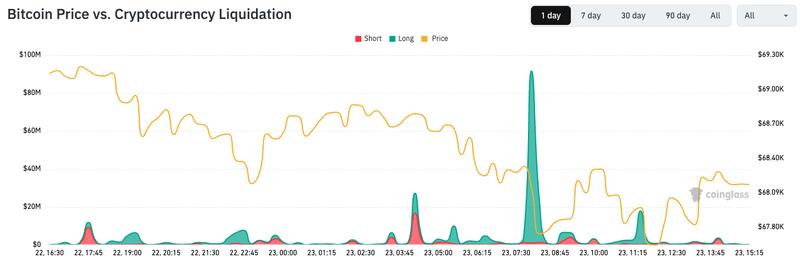
Bitcoin (BTC), traditionally viewed by supporters as a "safe-haven" investment comparable to gold, declined 1.8% over the past 24 hours to reach $68,160, bouncing back from Sunday's late-session trough below $67,600.
The decline in Bitcoin's valuation triggered a wave of liquidations throughout the cryptocurrency market, eliminating $336.3 million in value over the past day, with approximately one-third of that volume, roughly $100 million, stemming from unsuccessful Bitcoin long positions, based on data from CoinGlass.
In a conversation with Cointelegraph, Rachael Lucas, an analyst at crypto exchange BTC Markets, explained that cryptocurrency "is trading in lockstep with equities right now, not as a haven, and sentiment is sitting at historic lows, with the Fear and Greed Index deep in 'extreme fear' territory at 8."
Oil chops, Asia markets fall
Equity markets throughout Asia similarly responded to the escalating exchange of threats, with both Australian and New Zealand indices declining 0.8%, while Japanese markets experienced losses exceeding 4%.
Crude oil pricing experienced a brief surge to just above $100 per barrel during early Monday trading before rapidly declining to $97.20. Since that point, it has gradually increased to $99.30 as of publication time.
At the same time, Brent crude oil, recognized as a global benchmark for oil transactions, surged past $114 per barrel before stabilizing under $113.
According to Lucas, cryptocurrency market performance depends heavily on whether tensions with Iran decrease and what actions the US Federal Reserve takes.
She noted that the rise in Brent's price "is feeding inflation expectations, and the probability of a Fed rate hike has jumped from zero to 12.4% in a single week."
That is a significant macro repricing that crypto will continue to reflect until there is clarity on both fronts.
Lucas suggested that should tensions with Iran subside, "crypto would be among the fastest risk assets to recover. However, this conflict has no clear negotiating counterpart and no defined exit timeline, which makes that outcome difficult to call in the near term."
She noted that $68,000 represents the "immediate level" for monitoring Bitcoin support levels, with $65,800 serving as "the next meaningful support if that gives way."
To the upside, Bitcoin needs to reclaim $71,500 before any recovery narrative gains credibility.
She emphasized that Bitcoin continues to enjoy robust institutional backing, evidenced by $1.43 billion in net inflows to Bitcoin exchange-traded funds so far this month.
When sentiment is this low and institutional infrastructure is this strong, history suggests the setup for recovery is building, even if the timing remains uncertain.