
Major Bitcoin holders liquidate assets amid Iran conflict driving oil prices higher
Long-dormant Bitcoin wallets and veteran cryptocurrency investors are liquidating their holdings as military confrontations between the US-Israel alliance and Iran target critical energy facilities, triggering dramatic increases in petroleum and natural gas valuations.

Long-dormant Bitcoin wallet owners transferred tens of millions of dollars worth of cryptocurrency to trading platforms as Bitcoin valuations declined and energy commodity prices surged following military strikes targeting oil and natural gas facilities in the Gulf region, intensifying the ongoing confrontation between Iran, Israel and the United States.
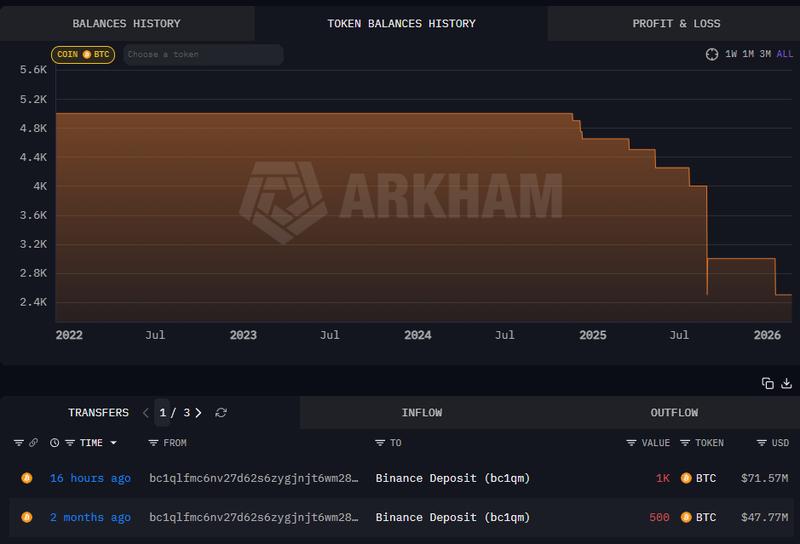
A long-dormant whale identified as "bc1ql" transferred 1,000 Bitcoin (BTC), valued at approximately $71 million based on prevailing market rates, to the Binance exchange on Wednesday, blockchain data platform Arkham confirmed. This particular whale originally acquired 5,000 BTC thirteen years ago and continues to maintain roughly 1,500 BTC valued at approximately $106 million, blockchain analytics platform Onchain Lens reported.
That same Wednesday, Owen Gunden, recognized as one of Bitcoin's earliest adopters, also moved 650 BTC ($46 million) to the Kraken crypto exchange platform, representing his first substantial liquidation in five months, when he previously sold a combined total of 11,000 BTC ($1.12 billion), analytics platform Lookonchain documented.
These transfers contributed to mounting evidence of profit realization among certain long-term cryptocurrency holders as market participants responded to a wider risk-aversion movement triggered by the Middle Eastern energy crisis.
The large-scale wallet movements came after reports emerged of Israel launching strikes against Iran's massive South Pars gasfield on Wednesday, following the killing of Iran's intelligence minister, Esmail Khatib, who became the third high-ranking Iranian official to be assassinated within recent days, the BBC reported. South Pars represents a portion of the planet's most extensive natural gas reserve, with both Qatar and Iran maintaining operational facilities within this region.
Following these military strikes, Brent crude prices climbed above $119 per barrel before moderating to approximately $114.77, while WTI temporarily reached $100 and subsequently traded around $96.59, Trading Economics data indicated.
European and UK wholesale natural gas valuations also experienced sharp increases after Iran launched attacks against Qatar's Ras Laffan natural gas facility on Wednesday and Thursday, news outlet Bloomberg documented.
Bitcoin sell-off began after attack on Qatar gas complex
Bitcoin's most recent wave of selling commenced shortly following Iran's military strike targeting Qatar's energy infrastructure, Aurelie Barthere, principal research analyst at crypto intelligence platform Nansen, confirmed.
"BTC began to sell off yesterday around noon CET, following the escalation of the war between Iran and Israel and the attack on gas infrastructure in Qatar," she told Cointelegraph, adding:
"If we fail to hold the $70K–$71K level, we could return to the previous range of approximately $60K–$71K."
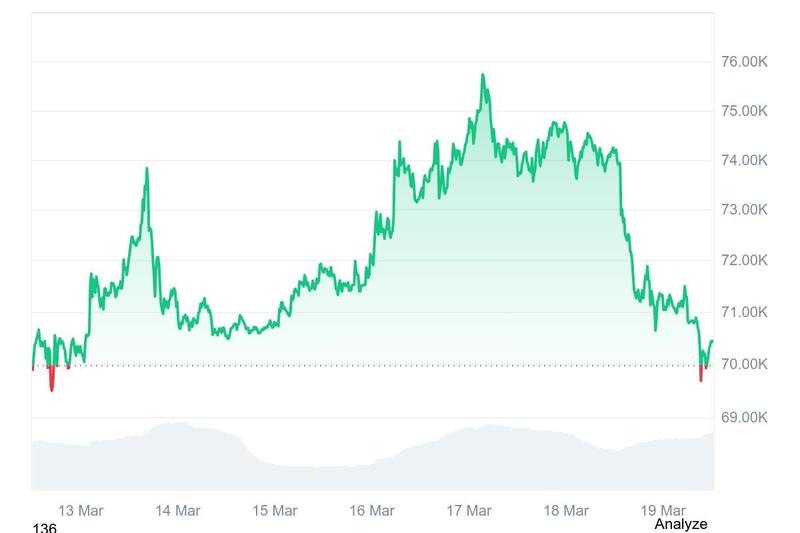
Bitcoin's valuation declined 5% throughout the preceding 24 hours and was exchanging at $70,439 as of 10:15 a.m. in UTC, CoinMarketCap data demonstrated.
Bitcoin's downward movement paralleled a 4.2% decrease in gold valuations during the past 24 hours, with the premier precious metal exchanging at $4,686 per oz on Thursday, goldprice data showed.
The concurrent decline of both assets indicates that market participants are executing a "broader risk-off move" instead of shifting toward safe-haven assets, Alvin Kan, chief operating officer at Bitget Wallet, told Cointelegraph.