
Latvia grants Paybis dual MiCA and payment licenses, enabling broader EU crypto operations
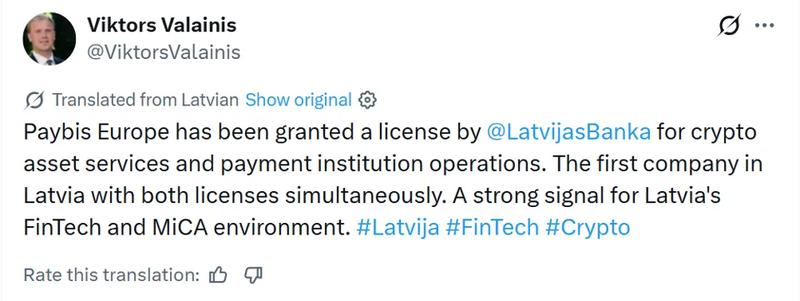
Latvia's central bank has approved Paybis for both a MiCA crypto-asset service provider licence and a PSD2 payment institution licence, marking the first time a single company in Latvia has obtained both regulatory approvals concurrently.


Digital currency exchange platform Paybis has obtained dual regulatory approvals from the central bank of Latvia, securing both a crypto-asset services licence under the European Union's Markets in Crypto-Assets Regulation (MiCA) framework and a payment institution authorization under the Payment Services Directive 2 (PSD2) regulations.
Both regulatory approvals were granted by Latvijas Banka's Supervision Committee on May 12 to SIA Paybis Europe, which serves as the company's European Union operating entity, based on a statement released by the central banking authority. According to the central bank, Paybis has become the third entity in Latvia to be awarded a MiCA CASP licence.
Under the MiCA authorization, Paybis is permitted to provide custody and administration services for crypto assets on clients' behalf, facilitate exchanges of crypto-assets for fiat currency or alternative crypto assets, handle order execution, provide transfer services and offer advisory services related to crypto assets, Latvijas Banka confirmed. The banking institution further noted that the PSD2 payment institution authorization grants Paybis's European Union entity the capability to process payment transactions and conduct transfers to designated payment accounts.
Innokenty Isers, CEO and co-founder of Paybis, commented that the combined licensing framework provides the company with the ability "to make a broad, future-focused offering, including working with stablecoins."
Paybis eyes B2B crypto infrastructure push
Konstantins Vasilenko, who serves as co-founder and chief business development officer at Paybis, shared with Cointelegraph that the company is focusing on business-to-business clientele with a white-label cryptocurrency infrastructure solution, which encompasses fiat on-ramps and off-ramps, buy/sell/swap functionalities, payment acceptance capabilities and stablecoin payout mechanisms. The full suite of services would be made available through a unified API, enabling business partners to provide cryptocurrency services to their end users without having to establish their own compliance and regulatory infrastructure.
"This is where the combination of MiCA CASP authorisation and PSD2 PI licensing is particularly important, because it allows us to connect crypto asset services with regulated payment rails," he added.
Established in 2014, Paybis currently provides access to 90 cryptocurrencies and maintains a user base of seven million customers spanning 180 countries worldwide. The platform additionally maintains money services business licences in both the US and Canada.
EU weighs "MiCA 2" amid rising scrutiny
During April, an adviser to the European Commission indicated that the EU's MiCA cryptocurrency regulation framework is expected to undergo evolution as time progresses, with the Commission organizing a public consultation process to evaluate whether the regulatory requirements are functioning effectively for industry participants. During his appearance at Paris Blockchain Week 2026, Peter Kerstens stated it would be "rather unusual" if there were no "MiCA 2" at some point, highlighting that EU financial legislation typically develops in stages.
The comments came amid growing scrutiny and opposition from the crypto industry. Stablecoin issuer Circle has pushed back on euro stablecoin thresholds, while policymakers debate whether supervision of major crypto firms should be centralized under the European Securities and Markets Authority.