
KuCoin EU Names Anti-Money Laundering Head Following Austrian Regulatory Restrictions Under MiCA
Following Austria's FMA prohibition on client onboarding due to insufficient compliance personnel, KuCoin EU has named a new Anti-Money Laundering chief and deputy officers at its Vienna operations.
In a strategic compliance overhaul, KuCoin EU has brought on board a fresh Anti-Money Laundering (AML) head while bolstering its Vienna-based compliance operations, coming just weeks following Austrian regulatory authorities' decision to block the platform from acquiring new customers under the European Union's Markets in Crypto-Assets Regulation (MiCA) framework.
Carmen Kleinhans has been designated as the Anti-Money Laundering officer for the MiCA-licensed platform, with two deputy AML officers joining the team who previously held positions as Austrian regulatory officials and banking sector compliance executives. A Wednesday announcement indicated that this newly formed team will be responsible for managing AML operations, Counter-Terrorist Financing (CTF) protocols and sanctions oversight, in addition to company-wide risk administration and interactions with regulatory bodies.
These appointments come in response to a decision made in February by the Financial Market Authority (FMA) of Austria, which imposed restrictions preventing KuCoin EU from accepting new customers or entering into fresh contractual agreements. The regulator determined that critical positions related to AML/CTF and sanctions compliance were insufficiently filled, representing a violation of the organization's internal structural requirements.
These new appointments represent the exchange's attempt to close these identified deficiencies and bring its operations more in line with compliance standards typically expected within conventional financial services, particularly as regulatory bodies place growing emphasis on organizational governance and internal controls beyond merely technical regulatory violations.
Wider regulatory pressure on KuCoin
This enhanced staffing initiative arrives amid an expanding landscape of heightened AML and sanctions oversight within the cryptocurrency sector, where regulatory authorities demonstrate increasing readiness to impose business freezes or partial operational suspensions stemming from governance deficiencies and inadequate staffing levels, rather than limiting enforcement actions to technical violations of securities regulations or licensing frameworks.
According to a Tuesday analysis published by blockchain security auditing firm CertiK, both KuCoin and OKX ranked among the cryptocurrency exchanges that received some of the most substantial AML-related financial penalties during 2025, demonstrating how enforcement priorities have evolved toward addressing financial crime prevention and control mechanisms rather than concentrating exclusively on securities law violations.
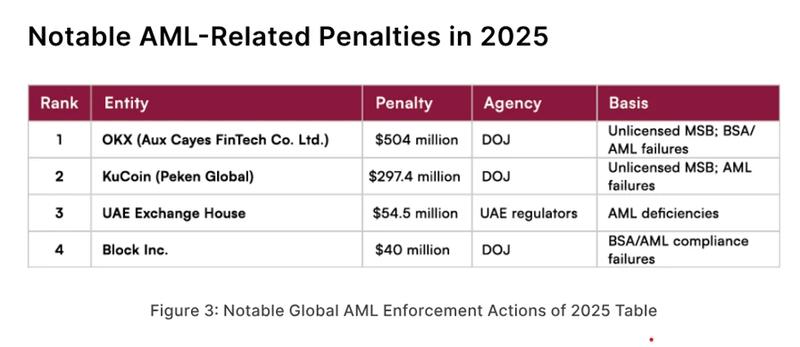
On a corporate-wide scale, KuCoin has encountered regulatory enforcement actions across multiple jurisdictions. During January 2025, the company reached an agreement to remit approximately $300 million in penalties and withdraw from United States markets for a two-year period as part of a criminal settlement addressing unlicensed money-transmission activities and AML compliance failures, as documented by the Wall Street Journal during that timeframe.
On March 30, KuCoin's parent entity agreed to remit a $500,000 civil fine to resolve allegations brought by the US Commodity Futures Trading Commission, which claimed the company operated an unregistered offshore commodities trading platform. Earlier during that identical month, the Virtual Assets Regulatory Authority in Dubai issued a formal warning to KuCoin regarding accusations that it provided virtual asset services within the emirate's jurisdiction without obtaining the necessary local authorization.
Whether these newly appointed compliance personnel will prove sufficient to reinstate standard business operations under KuCoin EU's Austrian regulatory authorization remains contingent upon the FMA's evaluation of whether the mandatory control mechanisms have been comprehensively and appropriately reestablished.
Cointelegraph reached out to KuCoin EU for comment, but had not received a response by publication.