
Japan's Cryptocurrency Legislation Progresses, Paving Way for ETFs and Tax Overhaul: Report
Legislative chambers in Japan have reportedly approved new cryptocurrency regulations that would integrate digital assets into the nation's financial instruments regulatory system, creating possibilities for ETF launches and reduced taxation.

According to reports, Japan's Lower House has approved legislation that would incorporate cryptocurrency assets within the nation's existing financial instruments regulatory framework, creating potential pathways for the introduction of exchange-traded funds (ETFs) and more favorable tax structures for digital currencies.
The legislative measure would align the regulatory oversight of crypto assets more closely with the treatment currently applied to traditional securities such as equities and debt instruments by imposing more rigorous trading regulations, according to a Thursday report from Bloomberg. Following approval by the Upper House, the law is anticipated to come into force during the next calendar year.
Under the proposed regulatory framework, capital gains taxation on cryptocurrency holdings such as Bitcoin (BTC) and Ether (ETH) could be reduced from the existing ceiling of 55% down to a uniform 20% rate, matching the tax treatment applied to stocks and bonds. Implementation of the revised tax structure is projected for 2028.
Documentation from official sources indicated that the legislative proposal had successfully passed through the Committee on Financial Affairs on June 10, though the bill-tracking system had not reflected the plenary vote information as of the time this article was written.
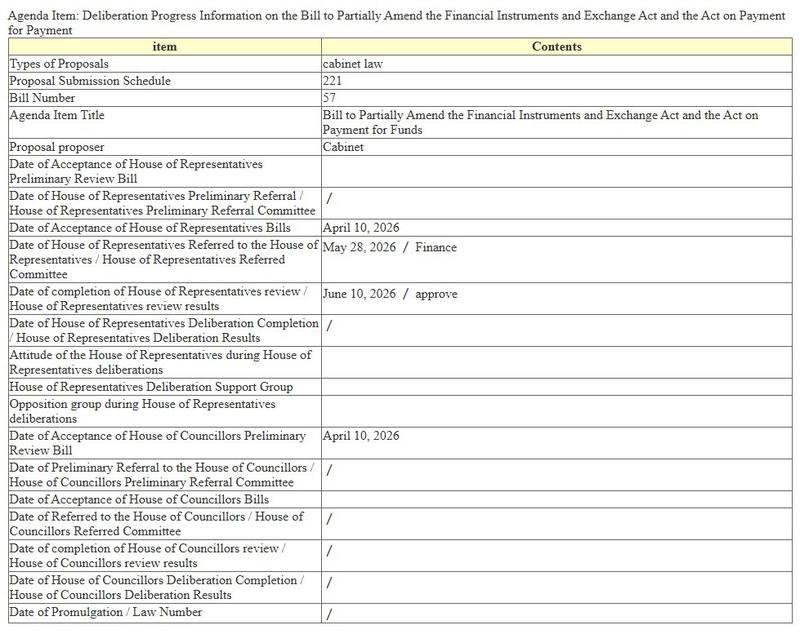
Japan shifts crypto into a financial-market framework
This most recent legislative progress comes after several months of indications that Japanese authorities were working toward transitioning cryptocurrency regulation from a payments-oriented system into a comprehensive financial-market regulatory structure.
Back in November 2025, news organization Asahi Shimbun published a report stating that the Financial Services Agency (FSA) had made the determination to bring crypto assets under the purview of the Financial Instruments and Exchange Act, encompassing Bitcoin (BTC), Ether (ETH) and additional digital tokens traded through domestic cryptocurrency platforms.
Documentation from the FSA with an April 2026 date indicated that the legislative proposal would transfer regulatory authority over crypto-asset trading operations from the Payment Services Act to the Financial Instruments and Exchange Act.
According to the FSA's statements, the legislation would classify crypto assets as distinct financial products that are separate from traditional securities, while simultaneously establishing disclosure requirements, enhanced regulatory supervision of trading platforms, prohibitions on insider trading activities, and more severe sanctions for entities operating without proper registration.
Under the proposed regulatory structure, businesses engaged in crypto-asset transaction operations would be mandated to publish detailed information regarding the digital assets they facilitate, while entities issuing specific categories of assets would be subject to disclosure obligations during primary offerings or when conducting secondary distributions to the market.
The regulatory transformation could additionally create opportunities for the launch of cryptocurrency-linked ETFs within Japan's financial markets, providing domestic investors with a regulated investment vehicle for gaining exposure to digital assets beyond direct purchases through crypto trading platforms and publicly traded corporations that maintain token holdings on their balance sheets, according to Bloomberg's reporting.