
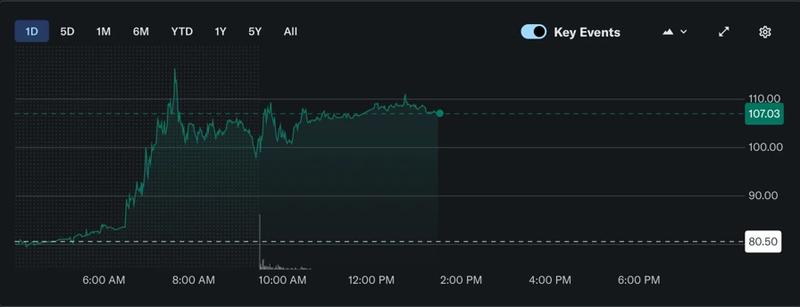
Hut 8 stock soars 33% despite Q1 losses as investors focus on AI partnership
The firm simultaneously revealed a significant AI energy leasing agreement while advancing its strategic expansion into neighboring high-performance computing sectors.

Shareholders of the Bitcoin mining firm Hut 8 seemed unfazed by the company's disclosed net loss exceeding $253 million for the first quarter of 2026 on Wednesday, propelling the stock upward by more than 33%.
The company pointed to a decrease in the fair market value of its Bitcoin (BTC) reserves as the primary driver of the loss, with prices declining from a peak exceeding $126,000 per coin in October to as low as $60,000 in February.
First quarter revenue reached more than $71 million, representing approximately a 22% decline from the prior quarter's $88.4 million, based on Hut 8's quarterly financial reports. Market analysts had projected revenue of $78.5 million, per FactSet data.
Hut 8 also disclosed a $9.8 billion agreement under which the company will provide 352 megawatts of power to an unnamed third-party artificial intelligence firm throughout a 15-year timeframe. The Wednesday financial release indicated the company produced $66.0 million in revenue during the first quarter from ASIC compute, AI cloud and traditional cloud solutions.
Hut 8's strategic expansion into artificial intelligence and energy infrastructure reflects a broader industry trend as publicly traded crypto mining companies pivot away from digital asset mining while grappling with elevated operational costs and shrinking revenue streams.
AI and Bitcoin mining increasingly compete for power
Bitcoin mining faces an existential threat from the emergence of AI infrastructure, according to market analyst and crypto trader Ran Neuner.
"Both industries compete for the same thing: electricity," Neuner said, adding, "right now, AI is willing to pay much more for it."
Bitcoin mining operations can generate revenue ranging from $57 to $129 per MW for blockchain security, while AI infrastructure operations command between $200 and $500 per MW, according to his analysis.
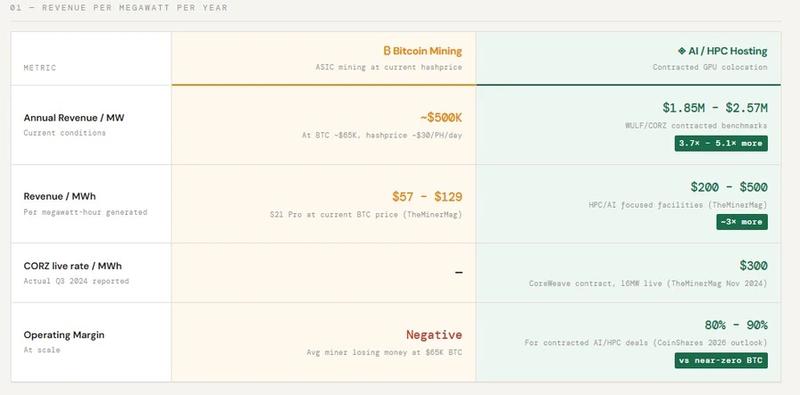
The migration of mining companies toward more lucrative AI business opportunities results in a reduction of total computing power committed to maintaining the Bitcoin blockchain's security, potentially increasing the network's vulnerability to attacks, according to Neuner.
High-performance computing applications, encompassing both Bitcoin mining operations and AI workloads, require enormous quantities of energy, fueling increased demand for nuclear power generation.
Beginning in 2024, multiple AI hyperscaling corporations including Google, Microsoft, Amazon and Meta have unveiled nuclear energy partnerships designed to supply power to their artificial intelligence infrastructure operations.