
How Using Google Search Could Compromise Your Crypto Wallet
Cryptocurrency holders face new threats from Google search results, including fraudulent advertisements and phishing schemes. Discover why search platforms have become a critical component of wallet protection.

The attack path now includes search results
Among the most overlooked vulnerabilities in cryptocurrency security today are search engine results.
Traditional approaches to crypto security emphasize safeguarding seed phrases, employing hardware wallets, activating multi-factor authentication and exercising caution with questionable links received via email or direct messaging. What frequently gets overlooked is how search engines serve as a potential entry point for malicious actors.
Over the years, search platforms like Google have been regarded as impartial portals to online content. People have grown accustomed to typing in their banking institution, preferred dining establishment or a decentralized finance (DeFi) protocol, expecting trustworthy results. Fraudsters are now exploiting this habitual behavior in the cryptocurrency space.
Contemporary cases featuring fraudulent advertisements that mimic prominent cryptocurrency platforms demonstrate that search engines have evolved beyond simple information retrieval tools. Criminals have transformed them into components of the attack infrastructure aimed at cryptocurrency holders.
The compromise of a wallet does not necessarily commence when someone connects to a fraudulent website. It might actually begin several minutes beforehand, through an ordinary search query followed by a single misguided click.
The transformation of search engines into crypto security threats
Conventional cyberattacks typically concentrated on technical vulnerabilities, including software bugs, server breaches and malicious software. Contemporary crypto scams operate on different principles.
Rather than exploiting systems, criminals exploit human behavior.
Both of these assumptions carry risks.
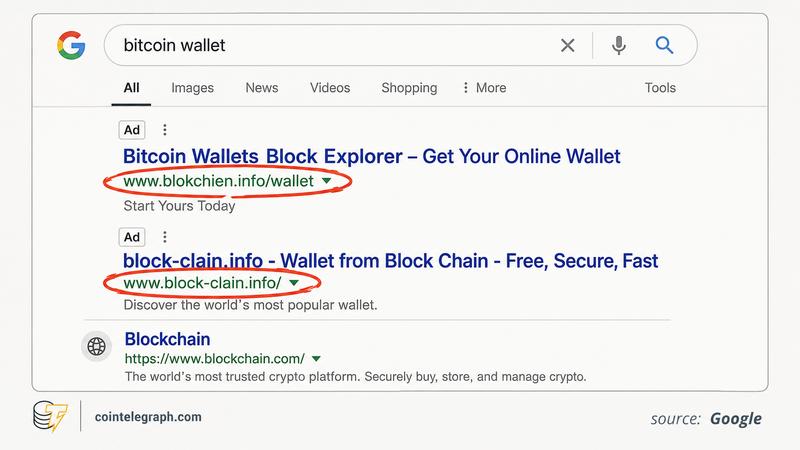
Search platforms are engineered to catalog information and monetize through advertising. Sophisticated criminals comprehend both mechanisms thoroughly. They purchase advertising positions, game visibility algorithms, duplicate recognized brand identities and target users during moments of vulnerability.
Within the crypto ecosystem, this presents substantial danger. Individual transactions can transfer significant amounts instantaneously and typically lack reversal mechanisms. This means a single erroneous click can result in devastating financial consequences.
Did you know? The name Google was not the original designation. The creators initially developed it as an academic project titled "BackRub," so named because of its capability to evaluate backlinks. Presently, this identical search infrastructure impacts trillions of dollars in digital activity, encompassing cryptocurrency transactions.
The fraudulent Uniswap advertising scheme
A contemporary incident demonstrates the potency of this approach. Based on recent accounts, criminals successfully extracted no less than $400,000 from a trader using fraudulent Google advertisements that mimicked the decentralized exchange Uniswap.
Upon clicking the advertisement, users found themselves directed to a replicated interface that closely resembled the authentic Uniswap platform. Beyond that point, everything appeared legitimate. Users established wallet connections, initiated what appeared to be routine transactions and authorized the necessary approvals.
The actual implications only became apparent afterward. The victims had unwittingly authorized permissions enabling the criminals to extract funds directly from their wallets.
What distinguishes this attack is the absence of technical penetration. The criminals did not require seed phrases, malicious software or compromised encryption. The targets personally signed off on the transactions that facilitated the theft.
The vulnerability of even seasoned users
There is a common assumption that only cryptocurrency novices succumb to these schemes. The reality shows that even seasoned users can be deceived when circumstances align.
One contributing factor is authority bias. Individuals instinctively trust established organizations and systems. Google, specifically, enjoys widespread perception as a dependable information discovery tool. Users frequently presume that prominent search results undergo thorough verification prior to display.
Habitual behavior compounds the issue.
For multiple decades, the search bar has served as the primary method for internet navigation. Numerous users no longer commit URLs to memory. They simply search for whichever platform they wish to access.
Convenience further promotes haste.
Active DeFi participants frequently transition rapidly among exchanges, staking platforms, governance portals and bridge interfaces. The more pressing the action appears, the less inclined users become to scrutinize every element before them.
Criminals understand this dynamic. They invest resources and effort constructing persuasive replicas of established platforms. A fraudulent interface that closely resembles a familiar platform can compromise even a veteran user's defenses, particularly when that individual is preoccupied or rushed.
Additionally, optimism bias plays a role. Individuals may acknowledge that threats exist yet continue believing they remain unlikely targets. Cryptocurrency's historical record provides minimal justification for such optimism.
Hardware wallet limitations
Hardware wallets frequently receive designation as the premier standard in cryptocurrency security. In numerous respects, this characterization proves accurate. Through maintaining private keys in offline storage, they deliver robust defense against various malware types and unauthorized access efforts.
Nevertheless, they possess one significant limitation.
A hardware wallet lacks the capability to determine reliably whether a transaction serves the user's interests. When a user authorizes a malicious request via a phishing interface, the device typically executes the instruction precisely as submitted.
The hardware wallet secures the keys. It cannot consistently safeguard the decision-making of the individual employing them.
This distinction has grown increasingly significant. The primary threat does not always involve an attacker forcibly extracting credentials. Occasionally, the attacker merely convinces the target to employ those credentials on a fraudulent platform.
Did you know? Phishing attacks existed long before Bitcoin emerged. During the mid-1990s, criminals targeted AOL subscribers by impersonating company employees and requesting passwords. The methodologies have evolved, but the fundamental concept persists: leveraging trust instead of exploiting technology.
The appeal of search advertising for criminals
Search advertisements provide criminals with a combination of benefits that few alternative channels can replicate. For cryptocurrency scammers, this makes them particularly appealing.
Initially, they provide exposure to substantial audiences. Millions of individuals conduct daily searches for terminology associated with crypto wallets, exchanges and DeFi protocols.
These users additionally demonstrate clear intention. An individual searching for "Uniswap," "MetaMask download" or "Ledger Live download" is already attempting to execute an action. The criminal does not need to generate interest. The prospective victim already stands prepared to engage.
The entry barrier also remains comparatively minimal. Phishing emails might be intercepted by spam filters or disregarded by recipients. Search advertisements, conversely, reach users at precisely the moment they seek a destination.
Fraudulent campaigns can likewise be reconstructed rapidly. When fake advertisements get removed, criminals frequently reemerge with fresh accounts, recently registered domains or marginally modified versions of identical schemes.
For criminals, the financial incentives can prove difficult to resist.
Did you know? Search results can differ between individuals. Geographic location, browsing history and device category can all influence what users observe. A fraudulent ad encountered by one crypto user may not display for another user conducting the identical search.
An issue extending beyond Google
Search-based deception forms part of a considerably broader challenge confronting online platforms. It extends beyond search engines alone.
Reddit users have consistently reported encountering fraudulent cryptocurrency advertisements alongside authentic community conversations. YouTube has contended with impersonation schemes featuring fake livestreams promising giveaways.
Social media platforms persistently address scam accounts replicating official project profiles within reply threads. Telegram channels likewise frequently experience targeting by individuals posing as support representatives.

Throughout all these instances, the pattern remains consistent. The identical systems constructed to disseminate legitimate content can equally be weaponized to propagate fraud. Advertising infrastructures are engineered to optimize for engagement and relevance. Scammers attempt to manipulate these systems by eroding user confidence.
SEO poisoning and the evolution of threats
Search engine optimization (SEO) poisoning involves the intentional manipulation of organic search rankings so harmful pages display near the top without paid promotion. Criminals may publish fraudulent educational content engineered to rank for popular search terminology. They may additionally acquire expired domains already possessing search authority.
Others employ typosquatting, which involves registering domains with minor spelling variations that prove easy to overlook during quick glances. More sophisticated scams utilize lookalike characters from alternative alphabets to make fraudulent URLs appear authentic.
For typical users, the distinction can prove virtually impossible to detect. Consequently, even individuals who avoid paid advertisements may still arrive at phishing pages through ordinary search results.
Crypto security as a challenge of user experience
Cryptocurrency security guidance has historically concentrated on protecting sensitive data: securing seed phrases, utilizing robust passwords, enabling two-factor authentication and storing backups securely. These recommendations retain their importance.
Nevertheless, they no longer suffice independently.
Numerous losses presently do not occur through compromised credentials. They transpire through misleading experiences engineered to appear virtually indistinguishable from authentic ones. In these scenarios, the vulnerabilities often involve straightforward user actions: searching, clicking, approving and trusting familiar-appearing interfaces.
Consequently, cryptocurrency security is evolving into a user experience challenge equally as much as a technical one. Genuine protection demands minimizing confusion and deception throughout every stage of the user journey, not merely strengthening the final transaction screen.
Actionable steps to minimize exposure
Straightforward precautions can substantially diminish a user's vulnerability to search-based attacks. They additionally make impulsive decisions less probable.
Users should examine URLs meticulously before establishing a wallet connection, paying particular attention to spelling mistakes and atypical characters. Links should originate from authenticated project accounts and official documentation whenever feasible.
Transaction requests should undergo careful review rather than rapid approval. When available, users should additionally employ wallet tools capable of simulating transactions and identifying unusual permissions. Token approvals no longer required should be revoked periodically.
Most importantly, it proves worthwhile to decelerate. Scammers intentionally capitalize on urgency. A few additional seconds invested in verifying details can represent the difference between a routine interaction and an irreversible loss.