
How the Democratic Midterm Victory Could Reshape Crypto's CLARITY Act
As Democrats prepare to take control of Congress, the CLARITY Act enters uncharted territory, sparking debate about investor safeguards, ethical standards, and the compromises the cryptocurrency sector might need to make.
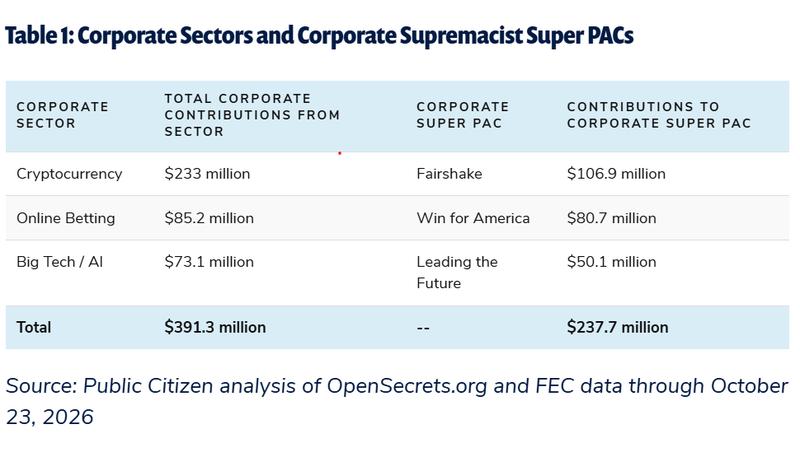
According to Public Citizen's review of federal campaign finance records, cryptocurrency firms poured $233 million into political committees throughout the 2026 US midterm election cycle.
The Democratic Party secured control of both the House and Senate in the midterms and will assume power in January, positioning them to potentially revamp the CLARITY Act, proposed legislation designed to establish federal oversight for cryptocurrency markets.
Despite crypto-backed political action committees investing $64 million in efforts to unseat him, Democrat and long-standing cryptocurrency skeptic Sherrod Brown emerged victorious over Republican Sen. Jon Husted in Ohio.
The Senate Banking Committee is anticipated to be led by Senator Elizabeth Warren, among the most outspoken cryptocurrency critics on Capitol Hill and the highest-ranking Democrat on the committee, when the new Congress convenes.
Enhanced investor safeguards, more rigorous examination of conflicts of interest in politics, and a transformation in regulatory authority are all anticipated to feature prominently in upcoming legislative discussions.
However, Democratic control of Congress doesn't necessarily spell doom for the possibility of cryptocurrency market structure legislation moving forward.
"President Trump's blatant corruption has set back progress on crypto legislation, so Democrats will need strong anti-corruption provisions that apply to the President, not just Congress."
The question remains: can the cryptocurrency sector's political clout still translate into legislative wins, and what compromises will be necessary to achieve that goal?
A different deal for crypto
In September, the Senate was unable to move forward with the CLARITY Act, with disputes over ethics-related provisions playing a role in the legislative stalemate.
According to reports, Democrats are already in discussions about reconfiguring the market structure legislative approach, with House Democrats allegedly weighing options to expand Representative Maxine Waters' proposals into more comprehensive market structure legislation.
Such legislation might encompass enhanced consumer safeguards, an expanded mandate for the Securities and Exchange Commission, and additional ethics requirements governing public officials' involvement with cryptocurrencies.
This development could potentially allow for the separation of the industry's desire for regulatory clarity from the scandals associated with Trump's private cryptocurrency business interests.
Democratic lawmakers have already indicated intentions to examine the Trump family's commercial activities and other business ties, with incoming House Oversight Committee Chair Robert Garcia planning to launch investigations into corporate misconduct.
According to Hadley Stern, head of institutions at Silence Laboratories and founder of Fidelity Digital Assets, Democrats are justified in "going after" the latter issue, and the industry should support this effort; that's "what's poisoning the bipartisan deal," he says.
"A sitting president's family launching memecoins and a stablecoin is a real governance problem," he tells Magazine. "If I'd done that at Fidelity, I'd have been walked out the same afternoon."
According to him, the digital asset sector in 2026 bears little resemblance to its state when Democrats last "held the gavel," noting its evolution from "FTX and a bunch of tokens" in 2022 to now including federal stablecoin legislation, onchain Treasuries and credit funds, and forthcoming tokenized securities:
"You don't regulate that by pretending it doesn't exist."
What would the industry have to concede?
The cryptocurrency sector may need to embrace more stringent requirements if it seeks legislation capable of withstanding shifts in political power.
Paul Brody, founder and CEO of Nightfall Networks and former global blockchain lead at EY, anticipates traditional financial institutions "to come out winners," as they will "push for crypto companies" to be held to the same exacting consumer protection and security standards.
While acknowledging the industry has resisted this approach, he tells Magazine that "a wise strategy" would involve accepting "similar conditions," considering that blockchain-native ecosystems remain "vastly more flexible, programmable and efficient."
Lindsay Fraser, chief policy officer at Blockchain Association, maintains that consumer protection and innovation should not be positioned as mutually exclusive goals.
"We can protect consumers while ensuring the law reflects how the technology actually works," she says, adding the goal is "lasting policy that earns public trust, gives builders a future in this country, and strengthens American financial leadership."
However, that doesn't mean the path to a potential compromise is without obstacles.
Brody notes the continued possibility of a presidential veto, and emphasizes that cryptocurrency legislation is likely to rank as a "low priority" when compared to "investigations of corruption and battles over budgets and the war."
How the Binance hack could influence lawmakers
The midterm election outcomes occurred as legislators were already dealing with the consequences of the Binance security breach, the most significant theft in cryptocurrency history, with more than $6.3 billion taken on Oct. 29, generating renewed worries about exchange security protocols and customer protections.
According to Thanedar, while the legislation "wouldn't solve every potential problem," it would deliver "much-needed certainty" and "security guardrails," and the security breach serves as a "clear example of the danger of not enacting appropriate legislation."
Maylea Ma, deputy general counsel at 1inch, contends that instead of strengthening the argument for approving the current version of CLARITY, the incident "highlights problems the legislation does not address."
Ma explains that the security breach involved a "centralized exchange's hot wallet and signing failure," yet the existing legislative draft "has no insurer, no loss payee, and no hot wallet cap that would have mitigated the loss for Binance or imposed security standards that would have prevented the hack."
Amanda Fischer, policy director at Better Markets, argued the incident demonstrated how "unfit for purpose the crypto ecosystem is for mainstream finance," and cryptocurrency exchanges should not serve as custodians, as it generates a "honeypot risk."

According to Ma, the security incident is "likely to impact" the subsequent vote on CLARITY and might diminish lawmakers' willingness to approve legislation favored by the industry, unless it includes more robust consumer protection measures.
The cryptocurrency industry invested years persuading Washington that it merits participation in policy discussions; now it must come to terms with the responsibilities that accompany such recognition.