
How NYSE's Blockchain Integration Could Transform Traditional Financial Infrastructure
Round-the-clock trading, tokenized assets and blockchain-based settlement represent key components of NYSE's vision to revolutionize post-trade operations across financial markets.

Key takeaways
- The blockchain initiative from Intercontinental Exchange (ICE) centers on infrastructure modernization rather than cryptocurrency adoption. The platform leverages blockchain to enhance settlement processes, reconciliation workflows and collateral optimization.
- Implementing delivery-vs.-payment settlement through blockchain technology could substantially minimize counterparty exposure and release capital currently locked in margin requirements. However, this approach redirects risk toward immediate liquidity demands and ongoing funding obligations.
- Extending trading to a 24/7 model may broaden international access, yet it doesn't automatically resolve fundamental market structure challenges. Potential drawbacks include fragmented liquidity pools, expanded bid-ask spreads and less reliable price formation during off-peak hours.
- Within this framework, stablecoins function as institutional settlement infrastructure rather than investment vehicles. Deploying them in regulated market environments will demand banking-level custody standards, liquidity provisions and regulatory compliance mechanisms.
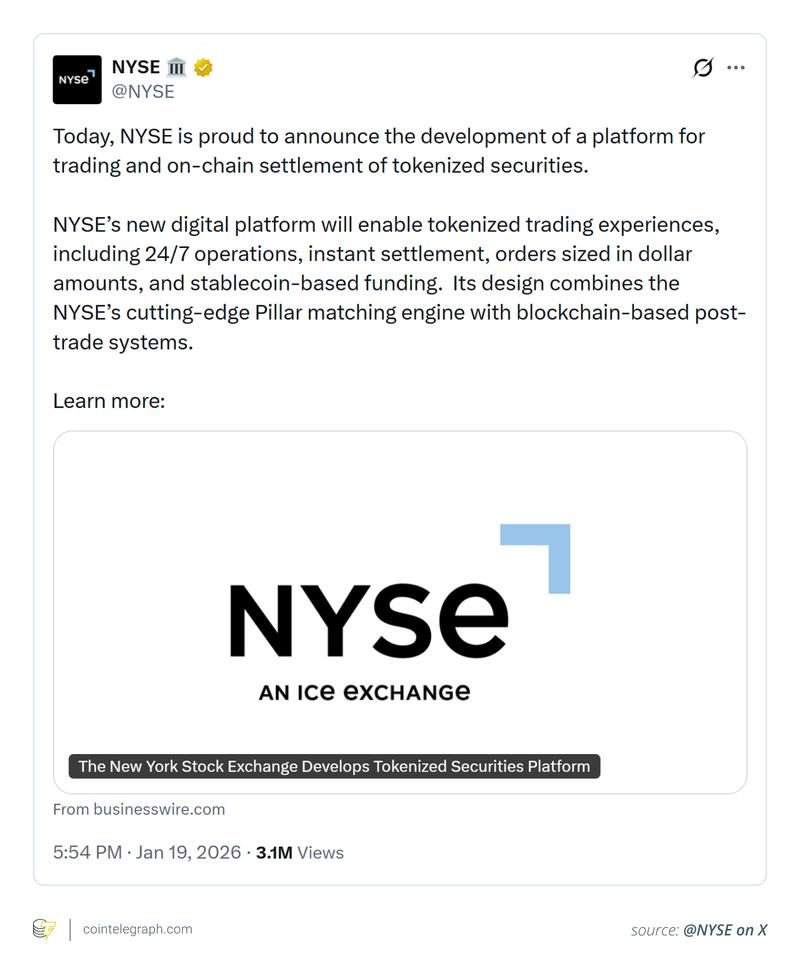
Following the announcement by Intercontinental Exchange (ICE), which owns the New York Stock Exchange (NYSE), regarding its development of a blockchain-powered platform for tokenized securities, certain market watchers viewed this as traditional finance completely embracing cryptocurrency.
In reality, the project represents a calculated infrastructure overhaul. The emphasis lies in leveraging distributed ledger technology to streamline collateral operations and remove inefficiencies inherent in outdated settlement frameworks.
According to ICE's statements, the platform will facilitate continuous trading around the clock, integrate blockchain-based settlement mechanisms, enable stablecoin-powered funding solutions and include tokenized forms of regulated securities, pending regulatory clearance. Should this deployment reach institutional scale, it would mark one of the most substantial attempts by a leading exchange operator to incorporate blockchain infrastructure into core market functions.
This analysis examines the NYSE's approach to using blockchain for separating trading execution from settlement finalization, the critical importance of onchain settlement infrastructure, the role of continuous trading availability and stablecoins serving as institutional funding mechanisms. The discussion covers how tokenization is entering mainstream financial services, obstacles in merging blockchain systems with existing infrastructure and challenges surrounding widespread adoption.
How the NYSE is using blockchain technology to separate execution from settlement
The proposed platform establishes a definitive boundary between the trading and settlement phases. ICE's strategy involves retaining the current NYSE Pillar matching engine, which presently handles substantial equity trading volumes, as the core execution layer. Blockchain infrastructure would principally strengthen post-execution activities, including settlement finalization, ownership recordkeeping and transaction reconciliation.
This delineation carries significance because operational bottlenecks in financial markets typically arise not from the price-formation process during active trading but from postponements and intricacies in clearing procedures, settlement completion, multi-party reconciliation efforts and collateral administration.
Tokenized securities describe regulated financial instruments such as equities or exchange-traded funds (ETFs) with ownership documentation maintained on blockchain infrastructure for enhanced operational efficiency. The fundamental legal entitlements remain subject to current securities regulations and corporate governance frameworks.
Why onchain settlement likely matters more than 24/7 trading
Despite faster settlement timelines now implemented for US equity transactions, the majority of trades continue to rely on numerous intermediary entities, including clearinghouses, custodial institutions and settlement agents, responsible for reconciling records between counterparties. This generates multiple tiers of operational complications and persistent counterparty exposure throughout the settlement period.
Onchain settlement fundamentally transforms this dynamic by facilitating nearly instantaneous exchange of asset ownership and payment through a distributed, tamper-resistant ledger. This mechanism, commonly referred to as delivery-vs.-payment (DvP), dramatically diminishes counterparty risk exposure and curtails reconciliation discrepancies. DvP has the potential to liberate capital currently immobilized in margin accounts or risk buffers for more constructive deployment. It directly addresses fundamental inefficiencies and vulnerabilities in post-execution infrastructure.
Accelerated settlement, nevertheless, involves certain compromises. It removes the temporal cushions that presently permit markets to correct mistakes, reverse unsuccessful transactions or manage liquidity shortfalls. Risk effectively transitions toward immediate liquidity requirements, necessitating that market participants maintain continuous position funding rather than depending on intraday credit facilities. From a systemic perspective, this reallocates rather than eliminates overall market risk.
What 24/7 trading may (and may not) achieve
Uninterrupted trading access attracts global market participants accustomed to perpetual crypto or derivatives markets. For US equities specifically, extended trading hours currently exist, though they characteristically exhibit reduced liquidity, expanded spreads and elevated volatility relative to standard trading sessions.
Completely 24/7 market operations could deliver improved access for cross-border investors and potentially more gradual responses to news emerging outside regular hours. However, multiple uncertainties persist:
- Liquidity may dissipate substantially during off-peak timeframes, compelling market makers to expand quotation spreads or raise transaction expenses.
- Trading during overnight or sparse-volume periods might magnify price fluctuations, especially surrounding significant international developments.
- Price formation might remain centered in conventional trading hours, with off-peak activity reflecting more volatile or less meaningful signals instead of genuine efficiency improvements.
Whether perpetual trading genuinely elevates market quality or merely distributes activity more sparsely across global time zones remains uncertain.
Onchain settlement confronts more fundamental structural impediments in trade finalization processes, diminishing risk and releasing efficiency gains, whereas 24/7 trading chiefly expands accessibility without fundamentally resolving those core challenges.
Did you know? Certain stock exchanges currently employ microsecond-precision timestamp coordination from atomic clocks for tracking trade sequences. Consequently, blockchain implementations must interface with ultra-accurate time standards to prevent disagreements over transaction sequence.
Stablecoins as institutional funding rails, not speculative plays
A central component in ICE's framework involves deploying stablecoins to manage the monetary settlement aspect of transactions. This approach would permit funds to settle continuously throughout the day, synchronizing with any transition toward uninterrupted securities trading and circumventing conventional banking-hour constraints. The methodology yields more rapid, reduced-friction cash transfers across jurisdictions and between transaction counterparties.
Should stablecoins become integrated within regulated market frameworks, they will undoubtedly encounter rigorous compliance mandates. These encompass continuous compliance surveillance, institutional-grade custody protocols, substantial liquidity reserves and additional protections equivalent to traditional settlement banking institutions.
Stablecoins operate exclusively as wholesale settlement mechanisms for institutional participants, rather than retail payment methods or investment instruments.
Tokenization steadily moving into mainstream finance
The NYSE-connected initiatives represent part of a wider industry movement. Leading asset management firms, banking institutions and market infrastructure operators are actively testing or pursuing authorization to tokenize traditional assets. These encompass US Treasury bills, money market fund holdings, ETF shares and comparable financial instruments.
Regulatory submissions indicate that tokenization is penetrating sectors conventionally regarded as conservative and infrastructure-intensive. The primary goal centers on operational effectiveness rather than innovation as an end in itself. Benefits comprise expedited settlement, programmable transaction conditions, diminished manual reconciliation requirements and potentially expanded market participation.
If tokenized representations of diverse asset categories achieve widespread acceptance, post-trade mechanisms could align toward unified, interoperable ledger frameworks. This would eliminate redundancy and duplication throughout today's fragmented network of clearinghouses, custodial services, transfer agents and registrar entities. Nevertheless, realizing such an outcome requires institutions and regulatory authorities to harmonize on technical standards, interoperability protocols and risk management controls.
Did you know? Within traditional markets, an individual equity transaction can initiate a cascade of back-office communications among brokers, custodians and clearing agencies, representing a primary reason financial institutions allocate billions annually toward post-trade information technology infrastructure.
Custody, records and legal ownership still the hardest hurdles
The most substantial obstacle to tokenized market adoption isn't the underlying blockchain technology. Legal uncertainty surrounds ownership documentation. Traditional finance depends on established, thoroughly tested frameworks for beneficial ownership designation, shareholder entitlements, voting privileges, dividend distributions and definitive recordkeeping authority.
Within a tokenized environment, regulatory bodies must determine what constitutes the authoritative information source, whether that involves the blockchain ledger, the transfer agent's registry, the broker-dealer's ledgers or some integrated approach. Each decision influences investor safeguards, corporate action processing, dispute resolution procedures and liability assignment.
Custody introduces additional complexity. Even within permissioned, institutional-quality blockchains, administering private keys or equivalent access controls demands comprehensive solutions addressing asset segregation requirements, key restoration following loss events, bankruptcy protection and operational sustainability. These concerns necessitate novel regulatory frameworks matching or surpassing current benchmarks.
These legal and operational considerations will likely impede adoption more significantly than any technological constraints.
Clearinghouses and the shift to real-time risk management
ICE has additionally expressed interest in incorporating tokenized deposits or comparable instruments into clearinghouse functions. The company has proposed integrating blockchain-powered settlement capabilities with clearing infrastructure.
Clearinghouses serve to eliminate counterparty risk exposures. Reduced or near-instantaneous settlement timeframes can compress exposure durations and decrease aggregate risk levels. Conversely, they also provide less time to identify and address defaults, collateral shortfalls or abrupt liquidity pressures.
This transition drives clearing participants and operators toward perpetual position surveillance, automated intraday margin adjustments, dynamic collateral assessment and thoroughly validated contingency plans for system outages, cybersecurity incidents or technology breakdowns.
From a regulatory standpoint, resilience within always-available, round-the-clock environments becomes paramount. Traditional markets incorporate scheduled maintenance windows. Continuous systems cannot tolerate unscheduled disruptions without triggering cascading failures.
Did you know? The NYSE previously reduced its trading session during World War I and actually suspended operations entirely for four months in 1914. This demonstrates that market "operating hours" have consistently adapted with technological advancement, geopolitical circumstances and infrastructure capabilities.
Who stands to gain and who might need to adapt
Should onchain market infrastructure prove reliable and secure regulatory authorization, multiple market participants could realize substantial benefits:
- International investors seeking continuous access to trading and settlement capabilities
- Institutional participants that could achieve more productive collateral utilization and decrease immobilized capital
- Asset issuers pursuing simplified distribution mechanisms and potentially expanded market reach.
Conversely, intermediary entities whose revenue streams depend substantially on current multi-phase settlement processes may encounter significant pressure to transform or risk diminished relevance. These comprise clearing agents, custodial providers and particular reconciliation service providers. Compliance departments would likewise transition from periodic, business-hours monitoring to continuous surveillance, introducing complexity in the near term.
Whether these operational efficiencies convert into reduced expenses for retail and institutional end users depends on the degree of savings transferred by exchanges, clearinghouses and other infrastructure entities.
A modernization effort, not a leap into crypto
The NYSE's initiatives regarding blockchain-powered systems represent an endeavor to modernize fundamental financial infrastructure, incorporating accelerated settlement, enhanced collateral flexibility and strengthened market accessibility. In this context, blockchain functions as an enabling technology layer for post-execution operations, rather than representing an asset category. Achievement depends on satisfying the demanding standards of regulated markets, including demonstrated scalability, elevated operational resilience, complete compliance conformity and extensive institutional acceptance.
The achievement of this NYSE undertaking relies on multiple factors, including regulatory authorizations, operational dependability and institutional readiness to transition. The initiative demonstrates that established exchanges are no longer approaching tokenization as an exploratory ancillary project. Rather, they are assessing whether blockchain-powered systems can accommodate the scale requirements, stability expectations and compliance obligations of mainstream financial markets. This represents a substantially higher threshold than most cryptocurrency-native platforms have encountered.