
GOP Legislators Push for Indefinite CBDC Prohibition Ahead of Upcoming House Decision
Members of Congress from the Republican party are advocating for an indefinite prohibition on central bank digital currencies through the 21st Century ROAD to Housing Act, with a vote anticipated in the House of Representatives this week.

Two Republican members of Congress are advocating for an indefinite prohibition on a central bank digital currency (CBDC) in the United States to be incorporated into the 21st Century ROAD to Housing Act, with the legislation anticipated to be voted on in the House of Representatives this week.
The legislation unveiled by the Senate Committee on Banking, Housing and Urban Affairs in March primarily focuses on modifications to federal housing initiatives but also contains a provision that prohibits the Federal Reserve System or any Federal Reserve bank from launching a CBDC or comparable instrument through Dec. 31, 2030.
The House of Representatives has developed its own revised version of the bill, which Representative Mike Flood stated eliminates the "backdoor green light for a CBDC" and seeks to establish the prohibition as permanent.
The revised legislation is anticipated to be voted on in the House this week. Should it receive approval, the bill will be sent back to the Senate, where additional amendments could be made. The measure must secure passage in both legislative chambers before it can be presented to President Donald Trump for his signature to become law.
Those who oppose CBDCs frequently point to their potential for abuse. The Human Rights Foundation stated that the advantages of CBDCs include the possibility of broadening financial inclusion for communities with restricted access to the banking system. Disadvantages include the digital currency's capability to violate privacy and create new opportunities for government corruption, along with other issues.
Ban needs to be made permanent: Warren Davidson
US Representative Warren Davidson, a House member, also expressed support for a permanent CBDC ban as the "2030 sunset works a pre-launch development period."
"The US House of Representatives could deliver a unifying win this week with bipartisan housing affordability legislation. Instead, they currently plan to deliver a go-live date for Central Bank Digital Currency, using housing as the Trojan Horse," he added.

The Atlantic Council's tracking system, maintained by the American think tank, indicates that only three nations have formally launched a CBDC: Nigeria, Jamaica, and the Bahamas, with an additional 41 countries currently in the pilot stage.
Alternate bills to ban a CBDC on the sidelines
In the meantime, Tom Emmer, who serves as the House majority whip, one of the highest-ranking Republican leadership roles in Congress, is championing his Anti-CBDC Surveillance State Act.
The legislation received House approval on July 17 but has not yet obtained complete Senate authorization. Its objective is to prevent the Federal Reserve from developing or launching a CBDC.
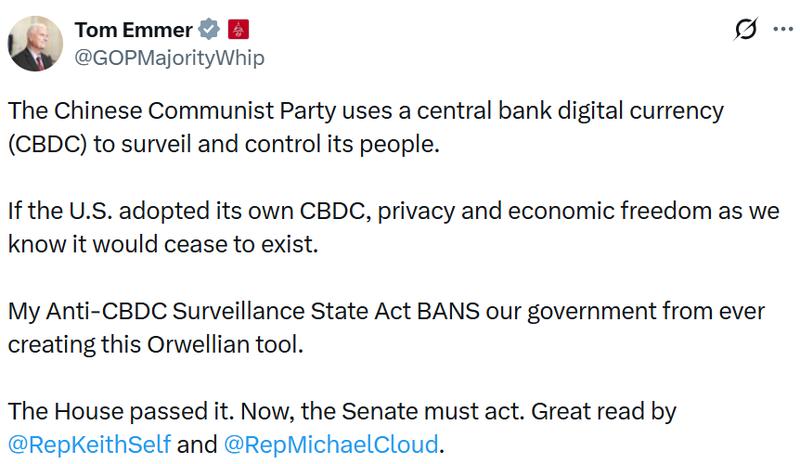
"The Chinese Communist Party uses a central bank digital currency (CBDC) to surveil and control its people. If the US adopted its own CBDC, privacy and economic freedom as we know it would cease to exist," he said.
"My Anti-CBDC Surveillance State Act BANS our government from ever creating this Orwellian tool. The House passed it. Now, the Senate must act."
Earlier, Senator Mike Lee put forward the "No CBDC Act" as an independent piece of legislation that would bar the Fed or Treasury from launching a CBDC. Nevertheless, it failed to advance in Congress.