
Gnosis Executive Warns CLARITY Act Could Consolidate Crypto Power Among Centralized Entities
A co-founder of Gnosis cautions that the proposed law presupposes all cryptocurrency operations must flow through US government-licensed financial intermediaries.

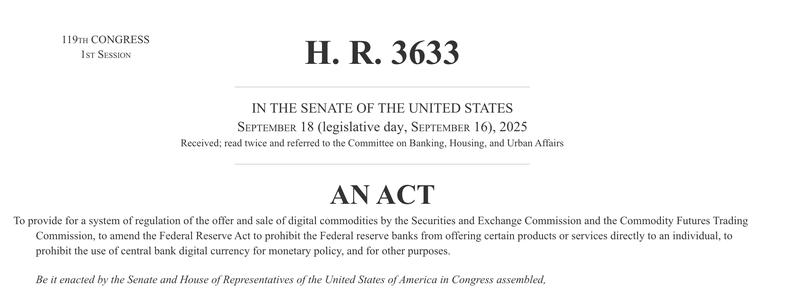
According to Dr. Friederike Ernst, a co-founder of the Gnosis blockchain protocol, the regulatory framework presented in the United States Digital Asset Market Structure Clarity Act—commonly referred to as the CLARITY Act—poses a danger of delivering cryptocurrency control to major financial institutions.
In an interview with Cointelegraph, Ernst explained that the CLARITY crypto market structure legislation's regulatory framework operates on the assumption that all transactions must flow through centralized intermediaries, creating a scenario where cryptocurrency infrastructure could become concentrated among a limited number of established entities.
"The genuine innovation of blockchain technology wasn't simply about creating new financial infrastructure. It represented the capability for users to directly own the networks upon which they depend," she stated. Ernst continued:
"If activity is pushed back through institutional intermediaries, users risk becoming customers renting access to financial technology once again rather than stakeholders in it. The challenge is ensuring regulatory clarity does not unintentionally undermine that ownership model."
Notwithstanding the legislation's deficiencies, Ernst acknowledged that the CLARITY Act does provide clarity regarding regulatory oversight of cryptocurrency between the Securities and Exchange Commission (SEC) and the Commodity Futures Trading Commission (CFTC), while also safeguarding peer-to-peer transactions and self-custody rights.
Nevertheless, Ernst warned that the market structure legislation's inability to sufficiently safeguard open, permissionless blockchain infrastructure and decentralized finance protocols creates a danger of importing all the identical vulnerabilities of the traditional financial system into the cryptocurrency space.
CLARITY Act stalled due to banks and traditional financial institutions
The eagerly awaited CLARITY Act continues to be stuck in Congress due to disputes between the cryptocurrency sector and the banking sector concerning the matter of stablecoin yield and the question of whether stablecoin issuers should be permitted to distribute interest to holders.
During January, cryptocurrency exchange Coinbase made public its decision to withdraw its backing for the legislation, expressing worries about provisions that would undermine the decentralized finance industry, ban stablecoin yield, and hinder the expansion of the tokenized real-world asset sector.

"We'd rather have no bill than a bad bill," Coinbase CEO Brian Armstrong said in response to reading a draft of the bill.
US Senator Bernie Moreno said he is optimistic the CLARITY bill will pass by April and head to US President Donald Trump's desk for signing.
Nevertheless, should the legislation fail to pass by April 2026, the probability of it being enacted into law during 2026 becomes "extremely low," according to Alex Thorn, head of firmwide research at investment firm Galaxy.
"It's very possible that rewards are not the 'final' hurdle but instead just the current hill the bill is dying on," Thorn said in an X post on Saturday, pointing to potential issues around DeFi, developer protections, and regulatory authority.