
Global Law Enforcement Launches Operation Atlantic to Combat Cryptocurrency Fraud Through Live Monitoring
An in-depth examination of Operation Atlantic reveals how international law enforcement organizations collaborate to locate potential victims and prevent cryptocurrency scams in real time.

Operation Atlantic: Taking proactive measures against increasingly sophisticated cryptocurrency fraud
Cryptocurrency fraud schemes have evolved into highly complex international operations that leverage cutting-edge technology and manipulative psychological tactics. By the point at which victims realize they've been defrauded, the stolen digital assets have typically been swiftly distributed through numerous wallets and trading platforms spanning various nations.
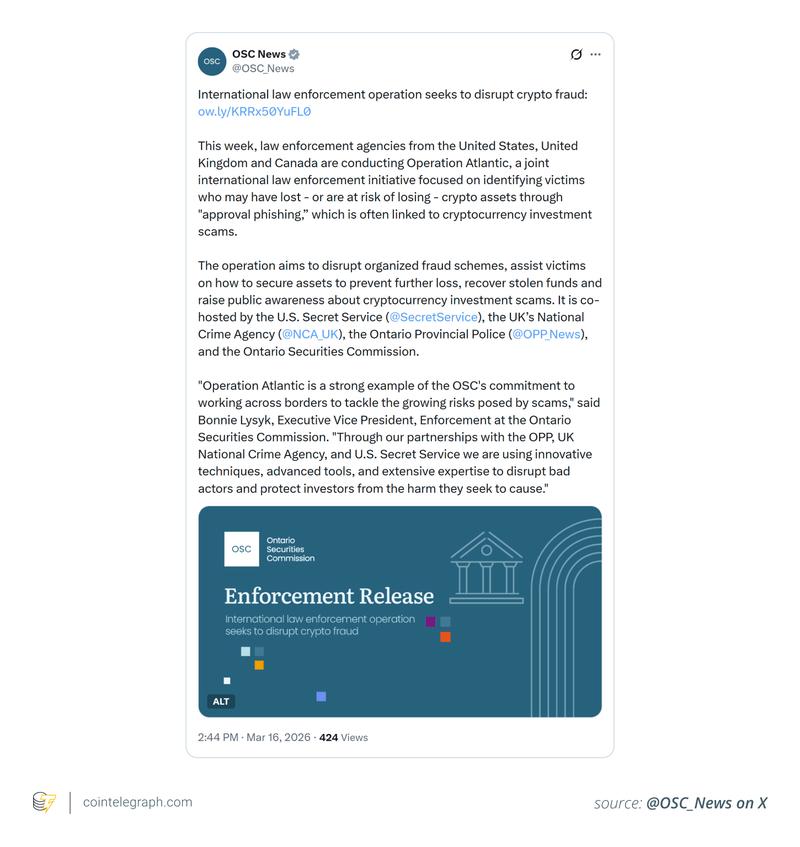
Operation Atlantic signifies a synchronized multinational endeavor led by enforcement authorities from the United States, the United Kingdom and Canada to address this growing menace. Instead of restricting its scope to investigations conducted after incidents occur, the operation emphasizes recognizing, monitoring and dismantling cryptocurrency scams as they unfold in real time.
The program unites critical organizations, including the US Secret Service, the US Attorney's Office for the District of Columbia, the Ontario Provincial Police, the Ontario Securities Commission, the Royal Canadian Mounted Police, the UK Financial Conduct Authority, the UK National Crime Agency and the City of London Police.
Unlike traditional investigative approaches that commence only following the theft of assets, Operation Atlantic has been designed to:
- Identify victims who are at risk
- Detect active scam infrastructure
- Interrupt fraudulent transactions
- Help recovery efforts where feasible
Authorities have emphasized that the core mission is to dismantle scams in near real time, representing a substantial transition toward more rapid, proactive enforcement methodologies.
Understanding why approval phishing serves as the focal point of Operation Atlantic
A specific type of fraud recognized as approval phishing stands at the core of Operation Atlantic. Instead of obtaining private keys or recovery phrases, fraudsters trick users into authorizing what seem to be authentic blockchain transactions.
These transactions provide scammers with authorization to transfer tokens directly from a victim's digital wallet. After approval has been granted, the perpetrator obtains the capability to:
- Drain funds at any time
- Avoid immediate detection
- Combine the exploit with convincing social engineering narratives
This characteristic makes approval phishing exceptionally hazardous. Victims frequently remain oblivious that something is amiss until their digital assets start vanishing.
Fraudsters commonly incorporate this methodology into more extensive fraud operations, including counterfeit investment platforms or progressive confidence-building schemes.
Transitioning from investigation to intervention
The defining characteristic of Operation Atlantic is its focus on real-time disruption instead of retrospective analysis.
This approach is founded on a simple principle: Although cryptocurrency transactions cannot be reversed, they remain public and entirely traceable.
Through the utilization of blockchain analytics, law enforcement and private-sector collaborators can:
- Detect suspicious wallet activity
- Identify addresses linked to known scams
- Track fund flows toward exchanges or liquidity pools
- Alert platforms and investigators
- Contact victims before their funds are completely drained
This framework does not ensure complete asset recovery, but it creates a crucial timeframe during which effective intervention remains achievable.
Did you know? The US Secret Service, originally established to combat currency counterfeiting in 1865, now tracks crypto fraud using blockchain analytics. It is one of the oldest agencies adapting to one of the newest financial systems.
Expanding upon previous initiatives
Operation Atlantic was not developed in isolation. It expands on earlier programs such as Project Atlas, which was introduced in 2024 by Canadian authorities working alongside the US Secret Service to disrupt cryptocurrency fraud networks.
It also incorporates insights from Operation Spincaster, an initiative that brought together blockchain analytics companies, cryptocurrency exchanges and law enforcement organizations.
Spincaster proved that coordinated efforts could produce concrete outcomes:
- Thousands of scam-linked wallet leads identified
- Significant losses mapped across jurisdictions
- In some cases, victims were warned in time to revoke malicious approvals
These programs demonstrate that cryptocurrency fraud can be disrupted during its active phase.
Understanding what "real time" truly signifies
The notion of real-time disruption is occasionally misinterpreted. It does not signify immediate asset recovery or absolute prevention.
Rather, it functions across three distinct phases:
- Pre-loss prevention: spotting suspicious approvals before funds are moved
- Mid-transaction disruption: flagging or freezing assets during transfers
- Post-loss response: attempting recovery after funds have been dispersed
Operation Atlantic primarily focuses on the initial two phases, where intervention remains practical.
The effectiveness of this operation hinges on the speed with which information can be examined, distributed and executed across international borders and various platforms.
Did you know? Approval phishing scams often exploit wallet permissions rather than passwords, which means victims technically authorize the theft themselves. This psychological twist makes these scams harder to detect than traditional hacking attempts.
Understanding why scams currently function as organized networks
Approval phishing scams are usually not isolated incidents. They commonly function as organized networks comprising multiple interconnected components:
- Social engineering pipelines to attract victims
- Fake interfaces or decentralized applications
- Wallet approval mechanisms
- Consolidation addresses used to pool stolen funds
- Exchange off-ramps for cashing out
This multi-layered configuration enables fraudsters to expand their operations while minimizing the probability of being detected.
Operation Atlantic approaches these scams as organized financial networks instead of separate criminal acts, a perspective that is fundamental to its real-time disruption methodology.
Examining the magnitude of the problem
The sense of urgency driving Operation Atlantic arises from the massive scope of cryptocurrency fraud.
Approval phishing by itself has been associated with billions of dollars in losses over recent years, impacting thousands of victims throughout numerous jurisdictions.
Even more troubling is the fact that many cases remain unreported, indicating the actual losses may be considerably greater.
Monthly data also indicate that although overall exploit losses may fluctuate, phishing attacks continue to increase, confirming that user-focused scams remain among the most enduring threats in cryptocurrency.
Did you know? Law enforcement agencies increasingly use blockchain clustering to map entire scam networks, sometimes revealing thousands of linked wallets behind a single fraud operation. This forensic technique groups related wallet addresses.
Examining the function of public-private coordination
A critical element of Operation Atlantic is the tight partnership between law enforcement and private-sector entities.
Each contributor plays specific roles:
- Blockchain analytics firms identify suspicious patterns and wallet clusters
- Exchanges monitor inflows and flag deposits linked to scams
- Stablecoin issuers may help freeze funds in targeted cases
- Platforms and wallets can warn users or block malicious interactions
This degree of collaboration facilitates more rapid responses compared to traditional investigations, which frequently depend on lengthier legal processes.
Simultaneously, it creates greater expectations for platforms to assume a more proactive position in fraud identification.
Recognizing the boundaries of real-time disruption
Notwithstanding its objectives, Operation Atlantic encounters several structural limitations:
- Once funds are bridged or layered across multiple services, recovery becomes extremely difficult
- User behavior remains a major vulnerability, particularly in social engineering scenarios
- Cross-border legal processes can still delay enforcement actions
- Wallet anonymity makes victim identification more complicated
In numerous situations, the most achievable result is preventing additional losses instead of securing complete recovery of stolen digital assets.
Understanding what this means going forward
Operation Atlantic represents a wider transformation in how cryptocurrency-related criminal activity is being addressed.
Instead of perceiving fraud as a static, single occurrence, authorities currently approach it as a fluid, continuous process that can be observed and disrupted while it remains active.
For users, this transformation may produce:
- More frequent warnings about suspicious transactions
- Greater emphasis on understanding wallet permissions
- Increased awareness of scam risks
For platforms, it could lead to:
- Higher expectations for transaction monitoring
- Deeper collaboration with law enforcement
- Integration of real-time risk detection tools