
Federal Regulators Fail to Meet GENIUS Act's One-Year Stablecoin Implementation Timeline
Federal regulatory bodies in the United States were unable to complete implementation regulations within the GENIUS Act's mandated one-year timeframe, releasing 10 draft proposals rather than finalized rules.

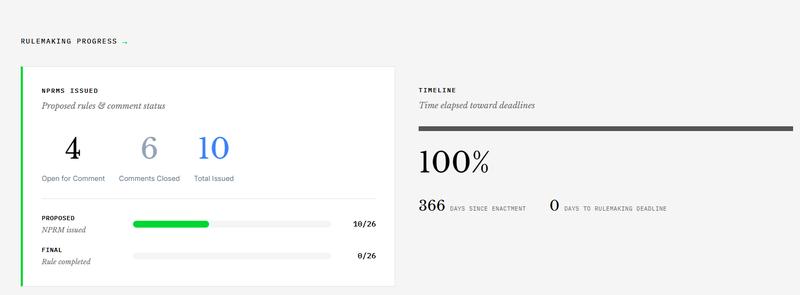
Federal regulatory bodies in the United States failed to meet the mandated rulemaking timeline established under the Guiding and Establishing National Innovation for US Stablecoins (GENIUS) Act this past Saturday, marking exactly one year since the legislation received presidential approval.
Multiple federal regulatory bodies released draft regulatory frameworks and solicited comments from the public throughout the preceding twelve months, yet none succeeded in publishing finalized regulations ahead of the mandated completion date.
The regulatory bodies in question include the Department of the Treasury, the Office of the Comptroller of the Currency (OCC), the Federal Deposit Insurance Corporation (FDIC) and the Federal Reserve Board, all of which released draft proposals without advancing them to final rule status, based on tracking data maintained by law firm Chapman and cryptocurrency investment firm Paradigm.
Failure to meet the legislatively mandated deadline does not render the GENIUS Act void, though the absence of completed regulations could create regulatory ambiguity for entities that issue stablecoins.
The GENIUS Act created the nation's first all-encompassing federal regulatory structure for stablecoins in the United States. US President Donald Trump signed the legislation into law on July 18, 2025.
Federal agencies published 10 draft regulatory proposals throughout the first year of the GENIUS Act
Federal regulatory authorities published 10 notices of proposed rulemaking (NPRM) during the twelve-month period following the GENIUS Act's enactment into law, based on data from Paradigm.
The Treasury Department released four draft proposals addressing the wider implementation of the legislation, encompassing standards for evaluating whether state-level stablecoin regulatory frameworks align with the federal structure, registration obligations for stablecoin issuers based outside the United States and protocols for adherence to anti-money laundering requirements.
The OCC released two NPRMs addressing nationally chartered payment stablecoin issuers, covering approval obligations and supervisory frameworks.
The FDIC released one NPRM addressing FDIC-supervised institutions engaged in payment stablecoin issuance, concentrating on supervisory requirements and operational frameworks including reserve management protocols.
The National Credit Union Administration (NCUA) released draft regulations permitting federally insured credit unions to engage in stablecoin issuance activities.
Additionally, federal banking regulatory bodies collaboratively released an interagency implementation proposal designed to harmonize oversight across the OCC, Federal Reserve and FDIC, with the objective of ensuring uniform supervisory requirements across all federal regulatory entities.
Anchorage calls on legislators to advance CLARITY Act legislation
Federally chartered cryptocurrency bank Anchorage Digital has called upon legislators to advance the Digital Asset Market Clarity Act (CLARITY).
On GENIUS' one-year anniversary, we're renewing our call for Congress to pass the CLARITY Act and extend the clear market-structure rules that worked for stablecoins to the broader digital asset economy.
Anchorage Digital
The CLARITY Act aims to create the nation's first federal regulatory structure for digital assets in the United States. The legislation successfully passed through the Senate Banking Committee in May, although banking industry organizations contended that the legislation would permit cryptocurrency companies to provide yields on stablecoins while avoiding the same regulatory obligations that apply to traditional banking institutions.
On July 13, state banking trade organizations, among them the American Bankers Association (ABA) and the Independent Community Bankers of America (ICBA), submitted a collaborative letter calling on Senate leadership to furnish additional specifics on the CLARITY Act's provisions concerning stablecoin yields and contended that new revisions must be implemented to prohibit payment stablecoins from functioning as deposit alternatives instead of purely transactional instruments.
On June 26, Galaxy Digital reduced its probability assessment of the CLARITY Act being enacted into law in 2026 to 50%, referencing the absence of a consolidated Senate Banking-Agriculture legislative text, the lack of a confirmed floor vote timeline and a contracting legislative calendar before lawmakers depart Washington.