
Federal Regulator Takes Legal Action Against Minnesota and Gov. Walz Over Prediction Market Prohibition
Just one day following Governor Tim Walz's approval of legislation effectively outlawing prediction markets throughout Minnesota, the CFTC responded by initiating legal proceedings against the state.

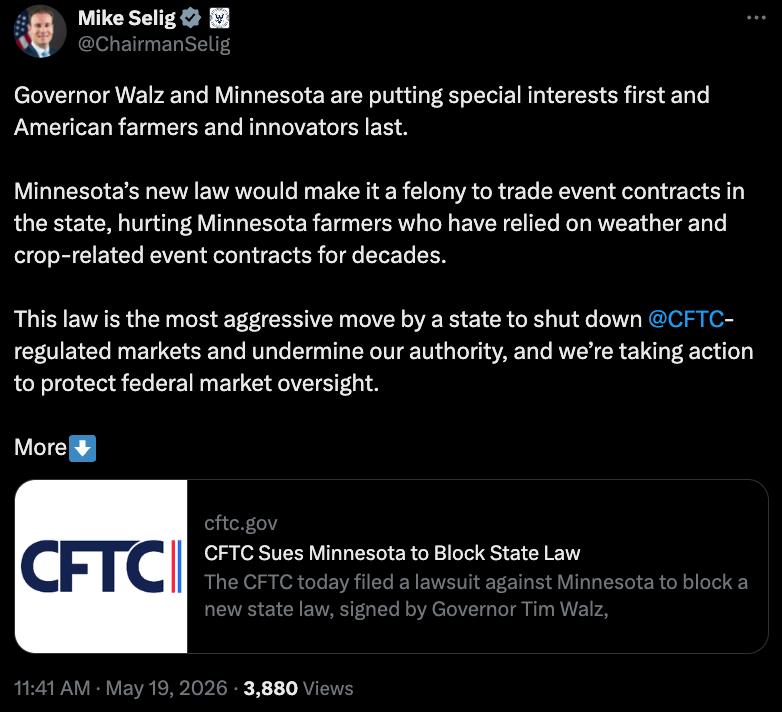
The Commodity Futures Trading Commission (CFTC) of the United States, led by Chair Michael Selig, has initiated legal action targeting Minnesota and its state officials following the passage of legislation that "prohibits activities related to prediction markets."
According to a Tuesday court filing submitted to the US District Court for the District of Minnesota, the CFTC contends that Minnesota, along with Governor Tim Walz, Attorney General Keith Ellison, and Jon Anglin, the state's department of public safety director, enacted what amounts to the nation's "first outright ban" targeting prediction markets through Senate File (SF) 4760.
The bill, which received Walz's signature on Monday, modified Minnesota's existing statutes to forbid the advertisement, creation, operation, or facilitation of prediction market platforms in any capacity, essentially eliminating them within state borders. Scheduled to become active on Aug. 1, the legislation explicitly categorizes event contracts offered on platforms such as Kalshi and Polymarket—encompassing sporting events, military conflicts, and weather predictions—as "wagers" and thus subject to prohibition.
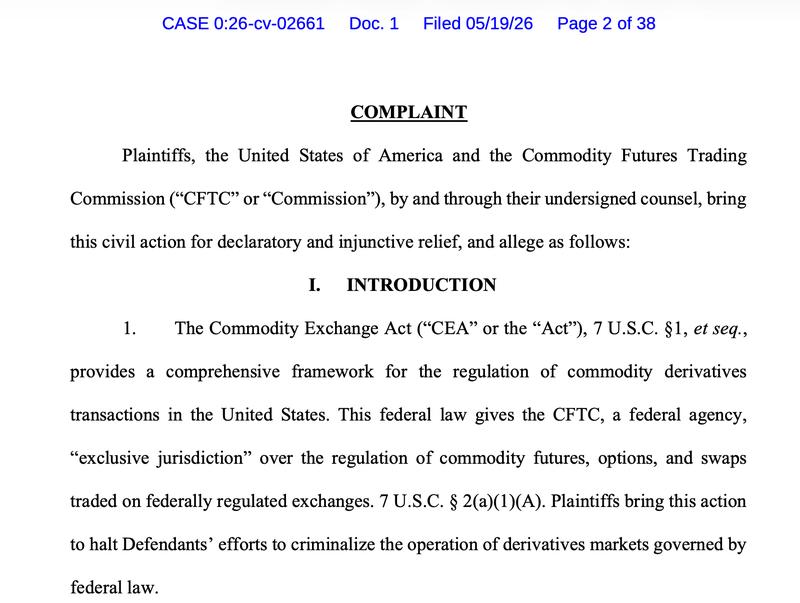
Within its legal filing, the CFTC asserts that it maintains "exclusive jurisdiction" over prediction market oversight pursuant to the Commodity Exchange Act. The federal commodities regulator has requested judicial intervention to "preliminarily and permanently" enjoin Minnesota's statute, arguing that event contracts available on these platforms constitute "swaps" falling under the CFTC's sole regulatory authority.
"If permitted to go into effect, Minnesota law will criminalize exchanges that the Commission has expressly approved, as well as event contracts that have been self-certified to the Commission and that the Commission has permitted to be listed. These consequences directly harm the federal government's legally protected interest in enforcing federal law."
CFTC lawsuit
Selig, who presently operates as the singular commissioner due to the lack of appointments from US President Donald Trump, has consistently declared that any state-level measures targeting prediction market platforms would face judicial challenges. Members of Congress have urged Trump to designate additional commissioners to establish a complete five-member bipartisan commission at the CFTC, yet the president had made no such announcements as of Tuesday.
Multiple state regulatory bodies have submitted complaints contesting the operations of prediction market platforms, particularly claiming violations related to illegal sports gambling and other forbidden activities, though Minnesota's statute represents what appears to be the first comprehensive legislative ban. The CFTC has previously supported Kalshi in state-level litigation originating in Ohio, and has also challenged regulatory actions from authorities in Connecticut, Illinois, and New York concerning similar measures against prediction markets.
Cointelegraph reached out to Polymarket for commentary but had not received a response at the time of publication. A representative from Kalshi characterized the Minnesota legislation as "unenforceable" and described it as a "blatant violation of the constitution and federal law."
Minnesota enacting additional legislation affecting cryptocurrency users and investors
Last Friday, Walz approved separate legislation authorizing banking institutions and credit unions based in Minnesota to provide and execute "certain virtual-currency custody services." Similar to the prediction markets prohibition, this statute is also scheduled to take effect on Aug. 1.
State legislators in Minnesota have additionally pursued measures to prohibit cryptocurrency kiosks and ATMs statewide in reaction to cases involving residents falling victim to fraudulent schemes. Walz provided his signature approving this legislation on May 5.