
Experts Dismiss 'Bunker Mode' as Ineffective Crypto Defense Strategy
Critics argue that 'bunker mode' represents an impractical approach to protecting cryptocurrency, even if Justin Drake's warnings about AI compromising cryptographic security turn out to be accurate.

While escalating global political conflicts already provide ample reasons for worry, the cryptocurrency sector now faces its own existential crisis.
A heated discussion has erupted within the industry regarding a catastrophic cryptographic failure scenario where malicious actors could extract private keys from publicly available keys through what was previously considered an implausible, yet now increasingly believable, artificial intelligence-driven attack vector threatening everyone's digital assets.
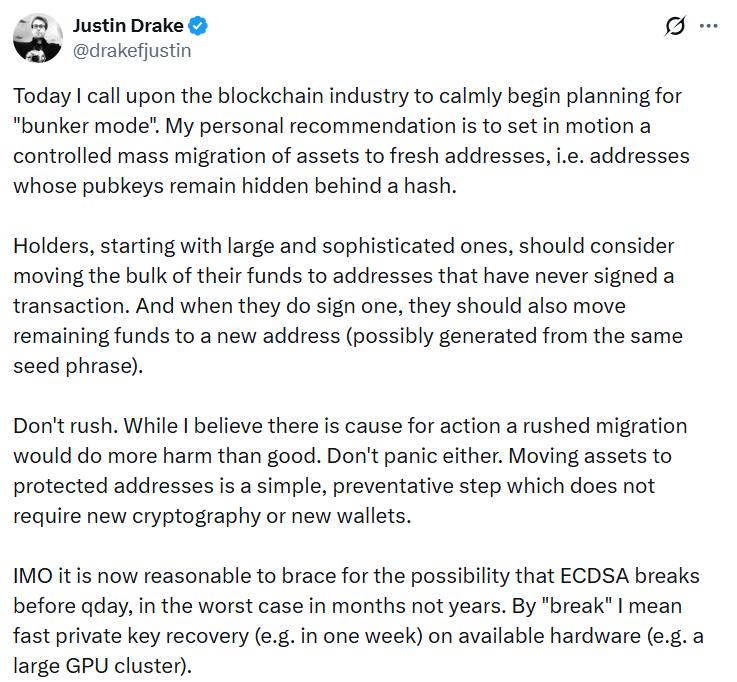
Last Wednesday, Justin Drake, a researcher working on Ethereum, advocated for initiating "bunker mode" contingency preparations, referencing "humbling" developments in artificial intelligence capabilities that might expedite the identification of mathematical vulnerabilities and eventually "break" existing cryptographic systems:
"IMO it is now reasonable to brace for the possibility that ECDSA [Elliptic Curve Digital Signature Algorithm] breaks before Qday, in the worst case in months not years."
Drake believes the cryptocurrency sector ought to start planning an organized transfer of digital assets to newly created addresses that haven't had their public keys revealed, thereby minimizing the data available for a hypothetical adversary to leverage.
However, what evidence supports his cautionary message, and should the community be genuinely worried?
Does the cryptocurrency alarm have merit?
Drake's apprehension extends beyond merely questioning whether artificial intelligence will hasten the development of quantum computing systems capable of compromising cryptography, but also considers the possibility that AI platforms might facilitate the discovery of mathematical attack vectors utilizing conventional computing power that human cryptography experts have overlooked.
He contends that elliptic curves — the cryptographic foundation supporting the majority of blockchain networks — could be more susceptible to these kinds of breakthroughs compared to hash functions due to their more complex mathematical structure, creating the potential for a classical algorithm to compromise elliptic curve cryptographic systems.
Matthew Green, who teaches cryptography at Johns Hopkins University, contributed his perspective on Drake's evaluation, intensifying the anxiety already sweeping across the cryptocurrency sector.
"I think we might lose public key cryptography," he said.
However, this sense of urgency isn't universally accepted. Yehuda Lindell, serving as Coinbase's cryptography director, stated that based on his understanding, there exists "no evidence whatsoever" suggesting the mathematical foundations supporting elliptic curve cryptography that have endured for decades have been compromised.
"There are no credible published advances against the math behind ECDSA, with AI or anything else."
He asserts that none of the recent mathematical research papers authored by OpenAI's artificial intelligence systems include any attack methodology against ECDSA — though Drake interprets this absence as grounds for concern rather than reassurance. Drake's additional reasoning centers on elliptic curves possessing greater mathematical structure compared to hash functions, potentially rendering them more vulnerable to compromise.
"He doesn't say how," Bourdon says. "He also calls his timeline a worst-case scenario and tells people not to rush."
Zach Herbert, who serves as chief executive and cofounder of hardware wallet manufacturer FoundationHQ, informs Magazine that transferring assets to unused addresses might prove insufficient when an extended public key (xpub) has previously been distributed to a wallet application or external service provider.
Under those circumstances, "they already have the information needed to derive the public keys you're trying to hide," he says.
And as Taylor Monahan, who founded and leads Ethereum wallet provider MetaMask, emphasized, should cryptographic systems fail, protecting your cryptocurrency holdings won't be the primary issue facing you:
"If elliptic curves are broken so that any exposed public key leads to compromise and it's by a financially-motivated hacker whose top priority is to steal crypto, the entire fu**ing world is going to zero. Having your magic internet coins in bunker mode is not going to help you."
The limitations of relocating digital assets
Herbert explains that xpubs enable wallet software to create numerous public keys for a single account, including keys corresponding to addresses that remain completely unused.
When a wallet application or external party already possesses that data, transferring assets to an unused address within the identical account may fail to conceal that new address's public key from their view.
Should ECDSA become vulnerable to practical exploitation, "an attacker could recover the corresponding private keys without ever touching your hardware wallet."
"No, it's obviously not sufficient protection," Eli Ben-Sasson, who cofounded and leads Ethereum scaling solution StarkWare, tells Magazine.
"Other than just moving your coins, if you want to use them ever again, you would need to download new kinds of wallets."
He indicates that a cryptographic compromise would impact far more than just wallet signatures. Ethereum's foundational infrastructure signatures and consensus protocols would require updates, along with the Kate-Zaverucha-Goldberg (KZG) polynomial commitment scheme that handles blob data.
"Finally, gas prices would likely also increase dramatically, because a lot of the functionality would break," he adds.
Within Bitcoin's ecosystem, certain address formats obscure the complete public key behind a cryptographic hash function until those coins undergo a transaction. Assuming the applicable hash functions maintain their security, this approach could offer an extra defensive layer against adversaries attempting to calculate a private key from its public counterpart. Conversely, Taproot addresses directly reveal a public key on the blockchain.
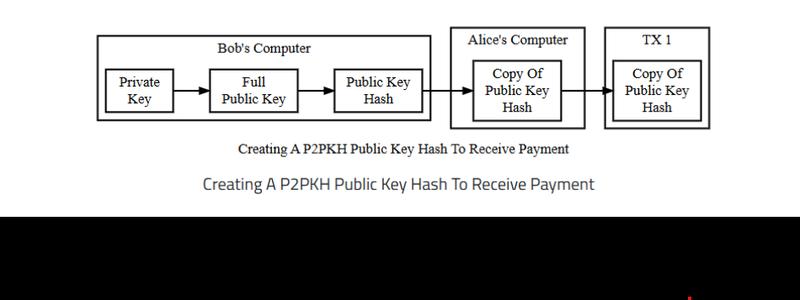
Bourdon explains that standard SegWit addresses, identifiable by their bc1q prefix, maintain public key privacy until funds are spent, while wallets such as Trezor create new receiving addresses to minimize address reuse patterns.
"There's nothing to do right now," he says, warning that a hasty migration would cause more damage than benefit. "People who rush to move funds make mistakes, and scammers use stories like this one to reach them."
Additionally, it bears mentioning that whenever a Bitcoin transaction is broadcast, the public key becomes visible in the mempool regardless, creating a vulnerability window during which an attack could potentially occur.
Cryptographic preparations vary across blockchains
Certain blockchain platforms are already implementing measures to address cryptographic vulnerabilities, though their proposed remedies differ substantially.
Within the AI-oriented NEAR Protocol ecosystem, account holders can incorporate a quantum-resistant FIPS-204 key into their existing mainnet account through a single transaction, eliminating the need to relocate their holdings, with wallets like Meteor offering quantum-safe signing capabilities. This approach depends on lattice based cryptography, which Ethereum creator Vitalik Buterin expresses concern might also prove vulnerable to attack.
Ethereum is constructing a comprehensive post-quantum strategy employing hash based signatures and ZK proof aggregation, encompassing everything from transaction signatures to consensus mechanisms and data protection. The network also has an emergency hard fork and asset recovery framework documented in theoretical form.
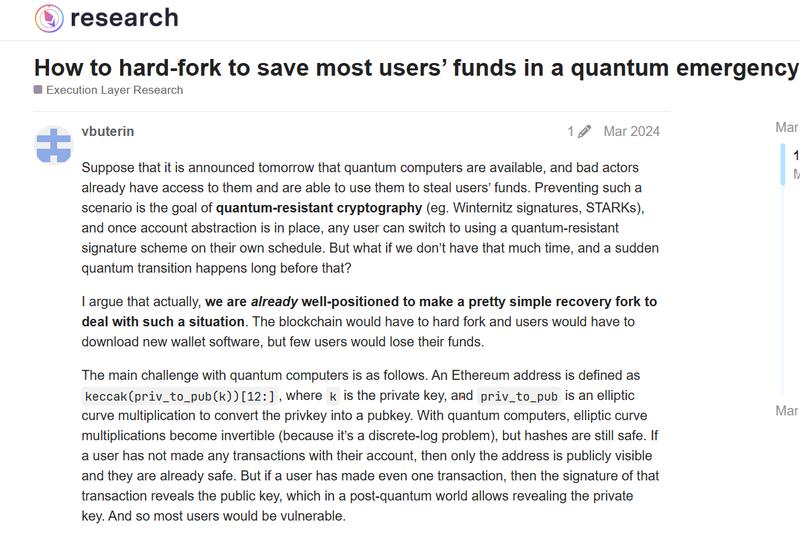
In a post from March 2024, Vitalik Buterin described a possible hard fork scenario that would reverse blocks subsequent to the beginning of widespread theft, suspend conventional wallet transactions and permit users to recover assets by utilizing zero knowledge proofs of a seed phrase.
Max Shannon, who works as senior research associate at Bitwise Europe, characterizes this as a proposal with "no set timeline."
Although nobody has demonstrated a functional attack to date, he advises users should transition to quantum-safe signature methods "over the long term."
Starknet's account abstraction framework permits users to modify signature schemes without requiring asset migration to a different address. Ben-Sasson explains the fundamental technology doesn't require modification, "because account abstraction means you can take any signature scheme."
Nevertheless, he notes other elements still demand consideration, including portions of the network's state tree and its dependency on Ethereum for maintaining security.
Creating a new address won't provide protection for users operating on Solana, since public keys are inherently exposed — although they can transfer assets to a post quantum storage solution like Winter Wallet.
Jacob Creech, technology vice president at Solana Foundation, indicated Solana users wouldn't need to activate "bunker mode" if the network's signature scheme became compromised.
A network enhancement could allow users to demonstrate ownership of their secret seed through a hash-based verification method and transition their accounts to a more secure signature scheme. He mentions a functional proof of concept already exists, though the actual upgrade hasn't been implemented.
Should cryptocurrency investors be concerned?
Shannon states Bitwise isn't currently preoccupied with this hypothetical risk, though it remains "worth being prudent over."
"We can discuss fresh addresses and xpub exposure as a thought experiment," Herbert says, "but I wouldn't pretend those steps amount to a practical plan for that scenario."
Given that some individuals possess outdated devices, intricate multisignature configurations, or Bitcoin holdings that have remained untouched for extended periods, he explains that a software update "would not automatically protect those coins."
Bourdon encourages crypto holders to carefully evaluate the messenger, noting that Drake's warning coincided with discussion of Ethereum's progression toward the hash-based cryptographic methods he advocates.
"So the warning about an unproven threat doubles as a pitch for Ethereum's roadmap," he says.
Although this observation doesn't necessarily invalidate Drake's concerns, there remains no concrete evidence indicating ECDSA faces imminent compromise, alongside numerous hazards associated with hastily relocating funds.
However, should the cryptographic systems underpinning cryptocurrency wallets and blockchain networks actually fail, relocating coins might represent the simplest component of the industry's emergency response.