
Digital Asset Platforms Target Traditional Commodities Trading Despite Valuation Discrepancies
Digital asset platforms are aggressively pursuing market dominance over conventional finance trading infrastructure, though the widespread acceptance of tokenized commodities faces challenges from valuation inconsistencies and liquidity constraints.
Digital asset trading platforms are progressively claiming a larger portion of market activity from conventional finance (TradFi) marketplaces by offering tokenized commodities instruments, yet widespread acceptance of blockchain-based precious metals continues to face obstacles related to valuation discrepancies and insufficient liquidity pools.
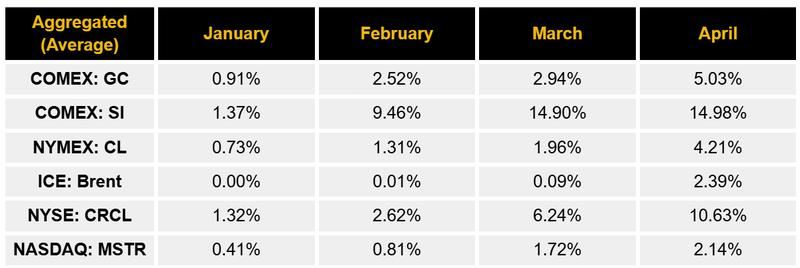
Perpetual contracts for silver have climbed to approximately 40% of the comparable trading activity seen in the Comex Silver (SI) Contract during their highest points, representing the globe's most substantial silver futures marketplace, which commands more than 70% of worldwide exchange-traded silver futures activity, based on a Thursday analysis published by Binance Research.
Throughout the months of March and April, blockchain-based silver represented 14.90% and 14.98% of Comex's trading activity, in that order, climbing substantially from a mere 1.37% recorded in January.
This expansion indicates that cryptocurrency trading platforms are successfully attracting greater demand for continuous, around-the-clock access to conventional financial instruments, especially within metals-based perpetual contracts, however experts from Kaiko noted that the depth of available liquidity and the mechanisms of price discovery continue to present substantial barriers preventing broader acceptance among institutional investors from traditional markets.
Crypto TradFi perps need reliable pricing, strong liquidity
Blockchain-based commodity instruments provide continuous 24/7 market access, though this capability can introduce certain weaknesses when compared to conventional finance gold and silver futures markets, where mandatory closures during holidays and weekends establish "natural circuit breakers that actually protect market quality," Kaiko research analyst Laurens Fraussen told Cointelegraph.
These characteristics leave tokenized commodity markets vulnerable to deteriorating order book depth, expanding bid-ask spreads and diminished access to benchmark pricing data from shuttered conventional trading venues.
Established commodities platforms circumvent these challenges by implementing centralized clearinghouse systems, aggregated liquidity pools, uniform contract specifications and "coordinated operating hours that prevent liquidity deserts," Fraussen said, noting that cryptocurrency markets require "better chain abstraction and unified liquidity aggregation" to effectively rival TradFi alternatives.
Notwithstanding these infrastructure-related concerns, tokenized gold perpetual contracts have exceeded the gold futures transaction volumes of multiple regional commodities trading platforms, a pattern that demonstrates month-over-month growth acceleration, based on findings from Binance Research.
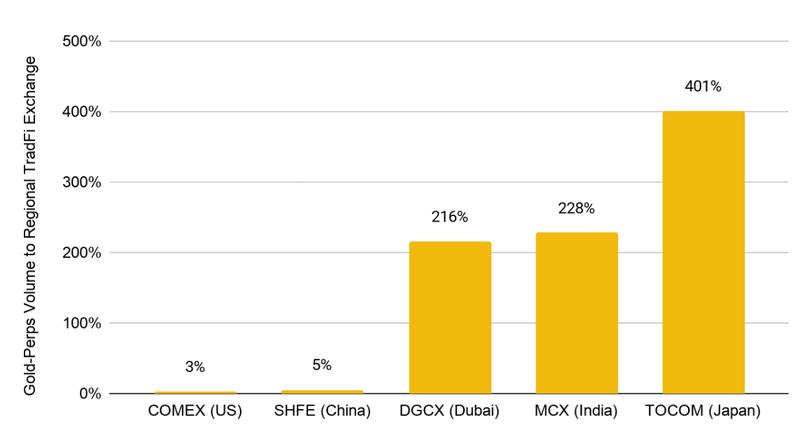
Binance Research further reported that gold perpetual instruments surpassed multiple regional commodity trading platforms throughout March, achieving 401% when measured against gold futures transactions on the Japanese energy commodities futures exchange TOCOM, 228% relative to India's Multi Commodity Exchange (MCX) and 216% compared to the Dubai Gold & Commodities Exchange (DGCX).
Binance credited a portion of this expansion to "market-moving events" that frequently take place during weekend periods, circumstances that would otherwise leave market participants vulnerable to price gap risks when trading through conventional platforms that operate within standard business hours.