
Democratic Lawmakers Propose Legislation to Ban War-Related Prediction Market Wagers
New legislation from Democratic members of Congress seeks to prohibit US government officials from having financial incentives through prediction market wagering that could influence their military policy decisions.

A pair of Democratic members of the United States Congress have put forward new legislation addressing concerns about "government corruption" stemming from wagering activity on prediction markets platforms.
According to a Tuesday statement, Representative Greg Casar from Texas and Senator Chris Murphy from Connecticut revealed they had put forth the Banning Event Trading on Sensitive Operations and Federal Functions (BETS OFF) Act following activity where multiple Polymarket accounts placed "highly unusual bets" regarding the potential outbreak of war between the United States and Israel against Iran.
On March 4, Murphy stated that individuals possessing "inside information" regarding US President Donald Trump's intentions to conduct bombing operations against Iran had likely placed the wagers.
"We shouldn't live in a country where someone sitting in the situation room making decisions about whether to invade or to bomb, decisions about war and peace, life and death, that those decisions could be driven by the fact that they have hundreds of thousands of dollars riding on the decision,"
said Casar.
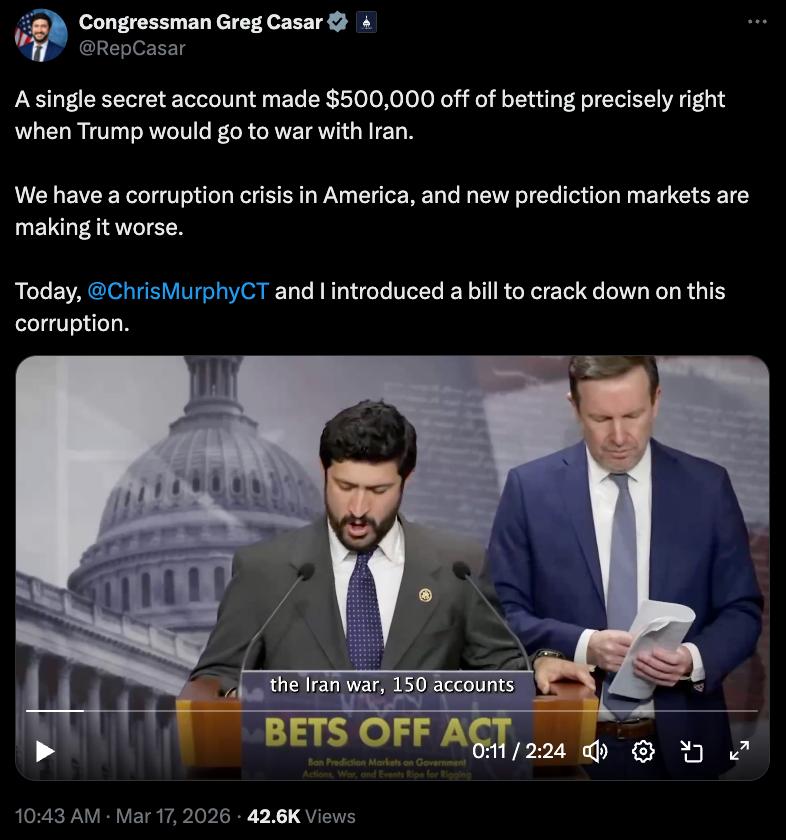
This proposed legislation represents the most recent development in ongoing efforts by United States lawmakers to impose restrictions on prediction market platforms and user accounts suspected of exploiting insider information for financial gain from governmental decisions. In the previous week, Senator Adam Schiff from California put forward the DEATH BETS Act, which would prohibit prediction markets platforms from offering event contracts involving war, terrorism, assassination and deaths of individuals.
Prediction markets platforms such as Polymarket and Kalshi provide wagering opportunities on numerous outcomes, ranging from sporting competitions to United States political events. Nevertheless, individuals placing wagers on specific aspects of the United States-Israel military conflict with Iran have sparked widespread controversy across multiple government sectors. This past Monday, a military correspondent working for the Times of Israel reported receiving death threats following his published report about the date an Iranian missile struck Israel, with all threats connected "in order to resolve a prediction on Polymarket."
War-related bets still live on Polymarket
At the time of writing on Tuesday, Polymarket continued to provide users with opportunities to wager on various possible outcomes related to the United States-Israel conflict with Iran, including whether the United States would deploy ground forces to Iranian territory, the potential timing of a ceasefire agreement, and possible shifts in Iranian leadership structure.
"The promise of prediction markets is to harness the wisdom of the crowd to create accurate, unbiased forecasts for the most important events to society. That ability is particularly invaluable in gut-wrenching times like today. After discussing with those directly affected by the attacks, who had dozens of questions, we realized that prediction markets could give them the answers they needed in ways TV news and [X, formerly Twitter] could not."
said Polymarket in a note on Middle East markets.
By comparison, Kalshi provided event contracts concerning the Iranian conflict but excluded specific military operations from its offerings, instead focusing on matters such as whether Iran might negotiate a nuclear agreement with the United States and the possibility of Trump or other elected officials making visits to Iran.