
Declining Bitcoin Demand Could Trigger Extended Consolidation Period: Expert Analysis
BTC faces weakening demand and declining ETF inflows while trading under $80,000, increasing the likelihood of extended consolidation or potential decline to $65,000 levels.

The appetite for Bitcoin (BTC) has witnessed a significant decline in recent days as the cryptocurrency encountered resistance when attempting to break through the $80,000 threshold. Market analysts indicate that BTC's failure to maintain critical support zones could be setting the stage for an extended period of price consolidation.
Key takeaways:
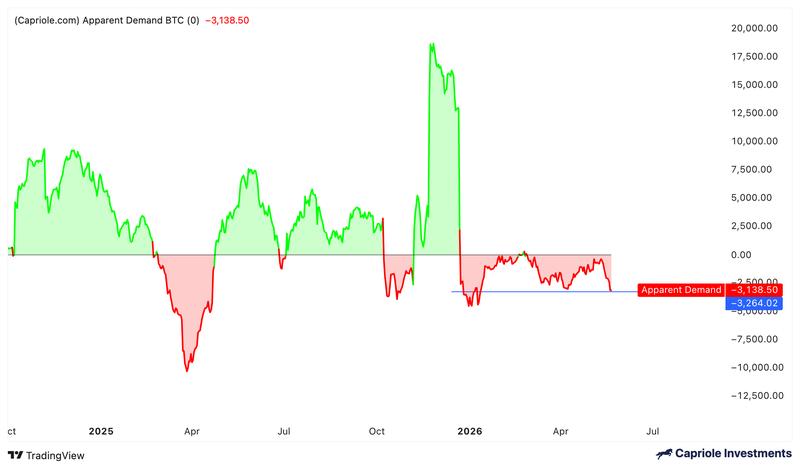
- Bitcoin's apparent demand dropped to -3,138 BTC, reaching its weakest point in four months.
- Diminished spot market activity combined with negative ETF flows are exerting downward pressure on BTC price beneath $80,000.
- Market analysts caution that Bitcoin faces the risk of extended consolidation or a more significant correction unless $78,000 is successfully breached.
Bitcoin apparent demand reaches four-month low point
The apparent demand for Bitcoin has plummeted to its weakest level since the middle of January, as market participants and investors have embraced a risk-averse strategy amid geopolitical tensions and macroeconomic uncertainty.
The Bitcoin Apparent Demand metric from Capriole Investment indicates that demand for Bitcoin has remained in negative territory since Dec. 22, 2025 and showed modest improvement during late February, before experiencing a sharp reversal to -3,138 BTC on Thursday.
In its latest Weekly Crypto report, CryptoQuant stated that "Bitcoin's overall demand has flipped into net contraction," further noting:
"Spot apparent demand is contracting at a slightly faster pace than in prior weeks."
"Despite Bitcoin remaining relatively resilient structurally, the latest spot positioning data suggests broad-based spot accumulation has yet to re-emerge."
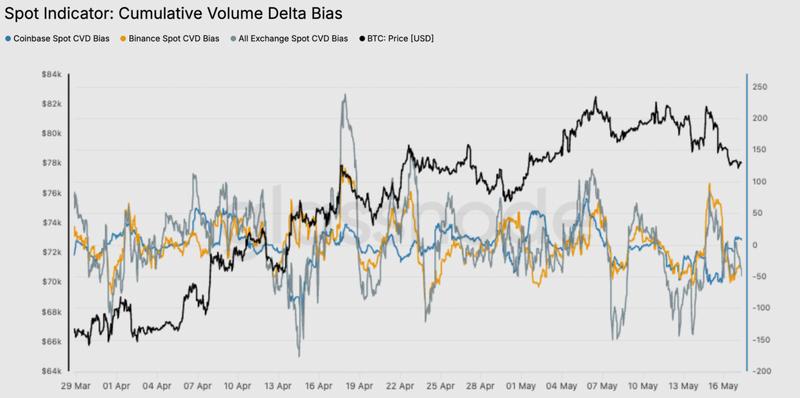
At the same time, spot exchange-traded funds (ETFs) based in the United States also transitioned to net sellers, as the 30-day change in ETF holdings declined to its weakest level in close to three months.
This indicates that "outright spot demand is becoming less aggressive near the current range highs," as Glassnode pointed out.
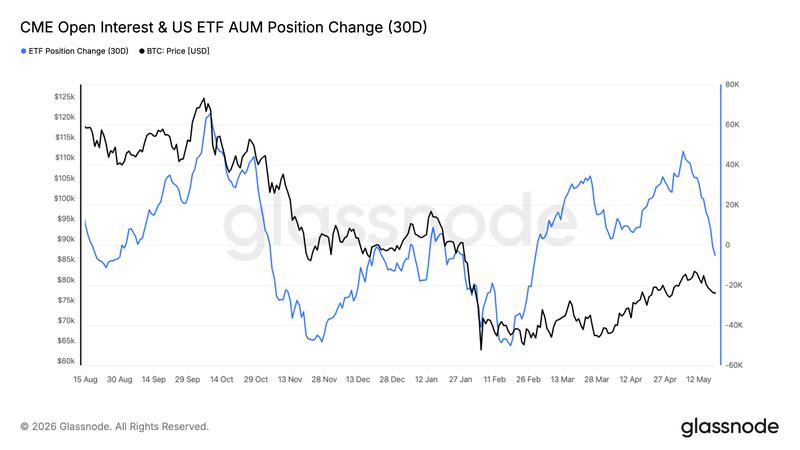
The concurrent weakening observed across both spot demand and ETF flows has "historically been more consistent with renewed price weakness than with stable consolidation," as CryptoQuant determined.
Bitcoin's price reaches a critical inflection point
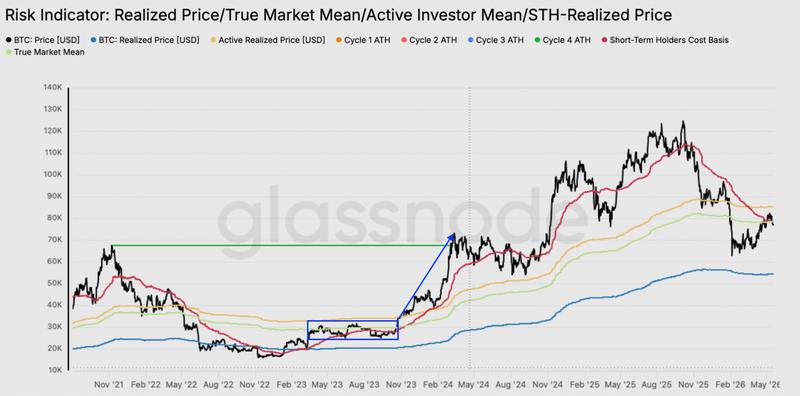
The 38% surge in Bitcoin's price to $82,800 from its macro bottom of $60,000 represented a significant recovery that pushed prices above the true market mean, which currently stands at $78,300.
The true market mean represents a price model that monitors the average acquisition cost of actively transacted Bitcoin supply and "historically serves as the dividing line between bear and bull market regimes, as stated by Glassnode.
The onchain data provider explained that recapturing this level constitutes a "necessary but not sufficient condition for a structural transition," further stating:
"Conventionally, pre-bull market phases require weeks to months of sustained consolidation around this model before a credible regime shift can be confirmed."
It's worth noting that the price underwent consolidation around the true market mean for more than six months, spanning from March through October 2021, prior to initiating a 174% surge to its previous all-time high of $74,00 achieved in March 2024.
Glassnode further elaborated:
"Any deeper correction from current levels would therefore reframe the recent rally as a local top within the ongoing bear market, a structure that has recurred multiple times in prior cycles and remains the higher probability outcome until price demonstrates sustained follow-through."
Additional analysts have drawn attention to vulnerabilities in Bitcoin's market structure, pointing to diminishing momentum, decreasing retail investor participation, heavy selling pressure in the futures markets and deteriorating technical structure, all of which place BTC at risk of falling to levels as low as $65,000 throughout the coming weeks.