
Crypto Takes a Back Seat in Ramaswamy's Ohio Governor Campaign Unlike Presidential Race
Despite owning shares in a digital asset management firm and securing financial backing from cryptocurrency industry figures, the Republican contender for Ohio governor has steered clear of emphasizing digital currencies in his campaign messaging.
During his presidential campaign two years prior, Vivek Ramaswamy, then seeking his party's nomination, consistently championed the benefits of digital currencies.
As he pursued the Republican nomination for the 2024 presidential election, Ramaswamy frequently incorporated endorsements of Bitcoin (BTC) and cryptocurrency mining facilities into his campaign speeches, while maintaining a firm opposition to the concept of central bank digital currencies.
Today, the former presidential hopeful Ramaswamy has set his sights on becoming Ohio's next chief executive. Though he hasn't exactly distanced himself from his digital asset policy positions, these issues aren't taking center stage in his gubernatorial campaign, despite his significant cryptocurrency investment portfolio and Ohio's considerable stake in the industry.
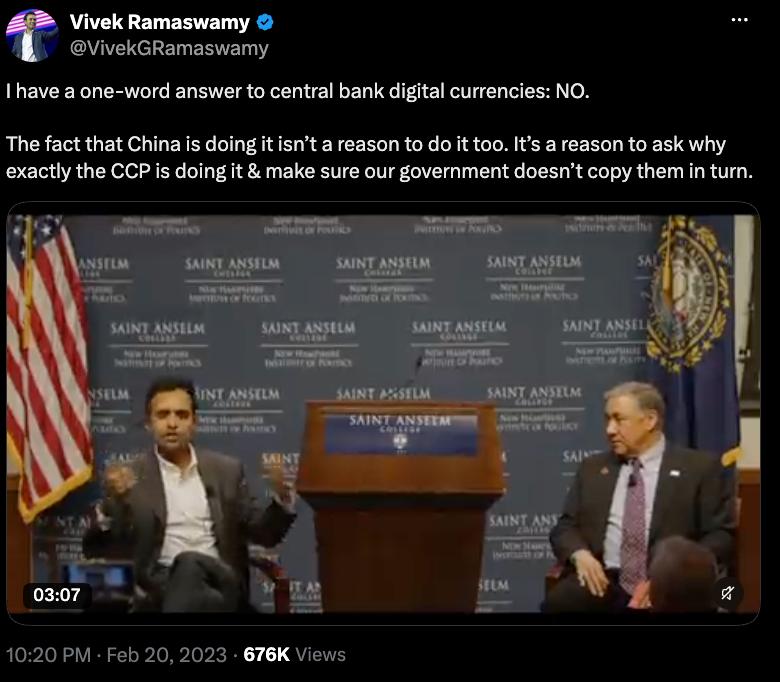
During his 2024 White House campaign, Ramaswamy regularly released declarations opposing central bank digital currencies (CBDCs), extolling the virtues of Bitcoin (BTC) along with its mining infrastructure, and routinely appeared as a featured speaker at cryptocurrency industry conferences.
Following Donald Trump's victory in the presidential election, Ramaswamy was selected to head the Department of Government Efficiency, or DOGE, working alongside Elon Musk. However, Ramaswamy departed without ever formally serving in the administration.
Prior to declaring his candidacy for Ohio's gubernatorial seat in February 2025, he publicly endorsed the Ohio Strategic Cryptocurrency Reserve Act, proposed state legislation that would permit establishing a strategic Bitcoin reserve. In September 2025, Strive, the asset management company he helped establish in 2022, revealed intentions to expand into the digital asset sector with a Bitcoin Bond ETF, targeting bonds from corporations accumulating BTC.
Cointelegraph contacted the Ramaswamy campaign seeking comment but did not hear back despite multiple interview requests.
Crypto as a gubernatorial candidate
In the immediate aftermath of launching his gubernatorial campaign officially, Ramaswamy continued with much of the identical messaging he had promoted throughout his presidential campaign, additionally appearing at the Bitcoin for America conference in March and Bitcoin 2025 in May.
His campaign's official website permits cryptocurrency donations, and he has garnered financial backing from the founding team behind World Liberty Financial, the Trump family's cryptocurrency venture: Chase Herro, Zak Folkman and Zachary Witkoff, each contributing the maximum permitted amount of $16,615.
Additional organizations connected to the cryptocurrency sector have contributed millions to Ramaswamy's Super political action committee (PAC) titled "V-PAC: Victors, Not Victims," including a $20 million contribution from Susquehanna International Group co-founder Jeff Yass, a $6 million donation from NYDIG founder Ross Stevens, $5 million from billionaire Elon Musk and $5,000 from the Bitcoin Voter Project.
Ramaswamy has retained his ownership interest in Strive, which disclosed holdings of 23,156 BTC valued at approximately $2 billion as of Aug. 28. A filing submitted in August to the US Securities and Exchange Commission revealed the candidate possessed 5,693,897 shares in the firm, valued at over $170 million as of Sept. 26. He additionally disclosed personally maintaining more than $1,000 in BTC and Ether (ETH) as of April via a Coinbase wallet.
By September 2026, merely weeks before the election, Ramaswamy's public commentary on digital assets and associated policies seems to have diminished compared to his 2024 and even 2025 messaging. As of publication time, he had not responded to a Sept. 17 announcement from Ohio Secretary of State Frank LaRose regarding the state's acceptance of cryptocurrency for paying state fees and services.
What's different for Ohio voters in 2026? Data centers, for one
Ohio's electorate may account for Ramaswamy's apparent decision to reduce his cryptocurrency-focused rhetoric. The state had already been targeted with over $40 million in expenditures by industry-affiliated organizations in 2024 supporting Republican Bernie Moreno's Senate campaign.
During that election cycle two years ago, Moreno successfully unseated incumbent Democrat Sherrod Brown, yet history appears to be repeating: Brown has now entered the race against Republican Jon Husted seeking another Senate opportunity in the upcoming November election. The Fairshake PAC has committed to an initial $30 million expenditure opposing the Democratic candidate once more, with $11 million already reported in advertising purchases.
Notably, polling data compiled by the Digital Currency Group in May 2024, several months prior to the election, indicated that Ohio's electorate was "more negative towards crypto" relative to voters in other US states, with 79% of Ohio survey participants stating they had never owned crypto and 77% expressing unfavorable opinions regarding digital currency.
Public opinion regarding data centers has emerged as another contentious campaign topic for Ohio political candidates in 2026. Data from the Pew Research Center indicates there were 166 data centers operating in Ohio as of April, providing the state with more facilities than any other across the nation. The state also hosts numerous crypto mining facilities, including operations by Cipher Mining, Bitdeer and BIT Mining.
Public surveys also indicated that the majority of Ohio's population opposes data centers being built in their local communities. In August, Ramaswamy made a commitment that any data center constructed in an Ohio community would ensure residents face no electricity costs while enjoying reduced property taxes, whereas his Democratic challenger, Amy Acton, has put forward a proposal that "all costs for gas, water and electricity needs to be covered by data centers and their investors, not Ohio taxpayers or our communities."
According to Sept. 22 data, a composite of RealClearPolling results revealed Acton holding a one-point advantage over Ramaswamy, rendering the contest essentially too close to call. A prediction market contract on Kalshi at the most recent check on Monday showed over $2 million in wagered funds and indicated the Democratic contender had a 66% probability of securing the gubernatorial race, with comparable odds reflected on a Polymarket contract.