
Crypto market downturn of 2026 fails to dampen AI and stablecoin momentum
While the broader cryptocurrency market experiences significant weakness in 2026, AI tokens and stablecoin platforms demonstrate exceptional strength backed by solid underlying fundamentals.

Despite widespread market challenges throughout 2026, the artificial intelligence and stablecoin segments have maintained impressive growth trajectories, demonstrating exceptional staying power fueled by what analysts describe as the "strongest structural tailwinds," according to recent industry analysis.
Key takeaways:
- AI sector posts smallest loss in Q1/2026, down just 14%.
- Stablecoin market cap hits a record $320 billion, with monthly transaction volumes at a record $1.8 trillion.
AI and stablecoin sectors buck the trend
While Bitcoin (BTC) has experienced an 18.5% decline throughout 2026, and the overall cryptocurrency market valuation has contracted to $2.42 trillion, with the majority of alternative cryptocurrencies underperforming, concerns and anxiety surrounding geopolitical tensions including the US and Israel-Iran conflict alongside the Federal Reserve's restrictive monetary stance continue to dominate market sentiment.
In stark contrast, artificial intelligence and stablecoin-focused enterprises persist in swimming against the current, demonstrating meaningful expansion and robust core metrics that underscore a strategic shift from speculative trading toward foundational infrastructure investments.
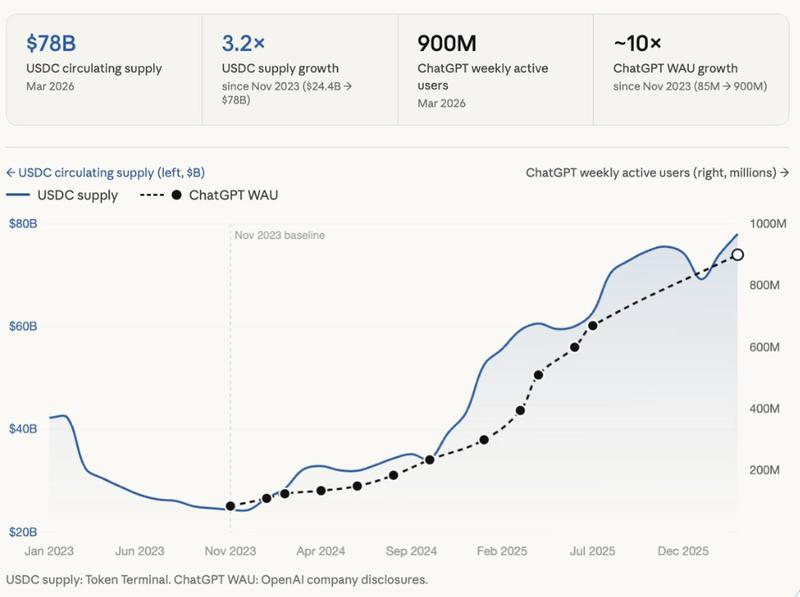
As one illustration, Circle's USDC (USDC) circulation has reached $78 billion, representing a 220% expansion since November 2023, according to information provided by Token Terminal.
Additionally, ChatGPT's weekly active user base has surged to 900 million in March 2026 from 85 million in November 2023, representing an approximately 10x multiplication during this timeframe.
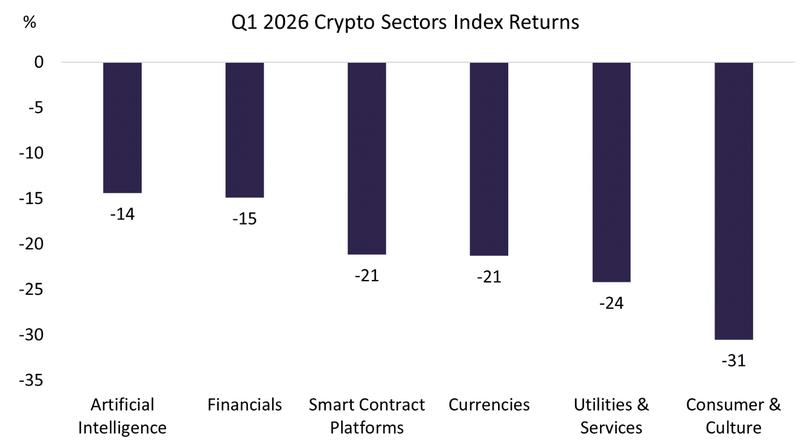
This trend receives further validation from Grayscale's Q1/2026 quarterly analysis, which demonstrates that the artificial intelligence category experienced the most modest decline at 14% throughout the opening quarter of the year, in comparison to Consumer and Culture declining 31%, Smart Contract Platforms dropping 21%, and Currencies falling 21%.
This pattern suggests that "investor appetite shifted away from momentum-driven and more speculative segments," according to the digital-asset investment manager, which further elaborated:
"Despite subdued overall sentiment, capital appeared to rotate toward projects with stronger fundamentals and those aligned with key themes such as AI and tokenization."
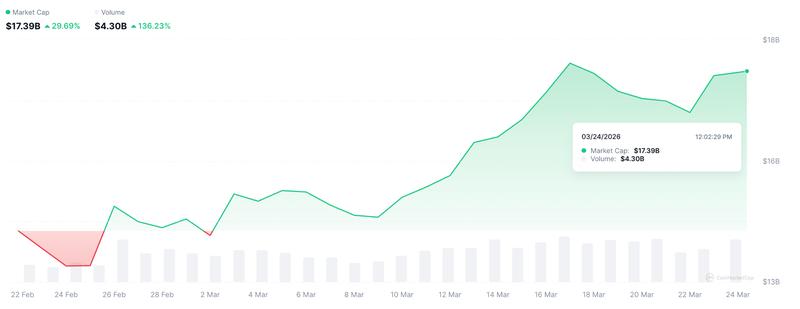
The aggregate market valuation of all artificial intelligence tokens currently sits at $17.4 billion, representing a 30% increase throughout the past 30 days. Leading this expansion are Bittensor (TAO) and NEAR Protocol (NEAR), which have posted 75% and 30% valuation gains, respectively, during the identical timeframe.
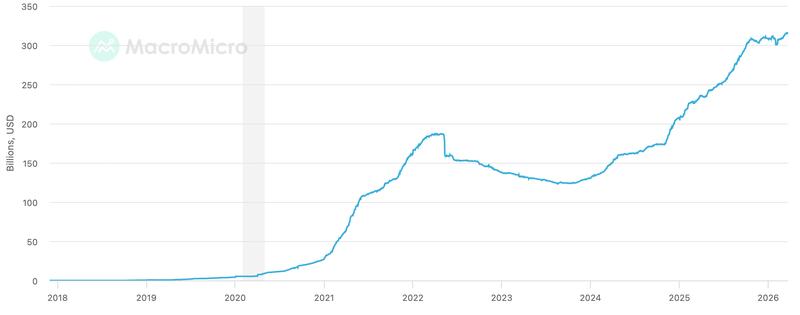
In parallel fashion, stablecoins have sustained their upward trajectory, with overall market capitalization achieving an unprecedented $320 billion on March 23. Tether's USDt (USDT) continues its market leadership position at approximately $184 billion, accounting for 57% of total stablecoin circulation.
Transaction volumes on a monthly basis reached an unprecedented $1.8 trillion in February, positioning them as competitive alternatives to conventional payment infrastructure. USDC spearheaded supply expansion with an 80% month-over-month growth to reach a $1.26 trillion all-time peak last month.
Stablecoins represent digital currencies engineered to preserve consistent valuation, most commonly anchored to traditional fiat currencies such as the US dollar, and possess the capability to operate across numerous blockchain networks.
During bearish market conditions, stablecoins function as purchasing power reserves and settlement infrastructure, commanding the majority of trading pair configurations, underpinning tokenized physical-world assets, and facilitating yield-generating financial products.
Ethereum alongside alternative blockchain networks process substantial transfer volumes, while institutional offerings from banking institutions and financial technology companies incorporate these instruments for yield optimization and treasury operations. This foundational utility continues uninterrupted even as speculative holdings experience value erosion.
"Structural tailwinds" drive growth convergence
Both sectors continue flourishing because they provide quantifiable utility independent of speculative market dynamics.
"AI labs and stablecoin issuers are among the businesses with the strongest structural tailwinds of the 2020s," according to Token Terminal.
These sectors occupy the "intersection of three distinct forces: technology, finance, and geopolitics," with each individual driver independently fueling demand across these categories, the cryptocurrency analytics platform explained, further noting:
"AI drives productivity and defense capabilities, while stablecoins provide financial infrastructure for global dollar distribution."
Through a social media post on X published Monday, cryptocurrency analyst Mando CT identified AI and stablecoins as two of the four prevailing sectors throughout 2026.
Discussing the interconnection between these trends, the analyst highlighted that artificial intelligence systems require instantaneous and minimal-cost payment mechanisms for optimal functionality, while stablecoins represent the "internet money" essential for facilitating such transactions.
"These trends are connected," Mando CT explained, proceeding to state:
"2026 isn't just another cycle. It's the transition from: Speculation to Infrastructure."
Previous reporting from Cointelegraph indicated that stablecoins stand positioned to capitalize on AI-powered payment systems by facilitating seamless, automated, and programmable transactions between various participants, thereby accelerating sustained growth across both technological sectors.