
Crypto Biz: When traditional markets shut down, tokenized equities continue
Beyond traditional Wall Street trading hours, tokenized stocks are generating significant activity, as Bitcoin mining companies grapple with expensive AI infrastructure expansion and potential new accounting standards offer advantages for stablecoins.

Traditional financial markets are starting to experience transformation through tokenization, with equities becoming an area of growing interest. While significant attention has focused on the $3.3 billion worth of tokenized equities currently existing onchain based on RWA.xyz data, one of the most significant developments may actually be occurring during the hours when Wall Street remains closed.
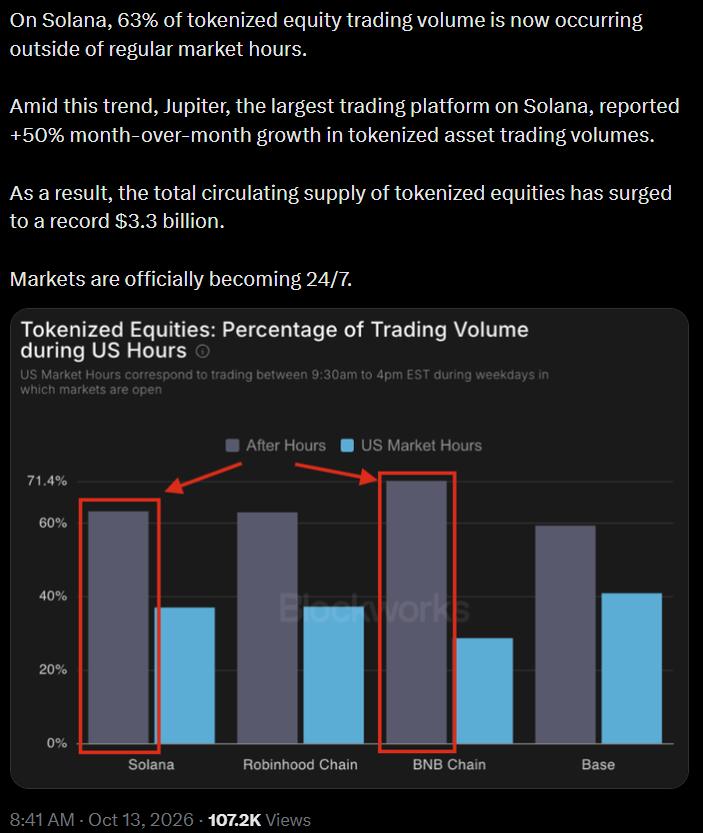
New industry statistics reveal that over 70% of trading volume for tokenized stocks on BNB Chain currently takes place beyond the standard US market operating hours, with comparable trends appearing on both Solana and Base networks.
Through tokenized equities, investors gain the ability to trade American stocks across different time zones without needing to wait for the opening of Wall Street's trading session, which could fundamentally alter the distribution of liquidity throughout each trading day.
Despite this growth, numerous platforms facilitating this trading activity continue to restrict access for American investors, even while US regulatory authorities have started creating frameworks to accommodate tokenized stock trading.
In this week's edition of Crypto Biz, we examine trading patterns in tokenized stocks, the financial realities facing Bitcoin mining operations, newly proposed accounting regulations that might enable companies to classify stablecoins as cash equivalents, and the continued growth of Strive's Bitcoin treasury holdings.
Trading hours beyond Wall Street attract tokenized stock participants
The majority of tokenized stock transactions on both Solana and BNB Chain currently happen beyond standard US market operating hours, indicating that continuous access throughout the day is emerging as a significant advantage for equities distributed onchain.
Data from Blockworks referenced by The Kobeissi Letter indicates that over 70% of trading volume for tokenized stocks on BNB Chain happens beyond the conventional 9:30 am to 4:00 pm Eastern time trading period. On Solana, the percentage reaches 63%, while Base sees nearly 60% of activity occurring outside regular hours.
Trading volumes are also experiencing growth. Jupiter disclosed a 50% month-over-month rise in trading volume for tokenized assets, while information from RWA.xyz demonstrated that tokenized stock valuations increased 15% during the previous 30 days, approaching nearly $3.3 billion.
This development emerges as the US Securities and Exchange Commission's innovation exemption creates opportunities for qualified platforms to facilitate trading of tokenized US-listed stocks through public blockchains, contingent upon meeting disclosure requirements and shareholder protection standards. Nevertheless, current platforms including xStocks and Ondo Global Markets continue to be mostly inaccessible to US investors, which restricts domestic engagement in this expanding marketplace.
Warrant exercises enable Strive to acquire 3,311 Bitcoin worth $208 million
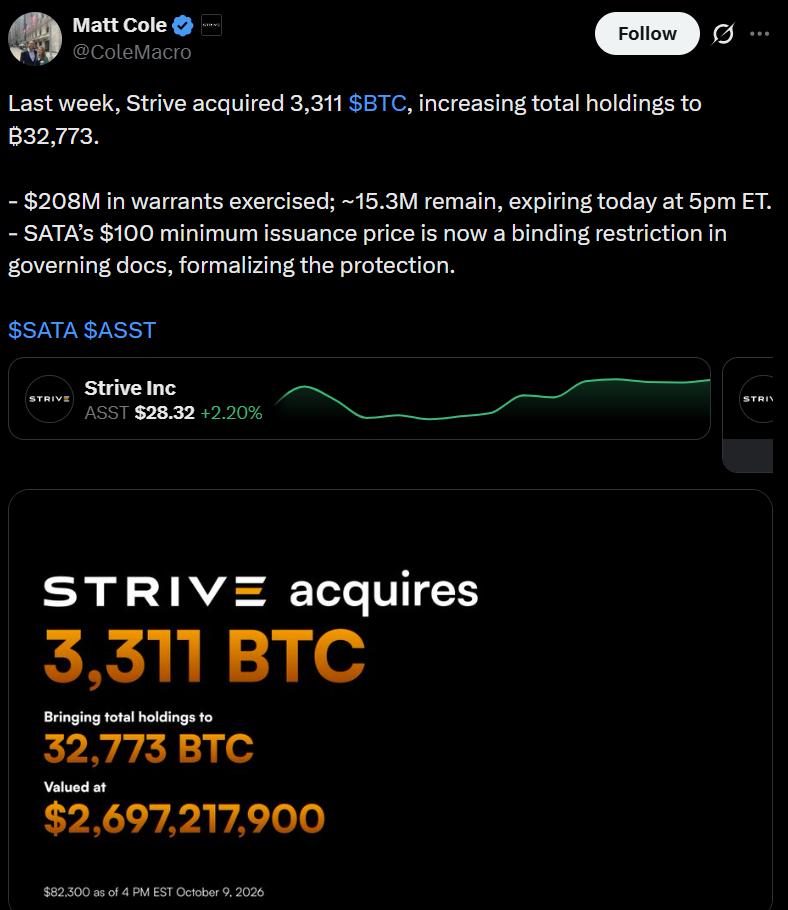
Strive, a Bitcoin treasury company, expanded its cryptocurrency holdings by over 11% in the previous week, utilizing funds generated from warrant exercises to grow its cryptocurrency reserves while simultaneously boosting Bitcoin exposure on a per-share basis.
Through a Tuesday SEC filing, Strive revealed its acquisition of 3,311 BTC throughout the week concluded Oct. 9 at an approximate average cost of $84,500 per coin. These acquisitions elevated its aggregate holdings to 32,773 BTC, positioning the company as the fifth-largest publicly traded corporate Bitcoin holder.
According to CEO Matt Cole, investors completed warrant exercises totaling $208 million, with approximately $15.3 million remaining outstanding before Tuesday's expiration deadline.
The company also modified its governing documents to implement a binding minimum issuance price of $100 for its SATA preferred shares, which had been trading at $99.40. At the same time, Bitcoin was trading around $83,300, beneath Strive's average weekly purchase price, while the company's common stock, ASST, showed minimal movement at $27.52.
AI infrastructure expansion creates substantial financing challenges for Bitcoin miners
Companies engaged in Bitcoin mining that are expanding operations into artificial intelligence and high-performance computing are encountering a growing disparity in borrowing expenses as financial institutions evaluate the risks associated with large-scale data center developments.
Based on BlocksBridge Consulting's Miner Weekly report, obtaining AI customers represents just one aspect of the challenge. Mining companies also require billions of dollars for facility construction, equipment acquisition and power infrastructure security, with financing terms becoming progressively dependent on customer quality and the probability of successful project completion.
Recent transactions highlight these disparities. In June, IREN obtained $3.65 billion in financing at a blended interest rate of 6%, then secured an additional $2.4 billion in August at a fixed 9% rate. However, these agreements cover separate projects, which complicates direct comparisons.
The magnitude of financing requirements is considerable. A June analysis from BlocksBridge referencing VanEck estimated that publicly traded Bitcoin mining companies needed $50 billion to support their AI infrastructure objectives. IREN alone confronted a $21.1 billion funding shortfall, with Riot Platforms following at $7.2 billion and HIVE Digital Technologies at $4.6 billion.
Proposed US accounting standards could enhance stablecoin appeal for corporations
A potential modification to US accounting standards might increase stablecoin attractiveness for corporate treasury departments by permitting qualifying tokens to be classified as cash equivalents on corporate balance sheets, based on a report from payments blockchain Tempo.
Current accounting practices may prevent stablecoin holdings from counting toward a company's documented cash reserves, which could impact liquidity ratios and loan covenant compliance even when the tokens maintain full backing by US dollars.
The Financial Accounting Standards Board (FASB) proposal has the potential to alter this situation, although Tempo emphasized that companies would require direct redemption rights with stablecoin issuers to qualify. As an example, merely purchasing USDC via a cryptocurrency exchange would not automatically satisfy that requirement.
Coinbase has already categorized USDC and additional payment stablecoins as cash equivalents within its 2025 annual report, backed by its redemption agreement with Circle.
The proposal remains available for public comment until Nov. 19, following which FASB will evaluate the feedback before establishing the final regulations and their implementation date.
Crypto Biz is your weekly pulse on the business behind blockchain and crypto, delivered directly to your inbox every Thursday.