
CFTC unveils regulatory framework distinguishing sports prediction markets from traditional gambling
The regulatory framework proposed by the CFTC would permit numerous sports-based prediction markets while exempting election contracts from gaming classifications.

The United States Commodity Futures Trading Commission (CFTC) has put forward new regulatory guidelines for prediction markets, indicating that contracts based on sports events typically do not conflict with public interest despite being categorized as "gaming" under federal statutes.
Published this Wednesday, the regulatory framework makes a clear distinction between sports event contracts and purely chance-based games, asserting that markets centered on final game scores and team win-loss statistics can facilitate price discovery mechanisms. However, contracts linked to player health incidents, referee calls, or other results that might incentivize manipulation are expected to fail the public interest standard.
The regulatory framework additionally establishes that election contracts fall outside the scope of "gaming" as defined by applicable federal statutes. According to Reuters, this clarification may reduce regulatory ambiguity for platforms like Kalshi and Polymarket, which gained significant traction throughout the 2024 United States presidential election as market participants increasingly relied on prediction markets to assess the electoral race's trajectory.
The proposed regulations are available for public feedback for a 45-day period and may play a crucial role in shaping the upcoming regulatory landscape for prediction markets in the United States.
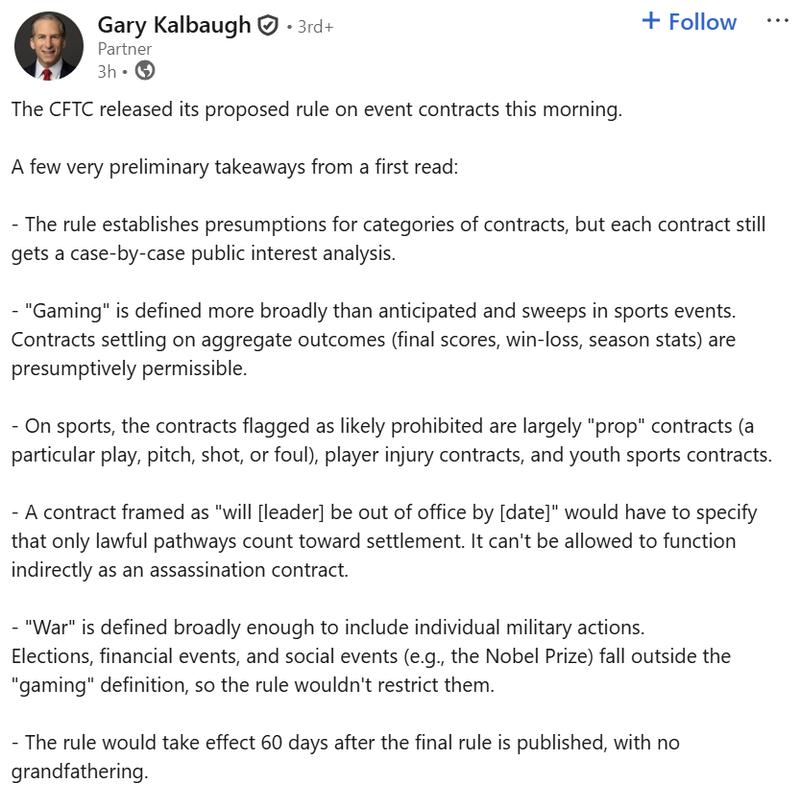
Gary Kalbaugh, a legal partner at Cahill Gordon & Reindel LLP based in New York, characterized the proposal as principles-oriented rather than providing blanket authorization, emphasizing that individual contracts would continue to undergo case-by-case public interest evaluation.
"'Gaming' is defined more broadly than anticipated and sweeps in sports events. Contracts settling on aggregate outcomes (final scores, win-loss, season stats) are presumptively permissible."
Gary Kalbaugh
Increased regulatory clarity comes as prediction markets see adoption surge
The regulatory proposal arrives at a time when prediction markets — characterized as an "asset class" within the draft documentation — are experiencing continued growth, with both Kalshi and Polymarket achieving valuations in the multibillion-dollar range amid heightened investor enthusiasm and institutional participation.
The two platforms have both strengthened their connections to conventional financial markets. Kalshi has recently entered into a partnership with Nasdaq to introduce a novel category of prediction markets that enables participants to project the future market valuations of privately held companies before their initial public offerings.
Polymarket, on the other hand, has established a partnership with Dow Jones to incorporate live prediction market information into its portfolio of media properties, which includes The Wall Street Journal.
"The prediction markets continue to become more mainstream, with newly formed partnerships with news organizations and more firms moving quickly into this space. As these markets continue to grow, the unanswered question is if event contracts are financial instruments or are they simply gambling."
Melinda Roth, professor of sports law and corporate finance at Georgetown University Law Center
Market analysts at Bernstein indicate that prediction markets are experiencing increased institutional adoption as investors pursue alternative macro-hedging instruments through binary-outcome contracts.