
Canadian institutions to gain stablecoin payment infrastructure through Deloitte-Stablecorp partnership
A partnership between Deloitte and Stablecoin will bring Canadian dollar stablecoin integration to institutional payment infrastructure amid federal government progress on digital asset regulations.

A new partnership between Deloitte Canada and Stablecorp aims to build stablecoin infrastructure tailored for Canadian financial institutions, coinciding with federal regulatory authorities progressing toward finalizing regulations for digital assets backed by fiat currency.
According to an announcement made on Monday, the professional services company intends to incorporate QCAD, Stablecorp's stablecoin pegged to the Canadian dollar, into institutional client payment and settlement systems.
Based in Toronto, Stablecorp operates as a fintech enterprise and serves as the issuer of QCAD, a stablecoin backed by fiat currency engineered to preserve a one-to-one parity with the Canadian dollar.
According to Soumak Chatterjee, a partner in Deloitte Canada's financial services division, the initiative is aimed at helping banks and other institutions prepare for the adoption of stablecoins once a regulatory regime is established.
According to the companies, potential applications encompass facilitating round-the-clock payment capabilities, enhancing settlement efficiency relative to conventional banking infrastructure, and leveraging blockchain-based record management to ensure transaction transparency. The firms also highlighted opportunities for developing novel financial products constructed on tokenized infrastructure.
No bank partners or rollout timeline were provided.

Canada moves toward stablecoin rules as global regulatory race intensifies
This development emerges as Canada's federal government pushes forward with a national framework for stablecoins through Bill C-15, budget implementation legislation that was introduced last November and contains a proposed federal framework to regulate fiat-backed stablecoins.
Although Canadian Prime Minister Mark Carney has previously expressed skepticism about crypto, he has lately acknowledged that the technologies underpinning digital assets could "improve financial stability; support more innovative, efficient and reliable payment services as well as have wider applications."
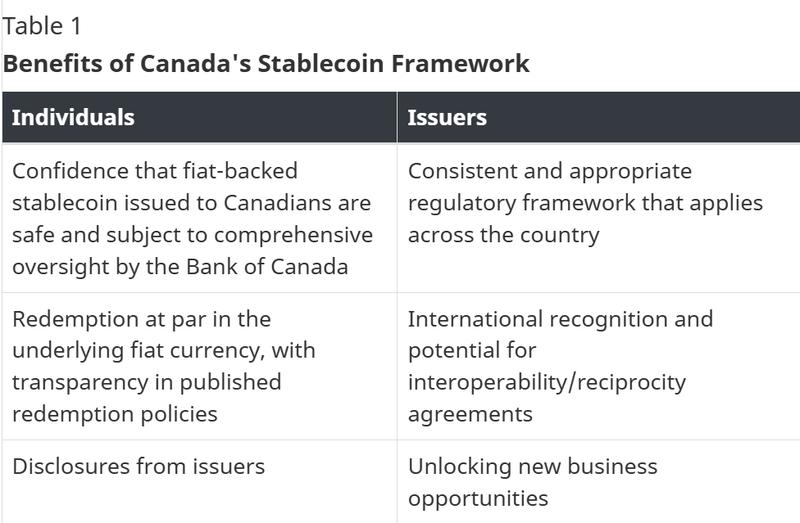
Canada's central bank has similarly advocated for more definitive regulations governing stablecoins, maintaining that regulatory clarity is essential to modernize the nation's payment infrastructure. According to the central bank, any regulatory framework must guarantee that stablecoins maintain full backing by high-quality liquid assets and remain redeemable at par, while cautioning that regulatory delays could result in Canada falling behind other jurisdictions.
This effort emerges as stablecoin regulatory frameworks in the United States have gained traction, culminating in the passage of the GENIUS Act for payment stablecoins last summer.
At present, the marketplace for stablecoins denominated in Canadian dollars remains limited, particularly compared to the dominant US dollar segment, where Tether's USDt (USDT) and Circle's USDC (USDC) account for the vast majority of global stablecoin supply and usage.
Plans for a central bank digital currency were discontinued by the Bank of Canada in September 2024 following more than seven years of research, including a public consultation process that drew nearly 90,000 public responses.