
BTC Slips Below $80K, Yet Three Catalysts Could Trigger a Faster Recovery Than Anticipated
BTC prepares for potential rebound past $80,000 driven by Strategy's massive $2 billion Bitcoin acquisition, deteriorating faith in US Treasury bonds, and possible diplomatic resolution between Washington and Tehran.

Key takeaways:
- Strategy's substantial Bitcoin accumulation helped counterbalance recent liquidations from leveraged bullish positions.
- Climbing Treasury yields combined with mounting US government debt obligations are pushing investors toward limited-supply assets.
- A prospective diplomatic agreement between Washington and Tehran could rapidly revive traders' willingness to take on risk.
Bitcoin (BTC) encountered resistance after an unsuccessful push beyond $82,000 last Thursday. When the cryptocurrency retested support at $76,000 this Monday, it resulted in $400 million worth of liquidations affecting bullish Bitcoin positions throughout the four-day span. Despite the 7% price drop dampening trader sentiment, the possibility of reclaiming the $80,000 threshold remains credible.
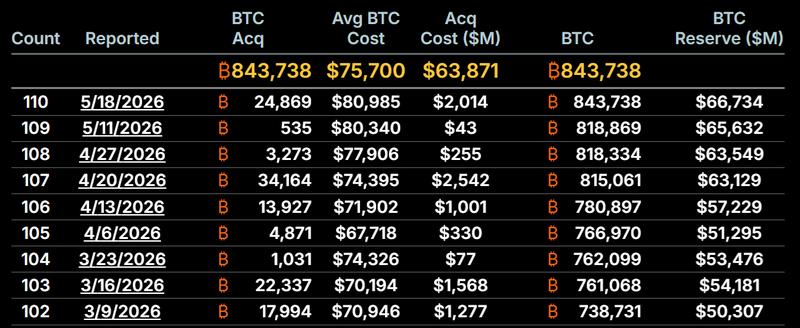
The publicly-traded Strategy (MSTR US) finalized its purchase of $2 billion worth of BTC during just the last week. Under Michael Saylor's leadership, the corporation consistently amazes market participants through discovering creative methods to lower capital costs and generate funds via stock offerings, utilizing either MSTR common shares or STRC preferred equity instruments.
Even more significantly, Strategy demonstrated its capacity to take advantage of market weakness by buying back $1.5 billion worth of its debt obligations maturing in 2029. The retirement of a portion of its senior convertible notes minimizes prospective future dilution affecting existing MSTR shareholders. This strategic maneuver creates additional capacity for fresh share offerings and further Bitcoin acquisitions.
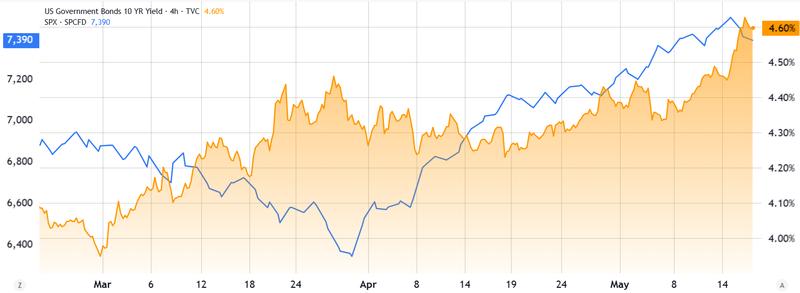
Looking at the broader economic landscape, the likelihood of sustained upward momentum for Bitcoin has strengthened as market participants require elevated returns for holding government bonds. The 10-year Treasury yield climbed to 4.60%, reaching its peak level in 16 months. Market participants are progressively acknowledging the significant pressure facing the US Treasury, particularly considering $2 trillion in long-term debt obligations coming due in 2026.
US dollar weakness and a potential deal with Iran
The US Federal Reserve will probably need to maintain its purchases of bonds and Treasurys, an action that could potentially undermine the US dollar's strength. In general, market participants pursue refuge in limited-supply assets whenever they experience declining confidence in the central bank's capacity to manage a crisis without currency debasement. Even though gold may serve as the principal beneficiary, the motivation to maintain fixed-income holdings decreases substantially.
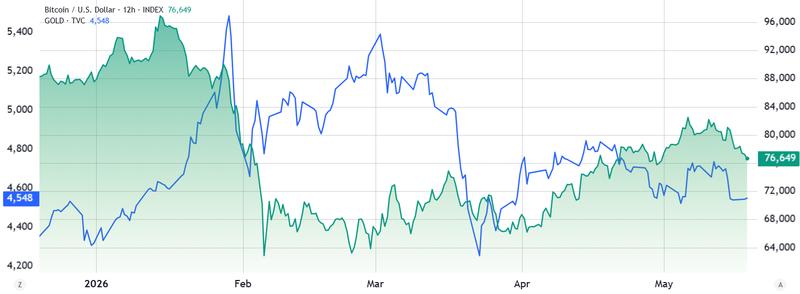
Gold valuations rallied throughout January following the US capture of Venezuelan President Nicolas Maduro and the escalation of President Trump's worldwide trade conflict. Nevertheless, gold gave back the majority of these advances during the subsequent four months, whereas Bitcoin established robust upward momentum, climbing to $76,500 from $65,000 in late February. These latest price movements suggest increasing trust in Bitcoin as a dependable hedging tool.
Crude Brent oil valuations soared to $113 this Monday as discussions to completely reopen the Strait of Hormuz stalled. Oil prices have climbed more than 50% following the US and Israel's strikes against Iran in late February. President Trump's administration additionally chose not to extend a waiver for Russian crude oil, creating further supply constraints, according to Yahoo Finance.
An agreement between the US and Iran, though not the most probable outcome, has the potential to spark renewed appetite for risk-taking and propel the Bitcoin price beyond $80,000 once again. Inflation remains constrained by elevated energy costs, reducing the probability of expansionary monetary policy implementation. Regardless, the conditions favor Bitcoin, given that the US stock market is trading close to its record high whereas the cryptocurrency remains 39% beneath its historical peak.