
BTC Mining Profitability Hits Historic Depths: Can Bitcoin Maintain $60K Support?
Mining operations face unprecedented profit compression as Bitcoin hovers near the $60,000 threshold. What does this mean for cryptocurrency investors?

Key takeaways:
- Bitcoin miners face unprecedented margin compression and increasing interest in AI infrastructure, creating pressure to liquidate BTC holdings.
- Spot Bitcoin flows from institutional sources dwarf mining production, suggesting broader market dynamics matter more than miner profitability trends.
As Bitcoin's valuation retreated to $62,000, the decline coincided with diminished blockchain activity and plummeting revenues for BTC miners, now sitting at unprecedented lows. This collapse in mining profitability is intensifying concerns about potential selling pressure, particularly given that miners and their associated pools maintain control of Bitcoin holdings exceeding $110 billion.
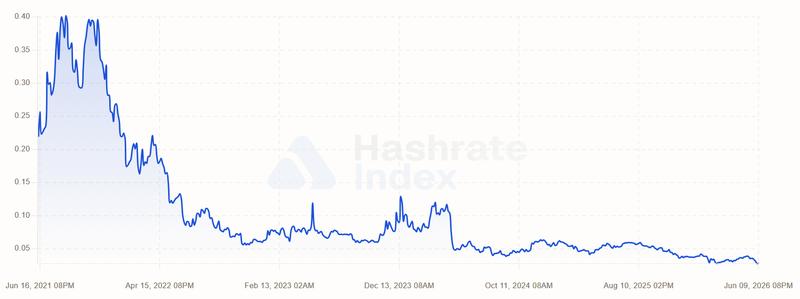
Daily revenue projections for each terahash per second of computational power dropped to an unprecedented $0.28 on Tuesday, representing a decline from $0.39 recorded just thirty days earlier. To illustrate this impact, the projected monthly gross earnings for an Antminer S21 XP Hydro unit (operating with electricity costs at $0.07 per kilowatt-hour) have declined to $137, a substantial decrease from the $192 figure seen in the previous month.
This squeeze on mining profitability emerges at a time when AI capacity requirements and infrastructure investment appetite have intensified, weighing on market confidence precisely as the critical $60,000 price support undergoes testing.
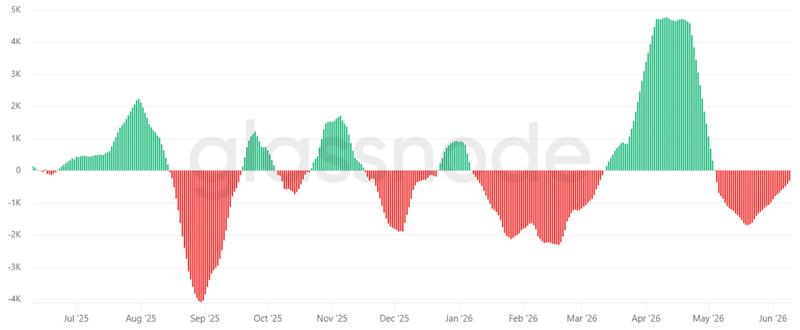
The 14-day rolling average for net position adjustments in Bitcoin balances held across miner and mining pool wallets turned negative during the early days of May and has continued in negative territory ever since. Regardless of whether these sell-offs serve to finance operational expenses, decrease debt obligations, or provide capital for AI data center expansion initiatives, the cumulative impact continues to weigh heavily on Bitcoin's price formation mechanism.
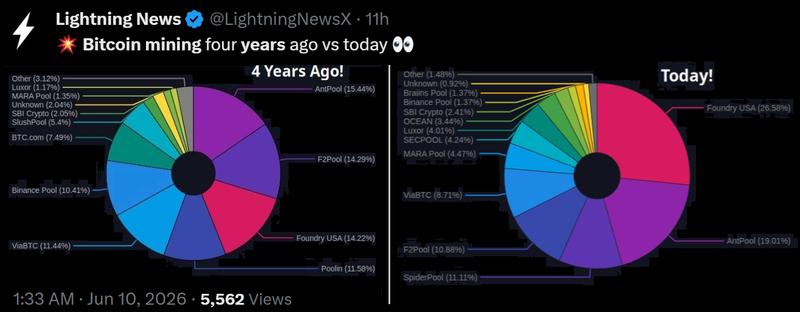
The substantial concentration of Bitcoin's computational power among the three dominant mining pools remains a common point of criticism from market analysts. Recent 7-day statistics reveal that Foundry USA, AntPool, and F2Pool collectively command 59% of the market. By comparison, the three leading Bitcoin mining pools maintained a combined hashrate share of just 44% during 2022.
Bernstein analysts have identified that the principal limitation preventing AI data center expansion is electrical power availability rather than semiconductor chip supply. This reality is driving certain Bitcoin mining operations to redirect portions of their electrical infrastructure toward supporting AI computational workloads, an industry segment currently perceived as offering greater stability and profitability compared to conventional cryptocurrency mining activities.
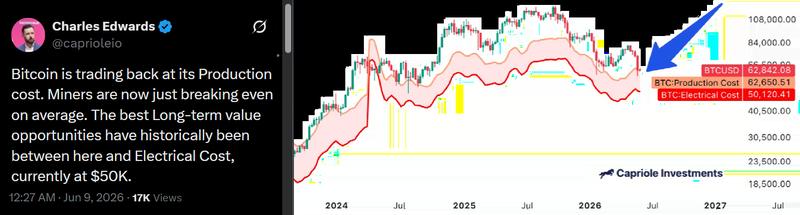
Charles Edwards, founder of Capriole Investments, indicates that Bitcoin's mining production cost, when factoring in depreciation and amortization expenses, reaches $62,650, whereas the absolute floor for covering electricity expenses alone sits at $50,120. That said, several publicly traded mining companies operate significantly more efficient ASIC hardware models combined with industrial-tier energy procurement agreements.
American Bitcoin Corp (ABTC US) disclosed gross operational expenses approaching $36,200 for each Bitcoin produced during the first quarter of 2026. In the final analysis, establishing a uniform, sector-wide production cost figure proves impossible, as certain operators willingly mine at negative margins to capture particular tax advantages. Even should these higher-cost mining operations temporarily cease production, institutional spot market activity now significantly exceeds the volume of newly mined Bitcoin entering circulation.
Bitcoin has historically traded beneath its calculated production cost for periods exceeding six months both in 2019 and again in 2023, according to data compiled by Capriole Investments. Whether the present market stagnation continues will depend on how investors assess risk within the context of wider macroeconomic instability, rather than being driven by mining profitability considerations in isolation.